
VAIRAVAN K
Updated on 30-07-2026
There is a quiet revolution happening in the world of accounting software, and most people do not even realize it yet. It is not just about dashboards or automated invoices. It is about giving AI agents the ability to actually do things inside your accounting system, not just read about them.
That is exactly what Ledgers MCP is built for.
MCP stands for Model Context Protocol. Think of it as a universal language that lets AI agents communicate directly with software tools. Instead of an AI assistant sitting on the sidelines and telling you what to do, MCP lets it roll up its sleeves and take action.
For accountants and finance teams, this is a big deal. Traditionally, AI in accounting has meant dashboards that show trends, or chatbots that answer generic questions. Useful, sure, but not transformative. MCP changes that by giving AI agents direct access to your accounting data and workflows, with the ability to read, create, update, and organize information in real time.
Ledgers, the cloud-based accounting platform at ledgers.cloud, has built its own MCP server that plugs directly into this ecosystem. The result is an accounting system that AI agents can actually work inside, not just look at from the outside.
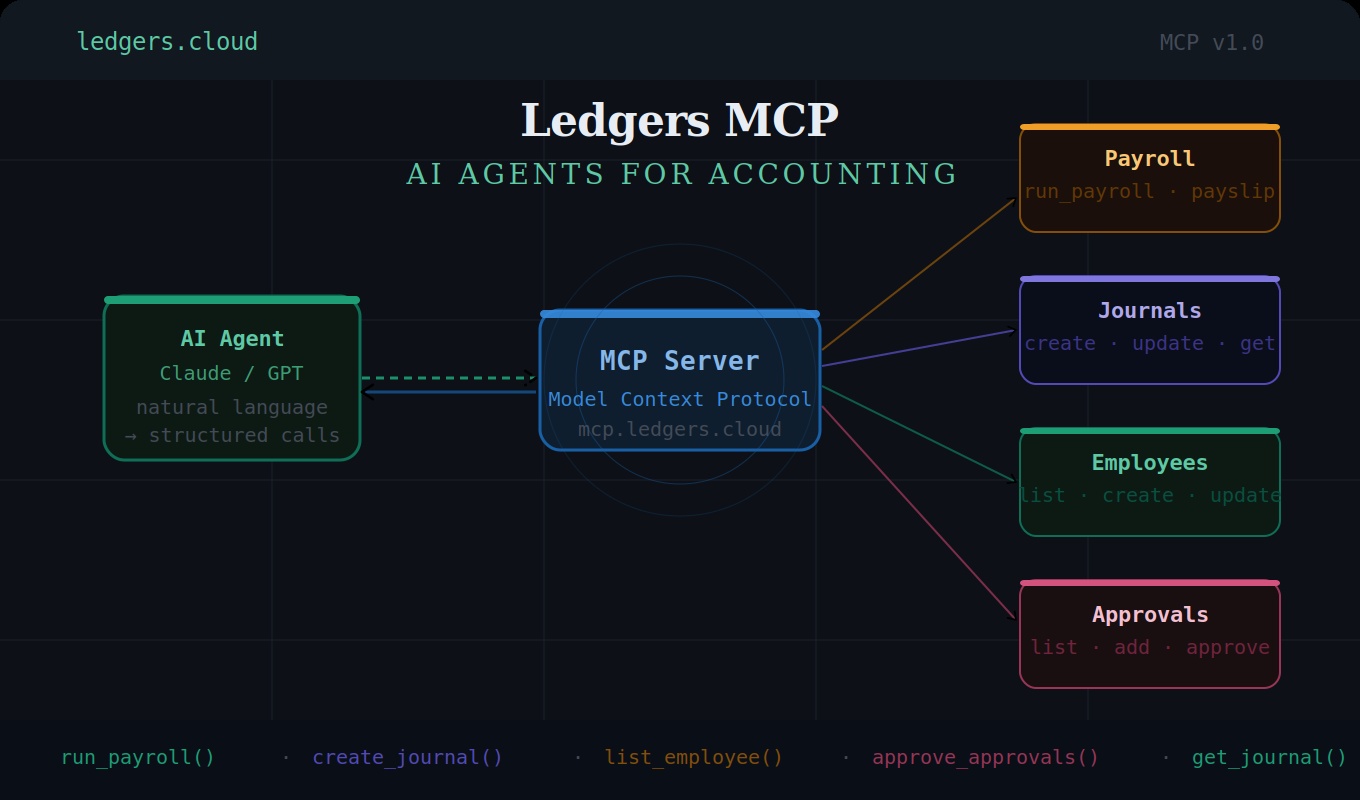
Once an AI agent connects to the Ledgers MCP server, it gains access to a wide range of accounting capabilities. Here are some of the things it can do today.
Employee and Payroll Management
An AI agent can list employees, fetch their details, create new records, and update existing ones. It can set up salary structures, run payroll computations, and even download payslips on demand. Tasks that used to require navigating multiple screens can now be triggered with a single natural language instruction.
Journal Entries and Chart of Accounts
Agents can create and update journal entries, retrieve transaction details, and browse the chart of accounts. This means that reconciling accounts or posting adjustments can happen in a conversation, not a workflow.
Leave and Approvals
The MCP server also supports HR workflows. Agents can list approval requests, submit leave applications, and approve them based on defined rules. When approval logic is embedded in the agent, routine approvals can happen automatically without anyone lifting a finger.
Holiday and Attendance Tracking
Scheduling holidays, reviewing attendance records, and managing branch-specific data across multiple office locations are all within reach for an AI agent connected to Ledgers MCP.
Let us be honest about something. Most accounting software today is designed for humans to click through. You log in, navigate to the right module, fill out a form, and submit. Multiply that across dozens of tasks every day and you have a significant chunk of time that just disappears into administrative work.
AI agents built on top of Ledgers MCP flip this model. Instead of a human navigating software, the software responds to the human. You describe what you want in plain language, and an agent handles the execution. Want to run payroll for all employees in the Mumbai branch this month? Say it. Need to pull a journal entry from last quarter and flag any anomalies? Done.
This is not science fiction. It is what happens when a well-structured MCP server meets a capable AI model.
Platforms like Claude, built by Anthropic, support MCP natively. This means businesses using Ledgers can connect Claude or any MCP-compatible AI agent directly to their accounting environment at ledgers.cloud without complex integrations or custom code.
The Ledgers MCP server exposes clean, purpose-built tools that cover payroll, HR, journals, and accounts. An AI agent using this server does not need to scrape screens or reverse-engineer APIs. It simply calls the right tool with the right parameters, and the accounting system responds.
For developers building internal finance tools, this opens up an entirely new design pattern. Instead of building a custom UI for every accounting workflow, you can build an agent that handles multiple workflows through conversation.
Here are a few concrete scenarios that become possible with Ledgers MCP today.
A finance manager asks an AI assistant to "review all pending leave approvals and approve anything under three days." The agent queries Ledgers MCP, filters the approvals, and processes them in seconds.
The entrepreneur behind the business has a need for his lean organization to automate payroll at the end of the month. He asks the AI to do the payroll processing based on the salary structure set by him with only one message.
There is an accountant who needs to prepare a journal entry for adjustment. Rather than navigating through the system, the AI agent prepares the entry based on the description provided to it.
These are not distant possibilities. They are what a well-configured AI agent connected to Ledgers MCP can do right now.
The accounting industry is at an inflection point. Cloud platforms like ledgers.cloud have already moved financial data out of siloed desktop software. MCP is the next step: making that data and those workflows accessible to AI in a structured, reliable, and secure way.
The businesses that figure this out early will spend less time on manual accounting tasks and more time on the decisions that actually move the needle. Their competitors, still clicking through screens, will wonder how they fell behind.
Ledgers MCP is not just a technical integration. It is a signal of where accounting software is going: toward systems that work for you, not systems you work through.
If you are curious about what AI agents connected to your accounting stack can actually look like in practice, ledgers.cloud is a good place to start.
