
MONISHA D
Updated on 13-10-2026
Generating accurate GST bills is one of the most important responsibilities for businesses operating in India. Whether you are a small business owner, freelancer, retailer, manufacturer, or service provider, issuing GST-compliant invoices correctly helps maintain tax compliance, improve financial accuracy, and avoid unnecessary penalties.
Even small invoice mistakes such as incorrect GST rates, wrong GSTIN numbers, missing HSN codes, or inaccurate tax calculations can create major compliance problems. These errors may lead to Input Tax Credit (ITC) mismatches, GST notices, delayed payments, and accounting complications.
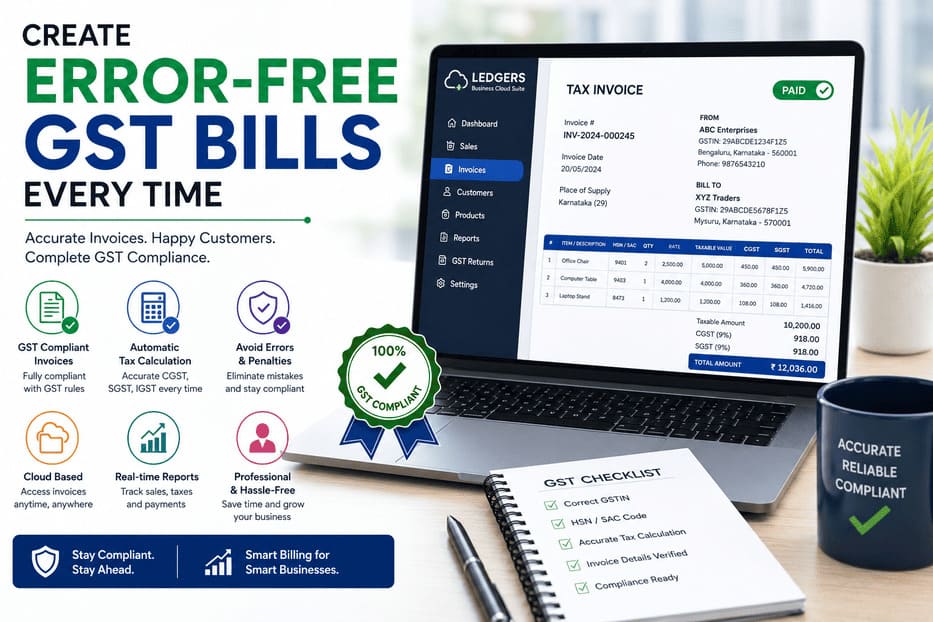
Modern invoicing platforms such as LEDGERS help businesses automate invoice generation, GST calculations, tax reporting, and compliance management. With digital billing systems, businesses can create professional and error-free GST invoices quickly and efficiently.
This article explains how businesses can create accurate GST bills every time, avoid common invoicing mistakes, maintain compliance, and improve billing efficiency using automated invoicing software.
A GST bill, also known as a GST invoice or tax invoice, is a document issued by a registered business when supplying goods or services.
The invoice contains important transaction details including:
GST invoices serve as legal proof of supply and are essential for claiming Input Tax Credit.
Accurate GST billing affects both compliance and business operations.
Incorrect invoices may lead to:
Error-free invoicing helps businesses avoid these complications.
Customers can claim Input Tax Credit only if invoices are accurate and properly reported.
Professionally generated invoices improve trust among customers and vendors.
Correct invoices automatically improve GST reconciliation and return preparation.
Automated invoice calculations reduce manual mistakes and duplicate entries.
A GST-compliant invoice must contain specific details required under GST regulations.
The invoice should include:
Every invoice must have a unique sequential invoice number.
The billing date must be clearly mentioned.
Include:
Clearly describe supplied goods or services.
Businesses must include appropriate HSN/SAC classification codes.
The invoice should mention the taxable amount before GST.
Clearly display:
Final payable amount including taxes must be shown clearly.
Missing or incorrect information may result in compliance issues.
Many businesses still generate invoices manually, which increases the risk of mistakes.
Applying the wrong GST percentage affects tax liability and ITC claims.
Incorrect customer or seller GSTIN details can invalidate invoices.
Incorrect classification codes may create tax mismatches.
Duplicate numbering creates compliance and accounting issues.
Manual tax calculation errors are common in spreadsheet-based invoicing.
Incomplete invoices may fail GST compliance requirements.
Wrong invoice dates can affect tax period reporting.
Businesses can significantly reduce invoice mistakes by following proper invoicing practices.
Modern invoicing software automatically handles:
Businesses using LEDGERS Invoice Software can generate GST-compliant invoices more efficiently while reducing manual work.
Always validate customer GSTIN numbers before generating invoices.
Incorrect GSTIN details can:
Use correct:
This ensures accurate tax application.
Avoid manual tax calculation wherever possible.
Automated systems calculate:
accurately in real time.
Maintain proper invoice numbering without duplication or gaps.
Automated systems help generate unique invoice numbers consistently.
Businesses should reconcile:
Regular reconciliation helps identify mismatches early.
Digital GST invoicing software provides several operational advantages.
Businesses can create invoices instantly.
Automation minimizes manual mistakes.
Software ensures invoices follow GST rules.
Cloud systems maintain centralized invoice records.
Businesses can monitor sales, taxes, and payments more efficiently.
Invoice data integrates directly with GST return preparation.
LEDGERS Invoice Management Software helps businesses simplify GST billing and compliance through automation.
Key features include:
These features help businesses reduce billing errors while improving productivity.
Businesses should follow structured billing practices to maintain invoice accuracy.
Ensure GST rates are updated according to latest regulations.
Keep customer:
updated regularly.
Verify invoice details before sharing with customers.
Maintain secure digital backups of all invoices.
Employees should understand GST invoicing requirements and compliance rules.
GST invoice accuracy directly affects return filing.
Invoices are used for:
Incorrect invoices may lead to:
Proper billing systems improve return filing accuracy significantly.
Invoice reconciliation helps businesses compare:
This process identifies:
Monthly reconciliation improves compliance and reduces year-end filing issues.
Manual invoicing systems create multiple operational problems.
Manual invoice preparation slows down business operations.
Spreadsheets and handwritten invoices increase mistakes.
Tracking invoices manually becomes difficult as transaction volume grows.
Managing multiple tax rates manually increases compliance risk.
GST compliance systems are becoming increasingly digital and automated.
Future developments may include:
Businesses adopting digital invoicing early will be better prepared for future regulatory changes.
Small businesses can improve invoice accuracy by:
Affordable cloud-based solutions now make professional GST billing accessible for businesses of all sizes.
Creating error-free GST bills is essential for maintaining compliance, improving financial accuracy, and ensuring smooth business operations. Incorrect invoices can lead to penalties, ITC issues, delayed payments, and unnecessary compliance complications.
By using automated invoicing systems, businesses can simplify billing processes, reduce manual errors, and improve GST return filing accuracy.
Platforms like LEDGERS help businesses generate GST-compliant invoices, automate tax calculations, manage customer records, and streamline GST filing from a centralized cloud-based platform.
With proper billing practices and modern automation tools, businesses can create professional, accurate, and error-free GST bills every time while improving operational efficiency and long-term compliance.
