
MONISHA D
Updated on 21-08-2026
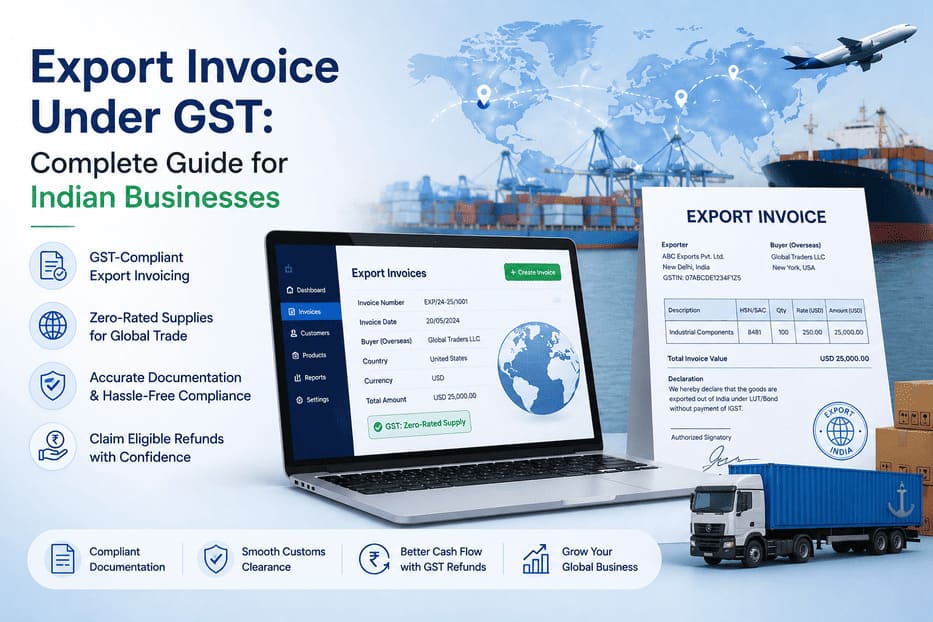
India's Goods and Services Tax (GST) framework has simplified indirect taxation while encouraging businesses to expand into global markets. Exporting goods and services has become more streamlined under GST, but it also requires businesses to follow specific invoicing, documentation, and compliance procedures. One of the most important aspects of international trade is creating a GST-compliant export invoice.
An export invoice is more than just a billing document-it serves as proof of an international transaction, supports customs clearance, enables GST compliance, and helps businesses claim eligible tax benefits and refunds. Any errors in export invoices may lead to delays in customs processing, rejection of refund claims, or compliance issues with tax authorities.
Whether you are a manufacturer, trader, exporter, freelancer, software company, or service provider dealing with overseas clients, understanding export invoicing under GST is essential for maintaining compliance and ensuring smooth business operations.
This guide explains everything Indian businesses need to know about export invoices under GST, including invoice requirements, taxation rules, mandatory details, documentation, common mistakes, and how LEDGERS simplifies export invoice management.
An export invoice is a commercial invoice issued by an Indian seller to a customer located outside India for the supply of goods or services. It records the transaction details between the exporter and the overseas buyer while fulfilling GST and customs requirements.
Unlike domestic invoices, export invoices include additional information related to international trade, such as the buyer's country, shipping destination, currency, export declaration, and other regulatory details.
The invoice serves multiple purposes:
Under GST, exports generally refer to:
Supply of goods from India to a location outside India.
Supply of services to a recipient located outside India where:
Exports are treated as Zero-Rated Supplies under GST, allowing eligible businesses to claim input tax credits and applicable refunds subject to compliance.
Export invoices play a critical role in both taxation and international trade.
They help businesses:
Without a properly prepared export invoice, businesses may face delays in shipment clearance, payment processing, or refund applications.
A GST-compliant export invoice should contain complete and accurate information.
The invoice should generally include:
Depending on the export method, the invoice should include the applicable declaration regarding export under Bond/LUT or export with payment of Integrated GST (IGST).
The invoice should be authorized by the exporter according to business requirements.
Exports are classified as Zero-Rated Supplies under GST. This means businesses can export goods or services without making them taxable in the same way as domestic supplies, while remaining eligible to claim applicable Input Tax Credit and refunds subject to GST provisions.
Businesses typically export under either:
Businesses export without paying IGST by furnishing a valid Letter of Undertaking (LUT) or Bond and may claim eligible refunds of unutilized Input Tax Credit.
Businesses pay Integrated GST on exports and subsequently claim refunds of the tax paid, subject to applicable GST procedures.
The appropriate method depends on the business's compliance strategy and eligibility.
An export invoice is generally accompanied by several supporting documents.
These may include:
Maintaining complete documentation helps ensure smoother customs processing and regulatory compliance.
Many businesses face difficulties while preparing export invoices.
Common issues include:
Incomplete overseas customer details can delay shipment processing.
Failure to include the required export declaration may lead to compliance issues.
Wrong classification affects GST reporting and documentation.
Incorrect currency selection or exchange rate calculations may result in accounting discrepancies.
Duplicate invoice numbers create reconciliation and audit challenges.
Manual invoicing often results in incorrect taxable values or pricing mistakes.
Incomplete supporting documents may delay customs clearance and refund processing.
To improve compliance and operational efficiency, businesses should follow these best practices:
Managing export invoices manually becomes increasingly difficult as business volumes grow.
An automated export invoicing solution offers several advantages:
Create professional export invoices within minutes.
Reduce manual data entry and calculation errors.
Generate invoices that comply with GST requirements.
Invoice overseas customers in their preferred currencies.
Maintain all export invoices securely in one place.
Generate reports for accounting, taxation, and reconciliation.
Access organized invoice records whenever required.
Automate repetitive invoicing tasks and reduce paperwork.
LEDGERS provides businesses with an efficient platform to create, manage, and track export invoices while supporting GST compliance.
With LEDGERS, businesses can:
By automating export invoicing, LEDGERS helps businesses reduce manual effort, improve accuracy, and focus on expanding their global operations.
Export invoicing is a critical part of international business under the GST framework. A well-prepared export invoice not only supports customs clearance and international payments but also helps businesses maintain compliance, file GST returns accurately, and claim eligible tax benefits.
As export volumes increase, relying on manual invoicing can lead to costly errors and delays. Automated solutions like LEDGERS simplify the entire export invoicing process by generating GST-compliant invoices, organizing documentation, supporting multi-currency transactions, and maintaining accurate financial records.
Whether you are a growing exporter or an established enterprise, using reliable export invoice software can improve efficiency, strengthen compliance, and enable smoother international trade.
