
ATCHAYA M
Updated on 30-07-2026
Invoicing used to be completed by taking handwritten bills (anything prior to 1999), using printed formats or simple spreadsheets. In the past, this worked well as required compliance was limited and the number of transactions were at reasonable levels. However, with the introduction of e-Invoicing through GST, businesses must now utilize standardized and government-interfaced digital processes.
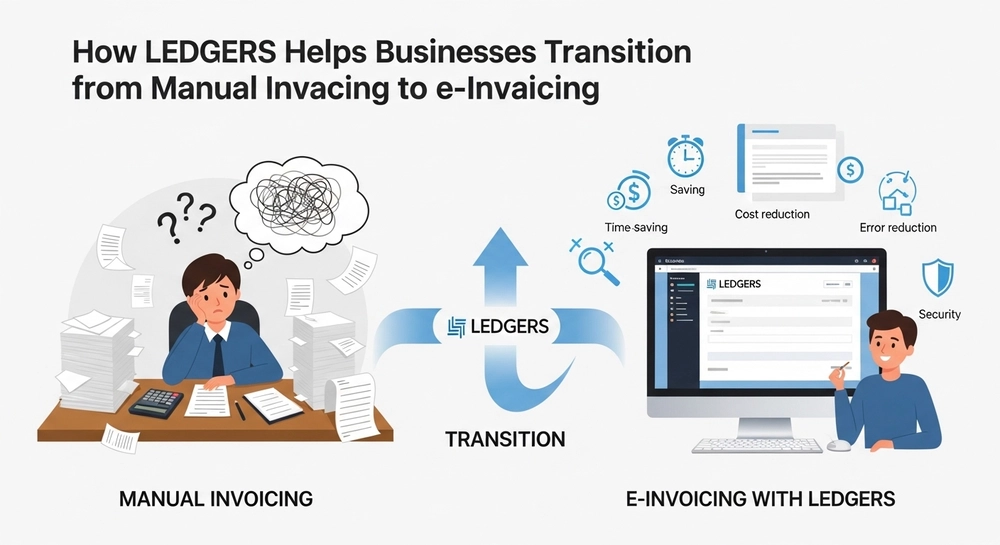
The move to e-Invoicing can feel overwhelming for businesses that have relied on manual methods for many years. Adoption is often delayed due to concerns over technology, training, data integrity and meeting regulations. A structured, gradual and business-friendly transition to e-Invoicing has been created through LEDGERS.
When moving from manual to digital systems, businesses will usually experience some of the following issues during the transition process:
Inadequate support in these areas can cause delays and incomplete e-Invoicing implementations or the use of outside consultants or transient contractors to perform these actions.
One of the key reasons businesses hesitate to adopt new systems is the fear of losing control over their existing processes. LEDGERS addresses this by preserving familiar billing practices while adding compliance layers in the background.
Users continue to:
Behind the scenes, LEDGERS structures this data for e-Invoicing and IRN generation. This reduces the learning curve and builds confidence gradually.
Manual invoicing rarely includes automated checks. As a result, businesses often depend on manual reviews to catch errors. In e-Invoicing, this approach is risky.
LEDGERS introduces built-in guidance through:
These features help users learn compliance requirements naturally while using the system, rather than through separate training programs.
For first-time e-Invoice users, IRN generation can appear technical and intimidating. LEDGERS simplifies this step by integrating it directly into the invoicing workflow.
Instead of uploading files or navigating multiple portals, users generate IRN from within the same interface. Clear status indicators and feedback messages help new users understand each stage without confusion.
This reduces anxiety and builds trust in the digital process.
Effective adoption depends on how easily staff can learn the system. LEDGERS is designed to support internal training through:
New employees can be onboarded quickly, and existing staff can adapt without extensive retraining.
Businesses transitioning to e-Invoicing often worry about past records and ongoing documentation. LEDGERS helps by allowing:
This ensures that businesses do not lose historical references while moving to digital compliance.
Manual systems give businesses a sense of control because everything is visible. Digital systems sometimes feel opaque.
LEDGERS maintains transparency by providing:
This reassures management that compliance remains under control.
Once businesses fully transition to e-Invoicing through LEDGERS, they experience long-term advantages such as:
Over time, the initial learning effort translates into operational efficiency and stronger compliance.
Moving from manual invoicing to e-Invoicing is not just a technical change — it is an organizational transformation. It involves people, processes, and mindset shifts as much as software adoption.
LEDGERS supports this transition by combining familiar workflows with intelligent compliance tools, training-friendly design, and structured validations. By easing businesses into digital invoicing gradually, the platform helps organizations build confidence, reduce risk, and embrace modern GST compliance without disruption.
