




ATCHAYA M
Updated on
30-07-2026
How LEDGERS Helps Teams Collaborate Better on GST Tasks
GST compliance is not a one-person or one-department job. It requires seamless cooperation of many different departments in order to complete the necessary tasks; for instance, you can find the departments needed for GST compliance are generally sales, operations, accounts and finance. Each department will have a piece of the overall information needed for correct invoice processing and return filing.
Typically, these departments work independently from one another. Sales wants to sell the best product at the best price, operations wants to deliver the product and finance wants to ensure compliance. Each of these departments needs to work together in order for the overall GST workflow to run smoothly and efficiently.
Challenges in Cross-Team GST Workflows
Structured systems like LEDGERS help bring all GST related activities into one tool in order for teams within an organization to work collaboratively.
When addressing the above issue, companies face the following common challenges managers will discuss when reviewing their company's cross-departmental GST processes:
- Information is not shared between teams and is therefore often incomplete.
- Invoicing is delayed due to not having all required information.
- There are multiple copies/versions of the same data.
- There are numerous follow-ups between departments.
- There are errors due to miscommunication.
For instance, if the sales department provides the wrong customer information, or is missing key pieces of information the finance department will need to suspend invoicing and return to the sales department for confirmation. This creates a bottleneck in the overall workflow.
Centralized Platform for All Teams
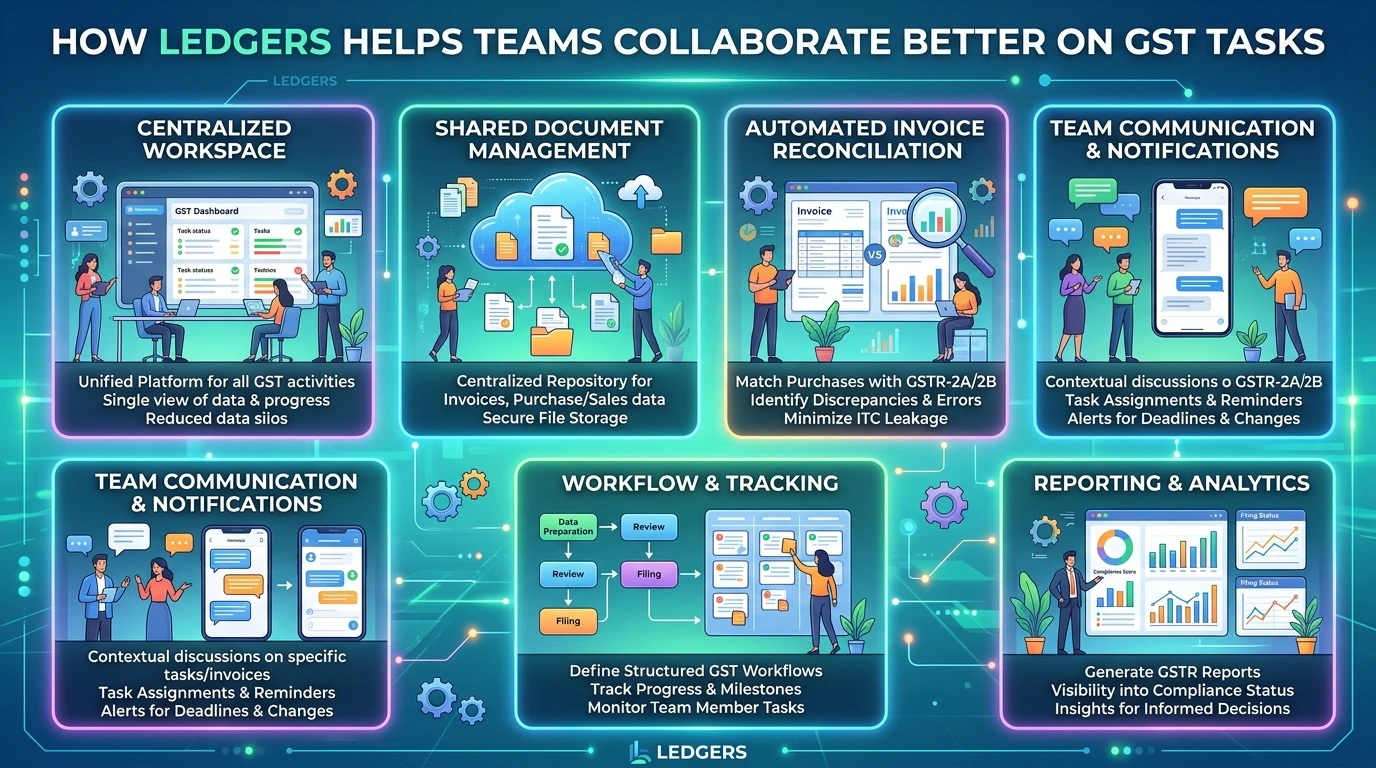
One of the biggest advantages of using LEDGERS is that it provides a centralized platform where all GST-related data is available in one place.
Instead of:
- Sales maintaining separate records
- Finance using different systems
- Operations tracking data elsewhere
everything is brought together into a single system.
This ensures that all teams are working with the same information, reducing confusion and duplication.
Clear Visibility Across Departments
When multiple teams are involved, visibility becomes critical. Teams need to know:
- What data is available
- What is pending
- What needs action
LEDGERS helps by providing clear visibility into invoice status and related data. Finance teams can easily see whether all required details are available before proceeding with invoicing.
This reduces unnecessary back-and-forth communication.
Reducing Dependency on Manual Communication
In many businesses, GST-related coordination happens through emails, calls, or messages. While this works for small volumes, it becomes inefficient as operations grow.
LEDGERS reduces dependency on manual communication by keeping data structured and accessible. Instead of asking for information repeatedly, teams can directly refer to the system.
This saves time and improves efficiency.
Standardized Processes for All Teams
Different teams often follow different working styles. Without standardization, this can create inconsistencies in invoicing and compliance.
LEDGERS helps establish a uniform workflow by:
- Standardizing invoice formats
- Ensuring consistent data entry
- Maintaining uniform processes across teams
This makes it easier for everyone to follow the same structure.
Faster Decision Making
When data is scattered across multiple sources, decision-making becomes slow. Teams spend time collecting information before taking action.
With LEDGERS, since all data is available in one place, teams can:
- Quickly review transaction details
- Identify issues
- Take corrective actions
This speeds up the entire process.
Improved Accountability
In collaborative workflows, accountability is often unclear. When something goes wrong, it can be difficult to identify where the issue occurred.
A structured system helps track actions and responsibilities more clearly. This ensures that:
- Each team knows its role
- Errors can be traced easily
- Processes can be improved over time
Better Coordination During Busy Periods
Month-end and return filing periods are usually the busiest times for businesses. During these periods, coordination becomes even more important.
LEDGERS helps teams stay aligned by:
- Providing clear status tracking
- Reducing confusion
- Ensuring that everyone works with updated data
This makes high-pressure periods more manageable.
Long-Term Benefits of Better Collaboration
When teams collaborate effectively, the benefits go beyond GST compliance. Businesses start experiencing:
- Faster invoicing cycles
- Fewer errors
- Improved efficiency
- Better overall workflow management
This creates a more organized and reliable operational environment.
Conclusion
GST compliance is a team effort, and its success depends on how well different departments work together. Without proper coordination, even simple tasks can become complicated.
LEDGERS helps bridge the gap between teams by providing a centralized platform, improving visibility, and reducing dependency on manual communication. By enabling better collaboration, it not only simplifies GST tasks but also helps businesses operate more efficiently as they grow.