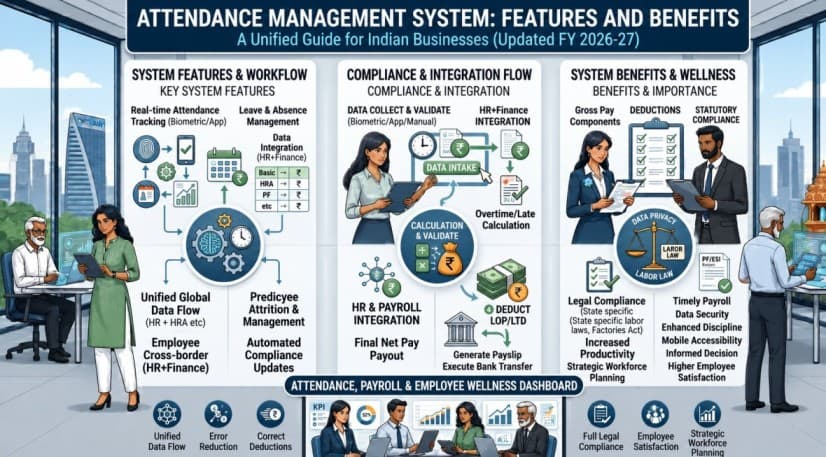
Attendance Management System Features Benefits
SHANJU A

SHANJU A

Updated on 30-07-2026

Attendance Management System: Features and Benefits

Introduction

The attendance management system is a help to us because it lets us know when people come to work and when they go home. It tells us who is at the office and who is not at the office. We use the attendance management system for a lot of things like writing down the hours people work and seeing who is at the office and making schedules and figuring out who worked and making sure everyone gets their money on time. The old way of using paper or spreadsheets is very messy. Takes a lot of time to do. When a company gets bigger it gets really hard to keep track of everything that is going on. The attendance management system makes our work easier. Reduces the mistakes we make and helps people do their work. It is really great to have the attendance management system because it helps us a lot. The attendance management system is very good for tracking when people come to work. The attendance management system is very helpful with tracking when people are, at work. We really need to have the attendance management system..

What is an Attendance Management System?

The Attendance Management System is a program that helps keep track of when employees come to work and when they go home. It writes down the times they come in and leave, how hours they work, when they take breaks and when they work extra hours. The Attendance Management System makes it simple for companies to keep track of who's at work and who is not which means administrators have less work to do. The Attendance Management System can work with things like: * devices * Mobile applications * RFID cards * Facial recognition systems These things help get the information about who is at work right away so the Attendance Management System can use it. The Attendance Management System is very helpful because it uses tools like these to get the information it needs. The Attendance Management System is good at keeping track of attendance. It does this with the help of tools, like Biometric devices and Mobile applications and RFID cards and Facial recognition systems.

Key Features of an Attendance Management System

1. Automated Attendance Tracking

The system automatically records employee attendance through biometric devices, mobile apps, web portals, or access cards, eliminating manual data entry.

2. Real-Time Attendance Monitoring

Managers can view employee attendance status in real time, including present, absent, late arrivals, and early departures.

3. Leave Management Integration

Employees can apply for leave through the system, while managers can review and approve requests. Approved leaves are automatically reflected in attendance records.

4. Shift Management

Organizations with multiple shifts can configure work schedules, rotational shifts, and flexible working hours within the attendance management system.

5. Overtime Calculation

The system automatically calculates overtime hours based on predefined company policies, ensuring accurate compensation for employees.

6. Biometric Integration

Attendance management software can integrate with fingerprint scanners, facial recognition devices, and access control systems for secure attendance tracking.

7. GPS and Mobile Attendance

Remote and field employees can mark attendance using mobile applications with GPS tracking, ensuring location-based attendance verification.

8. Payroll Integration

Attendance data is directly integrated with payroll systems, enabling accurate salary calculations, overtime payments, and deduction processing.

9. Employee Self-Service Portal

Employees can access attendance records, view working hours, check leave balances, and download attendance reports through self-service portals.

10. Reporting and Analytics

Organizations can generate detailed attendance reports, absenteeism analysis, overtime summaries, and workforce productivity insights.

Benefits of an Attendance Management System

Improved Accuracy

Automated attendance tracking minimizes human errors associated with manual attendance recording and spreadsheet management.

Increased Productivity

HR teams spend less time on attendance administration and can focus on strategic workforce management activities.

Enhanced Payroll Accuracy

Since attendance data is automatically linked to payroll, salary calculations become more accurate and reliable.

Better Workforce Management

Managers gain visibility into employee attendance patterns, helping them make informed workforce planning decisions.

Reduced Time Theft

Biometric authentication and GPS tracking prevent buddy punching and unauthorized attendance entries.

Compliance with Labor Laws

Attendance management systems help organizations maintain records required for labor law compliance, audits, and regulatory reporting.

Improved Employee Experience

Employees can easily access attendance information, apply for leave, and monitor attendance records through self-service portals.

Cost Savings

Automation reduces administrative costs, minimizes payroll errors, and improves operational efficiency.

Types of Attendance Management Systems

Biometric Attendance System

Uses fingerprint, facial recognition, or iris scanning technology to record employee attendance securely.

Web-Based Attendance System

Allows employees to mark attendance through a browser-based portal from any location.

Mobile Attendance System

Enables attendance tracking using smartphones with GPS and geolocation capabilities.

Cloud-Based Attendance Management System

Stores attendance data securely in the cloud and provides real-time access from anywhere.

Challenges Solved by Attendance Management Systems

Organizations often face challenges such as:

  • Manual attendance errors
  • Payroll discrepancies
  • Attendance fraud
  • Shift scheduling complexities
  • Overtime calculation issues
  • Compliance requirements

An automated attendance management system addresses these challenges by providing accurate, real-time, and centralized attendance tracking.

Choosing the Right Attendance Management System

When selecting an attendance management solution, organizations should consider:

  • Ease of use
  • Scalability
  • Integration capabilities
  • Mobile accessibility
  • Biometric support
  • Reporting features
  • Payroll integration
  • Security and data protection

Choosing the right system ensures long-term efficiency and supports organizational growth.

Conclusion

An attendance management system is really important for companies. It helps them keep track of their workers. Makes sure they pay them correctly. * When companies use such a system they can reduce paperwork. * They can ensure they are following the rules. * It also makes their workplace more productive. This system is beneficial for all kinds of companies whether they are small or really big. It helps them work better and save money with an attendance management system in place. Companies should have an attendance management system because it is really useful, for them. It helps them manage their workers and makes sure they pay them correctly. An attendance management system keeps track of whos at work. For more details ledgers.cloud.

Related Guides

Nobody really thinks about attendance management until there's a problem. A salary gets miscalculated. Someone from the labour department shows up asking for records. An employee raises a dispute about their timesheet. Then everyone suddenly cares. The truth is, attendance tracking impacts almost everything — payroll accuracy, legal compliance, how operations run, even employee morale. In India, where labour laws change from state to state and more companies are going hybrid, the old ways of doing things just don't work anymore. More Than Just Showing Up Most people think attendance management means checking who showed up and who didn't. It's far more than that. There's recording daily hours, managing different shifts and rotations, tracking leave and public holidays, figuring out overtime and compensatory offs, fixing mistakes when they happen, and making sure all this information feeds correctly into payroll and compliance documents. Organisations that use structured systems for this consistently have fewer payroll mistakes and easier audits compared to those still doing things manually or using five different disconnected tools. Choosing the Right Method for Your Workforce How you record attendance matters. Indian companies today have office workers, factory staff, sales teams on the road, and people working from home — one method doesn't fit everyone. Some use biometric machines with fingerprint or face scanning. Others have RFID cards. Field employees might use mobile apps that verify location. Remote workers log in through web portals. A few small businesses still use paper registers, though that's becoming increasingly risky. Modern platforms like LEDGERS let you use multiple methods together instead of juggling separate systems for different groups. The Parts That Cause the Most Trouble Shift management is genuinely difficult if you run round-the-clock operations. IT firms, factories, hospitals, call centres — they all struggle with this. You have to create shifts, assign them, manage rotations, track night and weekend work, deal with shift swaps, and follow legal requirements about working hours and rest time between shifts. Laws like the Factories Act and state-specific Shops & Establishments Acts set clear limits here. When leave and attendance run on separate systems, mistakes happen constantly. Employees can't figure out their balance. Approvals take forever. Year-end calculations go wrong. Integration fixes this — leave accrues automatically based on attendance, people can see their balance anytime, and approvals flow smoothly. Overtime and Error Handling Overtime costs add up fast if you're not watching. What you need is automatic calculation based on daily or weekly hours, required approvals from managers before overtime counts, correct pay rates as per the law, and tracking of compensatory offs earned. The Code on Wages requires overtime to be paid at double the rate — getting this wrong is both expensive and illegal. Missed punches are normal. Someone forgets to clock out. The machine doesn't read properly. The issue is how you handle fixes. A good process lets employees request corrections, has managers review them, keeps a record of every change, and flags frequent requests. Attendance Records Are Legal Documents In India, attendance records aren't optional paperwork — they're actual legal documents. You must retain them for specific periods, make them available when inspectors ask, enforce working hour limits, and ensure wages tie back to time records. Special rules for women employees must also be followed. Penalties for non-compliance are serious. Software that builds compliance checks into the daily process means you're not constantly worried about meeting requirements before every audit. Technology Helps, But Policies Matter Just as Much Your attendance policy needs to cover working hours and grace time, clocking in and out requirements, types of leave and how to use them, reporting absences, half-day and short leave rules, consequences for rule violations, and expectations for remote or hybrid work. Review it regularly — laws change, work practices evolve. When evaluating software, look at whether it can grow with you across locations, connects with your existing payroll and HR systems, is simple enough for people to actually use, can match your specific policies and shifts, and comes from a company that provides decent support. For most Indian businesses, integration capability and compliance coverage matter far more than premium features. Making Implementation Stick Implementation fails more often because of poor execution than technology problems. What works: get input from everyone affected early on, start with a small pilot, train people properly, explain why the change helps them, run old and new systems together for a while, and keep improving based on feedback. Organisations that follow this approach typically reach full adoption within three months. Rush it and you'll be managing complaints and workarounds far longer. Does It Pay Back? Yes. The benefits are measurable — fewer payroll errors, less admin work for HR, reduced time theft, better compliance, and managers spending less time on attendance issues. For mid-sized companies, the savings typically exceed the system cost within a year, not counting the value of avoiding legal penalties. Final Thoughts Attendance management seems basic but it affects everything. Done right, it improves compliance, payroll accuracy, and employee trust. Done poorly, it creates ongoing friction between HR, managers, and staff. For Indian organisations, moving from manual methods to a proper attendance system changes more than just the process — it changes how reliably employees get paid, how well you comply with the law, and how much time HR spends fixing avoidable problems. Platforms like LEDGERS help make that transition manageable, turning attendance from a constant headache into something that simply works reliably in the background.