




HARI KRISHNAN S
Updated on
30-07-2026
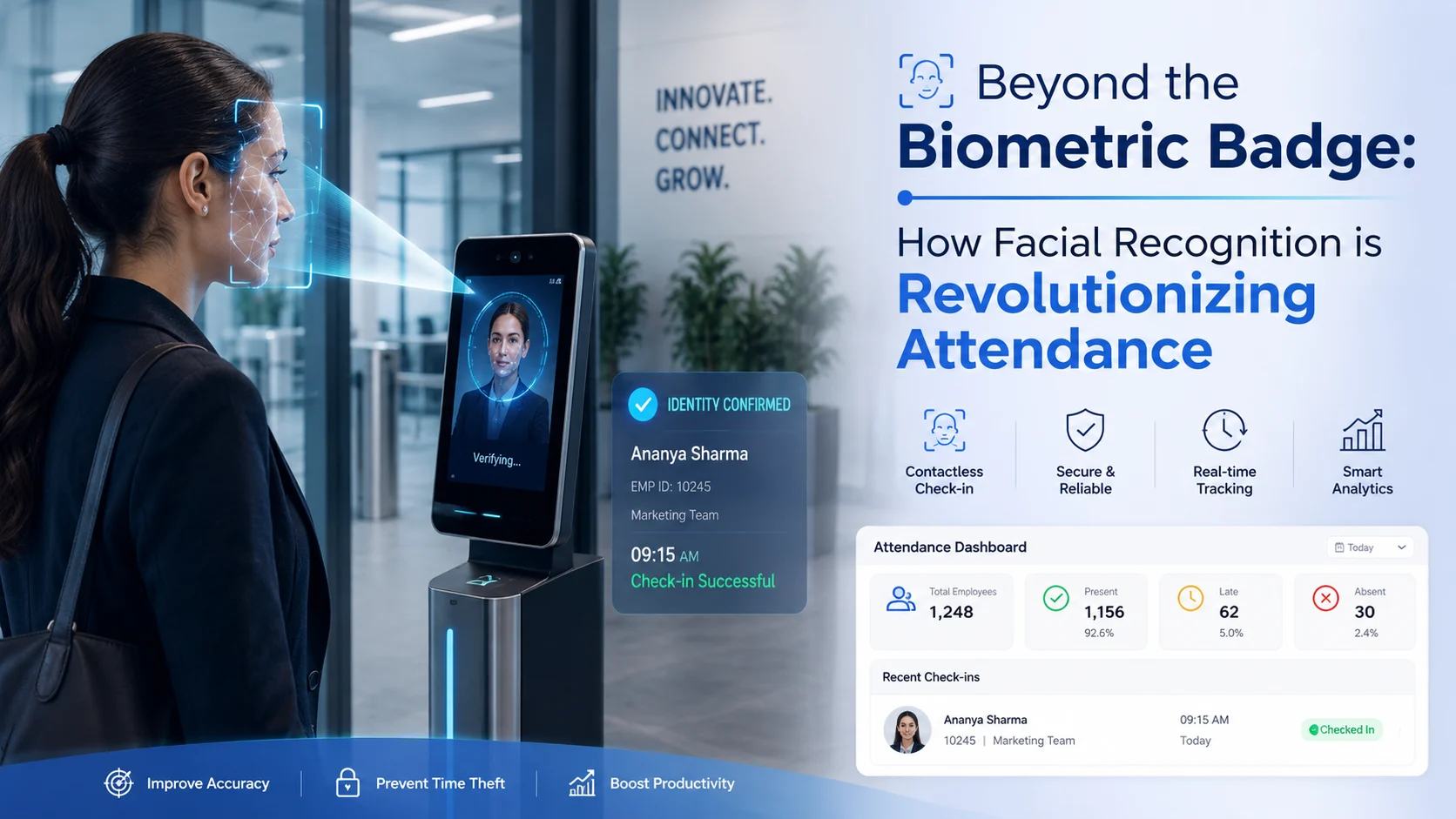
Beyond the Biometric Badge: How Facial Recognition is Revolutionizing Attendance
I today's digital age, Traditional methods of attendance tracking are becoming increasingly obsolete. Beyond the biometric badge, revolutionizes attendance by introducing facial recognition. A new era of accuracy and efficiency. This modern technology is reshaping business and doing organization. Educational institutions Manage attendance by offering a seamless, secure and efficient solution. Let's determine out how facial recognition is changing the game And what does that mean? the future of attendance management.
The Rise of Facial Recognition in Attendance Management
Facial recognition technology, once a futuristic concept, is now a vital tool I various sectors. I attendance management, It's starting to be traction due To its ability To streamline and reduce the process human error. Key benefits include:
- Accuracy: Facial recognition eliminates manual errors, ensuring precise attendance tracking.
- Efficiency: Automated systems speed up the process, minimizing queues and wait times.
- Security: With built-in authentication, it enhances access control and prevents identity fraud.
How Facial Recognition Technology Works
At its core, facial recognition uses advanced algorithms to identify individuals based on their facial features. Here's a simplified breakdown of the process:
- Face Detection: The system captures an image of a face through a camera.
- Feature Extraction: It identifies unique facial features such as the distance between the eyes and the shape of the cheekbones.
- Comparison: These features are matched against a stored database for verification.
- Authentication: Once verified, the system records attendance or grants access accordingly.
Applications Across Industries
The implementation of facial recognition technology for attendance spans several industries. Here are some notable applications:
Corporate Sector
As companies strive. Higher productivity, Offers facial recognition an efficient way to monitor employee attendance. This technology helps to reduce payroll errors And increasing time management By providing:
- Real-time Tracking: Instant attendance data helps managers gauge employee presence effectively.
- Seamless Integration: Easy to incorporate into existing HR systems for better workflow management.
- Enhanced Security: Limits unauthorized access and secures sensitive areas through access control.
Education Institutions
In academia, to be definite student attendance is significant for both compliance and learning outcomes. Facial recognition Solves attendance challenges with features such as:
- Automated Roll Calls: Eliminates the need for manual attendance, saving valuable class time.
- Improved Student Safety: Quickly identifies students, keeping track of their presence within the premises.
- Data Analytics: Provides insights into attendance patterns, aiding in academic performance analysis.
Health and Safety Compliance
During the global COVID- 19 pandemic, Contactless solutions became essential. Facial recognition The offer a hygienic alternative For touch- based systems:
- Contactless Entry: Reduces contact points, minimizing the risk of virus transmission.
- Masks Compatibility: Advanced systems can recognize individuals even with masks on.
- Temperature Screening: Integrated systems can also screen for elevated temperatures, bolstering safety protocols.
Challenges and Considerations
Despite its benefits, Offers facial recognition technology. Several challenges. It is very significant to address. These issues To be guaranteed smooth implementation:
- Privacy Concerns: Collecting biometric data raises privacy issues, necessitating clear policies and consent mechanisms.
- Data Security: Storing facial data requires robust security measures to prevent breaches and misuse.
- Bias and Accuracy: Ensuring fairness and minimizing errors in diverse populations remains a significant focus area.
The Future of Facial Recognition in Attendance
The future Of facial recognition is promisingly present, with continuous advancements But the horizon. Innovative trends include:
- AI Integration: Combining AI with facial recognition to enhance decision-making and predictive analytics.
- Augmented Reality (AR): Utilizing AR to offer real-time data overlays for better management insights.
- Blockchain Security: Employing blockchain for added data integrity, ensuring secure and tamper-proof records.
Conclusion
The journey beyond the biometric badge I facial recognition territory shows immense potential In change attendance management. Despite today's challenges, the technology Promise to give unmatched benefits In terms of accuracy, efficiency, and security across various domains. As it develops, businesses and institutions That embrace this innovation You will locate yourself the forefront Of operational excellence. The era Of facial recognition Attendance is here, and it's more transformative than ever. Finally, facial recognition It's not just about recognizing faces– it's about redefining how we view and manage attendance. As we transfer further into this technology- driven landscape, staying informed and adapting will be key to capitalizing on it. Its full potential.