
PUGALENTHI
Updated on 30-07-2026
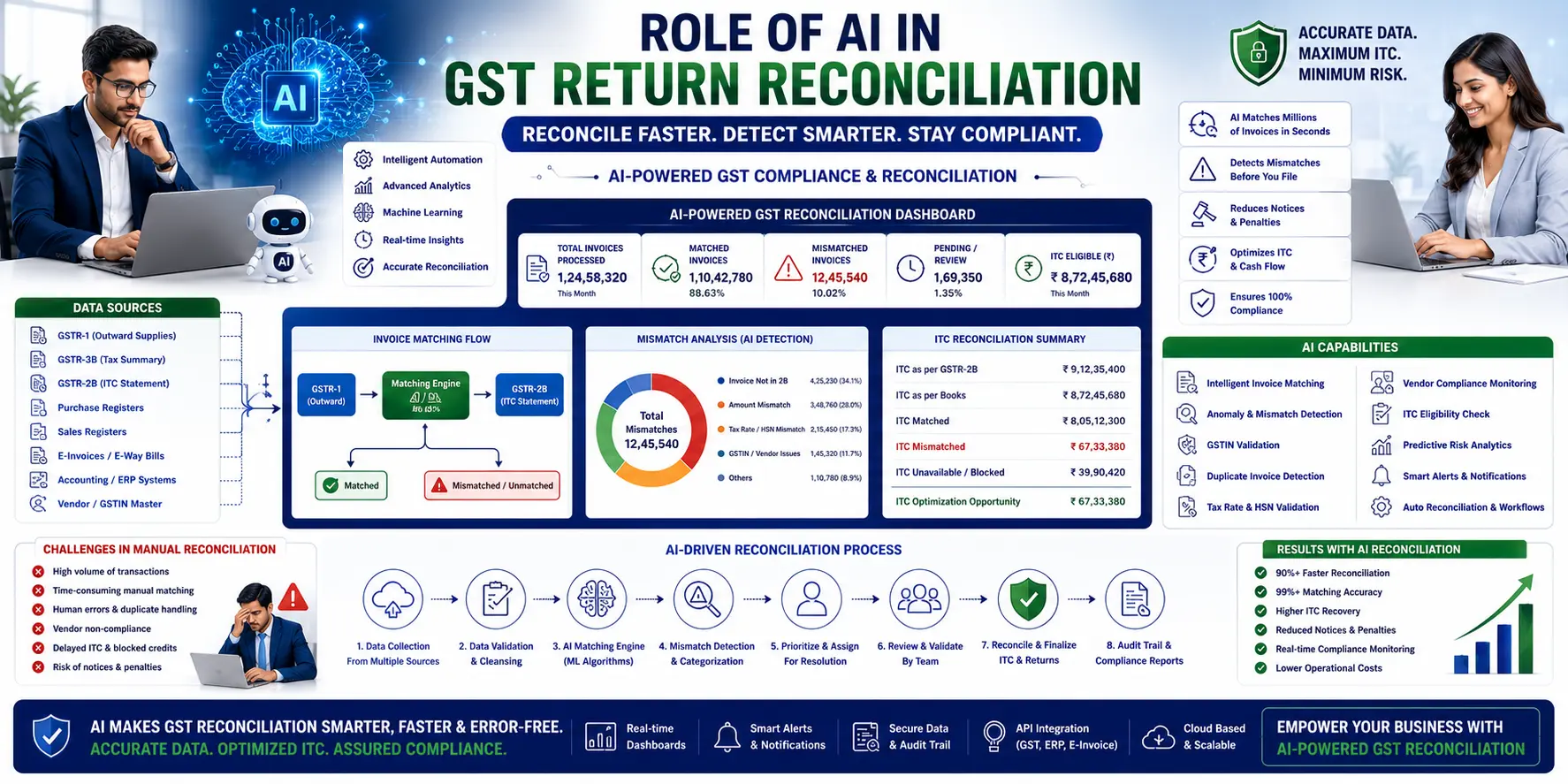
The introduction of Goods and Services Tax (GST) in India has transformed the compliance landscape for businesses. With the multitude of returns and records involved, GST return reconciliation has emerged as a critical process to ensure that businesses comply with tax regulations and optimize their input tax credit (ITC). Typically, this involves matching data across a variety of documents such as GSTR-1, GSTR-3B, GSTR-2B, purchase registers, sales registers, e-invoices, and accounting records. However, the complexity and volume of these data sets pose significant challenges that are difficult to manage manually. Enter Artificial Intelligence (AI), revolutionizing the way businesses approach GST return reconciliation by introducing automation and increasing accuracy.
GST return reconciliation involves cross-verifying various financial documents to ensure that all transactions are accurately declared and tax obligations are met. This process is pivotal for claiming input tax credits, avoiding penalties, and ensuring compliance with GST laws. Businesses must accurately match all their commercial transactions across:
Manual GST reconciliation is fraught with challenges due to the extensive volumes of data, which increases the likelihood of errors:
AI-powered systems have emerged as a potent solution to the hurdles posed by manual reconciliation. These systems automate several critical functions, including:
For instance, AI can quickly identify mismatches between reported sale transactions in GSTR-1 and purchase transactions in GSTR-2B, thus predicting compliance risks and minimizing manual intervention.
AI technologies utilize smart algorithms to:
Consider how AI might detect an unusual transaction based on its volume or size, prompting further investigation to ensure accuracy and compliance.
Embracing AI for GST return reconciliation brings several advantages:
AI systems can seamlessly integrate with:
To ensure successful implementation of AI-driven GST reconciliation, businesses should adhere to these practices:
The integration of Artificial Intelligence in GST return reconciliation signifies a transformative step towards the future of tax compliance. With its ability to automate complex processes, detect anomalies, and ensure real-time compliance monitoring, AI stands as a pivotal ally for businesses striving for seamless operations and compliance in India. By embracing AI technologies and following best practices, businesses can not only optimize their GST processes but also contribute to a more efficient tax ecosystem.
