




KARTHICKKUMAR R
Updated on
21-08-2026
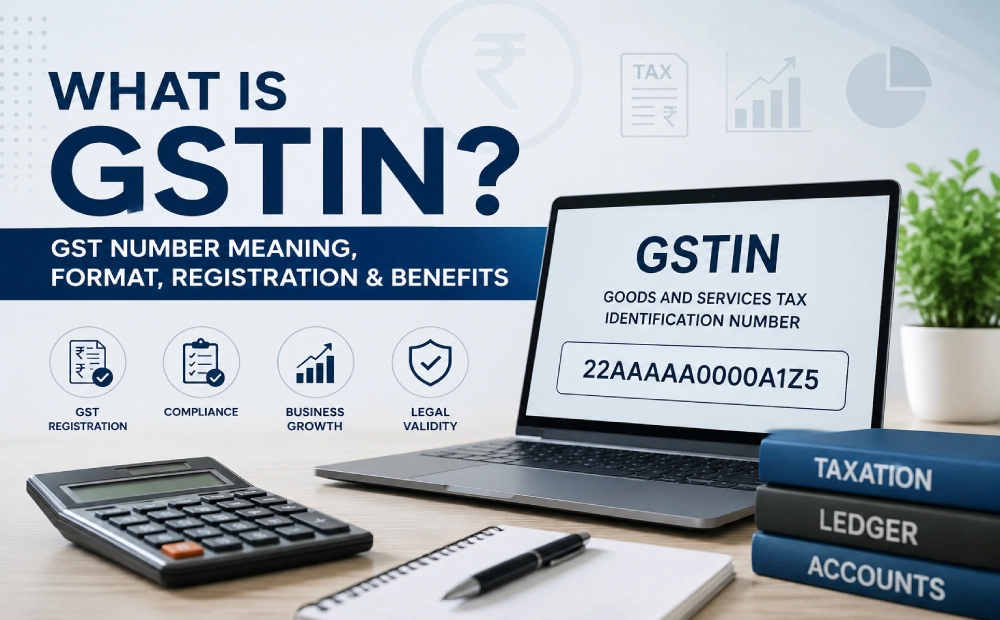
What Is GSTIN? GST Number Meaning, Format, Registration & Benefits
GST is one of the most important tax systems for businesses operating in India. Whether you are starting a new business, selling products online, providing professional services, or expanding your operations, understanding your GST registration and GSTIN is essential.
A GST Number, officially known as the Goods and Services Tax Identification Number (GSTIN), is a unique identification number issued to businesses registered under the Goods and Services Tax system in India.
In this guide, we explain what GSTIN is, who needs it, how it is structured, how to apply for GST registration, and how businesses can manage GST-related compliance efficiently.
What Is a GST Number or GSTIN?
GSTIN stands for Goods and Services Tax Identification Number.
It is a unique 15-digit identification number assigned to every taxpayer registered under GST in India. The GSTIN is used by the government to identify a registered business and track its GST transactions, tax payments, returns, and compliance activities.
Once a business successfully completes GST registration, it receives a GSTIN from the tax authorities.
A GSTIN is generally required to be mentioned on:
- Tax invoices
- GST credit notes and debit notes
- GST returns
- E-commerce transactions
- Business quotations and relevant documents
- Other GST-related records
What Does a GSTIN Look Like?
A GSTIN contains 15 characters consisting of numbers and letters.
For example:
33ABCDE1234F1Z5
The GSTIN structure provides information about the state in which the business is registered, the taxpayer's PAN, and other registration details.
GSTIN Structure Explained
The 15 characters can be broadly understood as follows:
| Characters | Meaning |
|---|---|
| First 2 digits | State code |
| Next 10 characters | PAN of the taxpayer |
| 13th character | Entity number under the same PAN and state |
| 14th character | Usually "Z" |
| 15th character | Check code used for validation |
For example, in 33ABCDE1234F1Z5:
- 33 – State code
- ABCDE1234F – PAN
- 1 – Entity number
- Z – Default character
- 5 – Check code
Why Is GSTIN Important for Businesses?
GSTIN is more than just a registration number. It plays an important role in GST compliance and business transactions.
1. Identifies Your Business
GSTIN provides a unique identity to a registered taxpayer under the GST system.
2. Helps Issue GST-Compliant Invoices
Registered businesses need to issue proper GST invoices containing the required tax and registration details. GSTIN is an important part of these invoices.
3. Enables Input Tax Credit
Eligible registered businesses can claim Input Tax Credit (ITC) on qualifying purchases, subject to applicable GST rules and conditions.
4. Supports GST Return Filing
GSTIN is associated with the taxpayer's GST returns and related compliance records.
5. Builds Business Credibility
Displaying valid GST registration details can help customers, suppliers, and business partners verify the tax registration status of a business.
6. Helps With E-Commerce and B2B Transactions
GST registration and GSTIN can be particularly important for businesses involved in B2B transactions and certain e-commerce activities, depending on the applicable GST rules.
Who Needs a GSTIN?
GST registration requirements depend on factors such as turnover, nature of business, type of supply, location, and applicable exemptions.
GST registration may be required for businesses that:
- Cross the applicable GST registration threshold
- Make certain taxable supplies where registration is mandatory
- Conduct certain interstate supplies, subject to applicable provisions and exceptions
- Operate through e-commerce platforms where registration requirements apply
- Fall under categories for which GST registration is compulsory
- Choose voluntary GST registration for business or commercial reasons
Because GST registration requirements can vary based on the nature and circumstances of a business, it is important to check the latest rules applicable to your situation.
GST Registration Threshold
GST registration is generally linked to the aggregate turnover of a business. However, the applicable threshold can differ depending on the state or Union Territory and the nature of supplies made by the business.
Certain businesses may also be required to register even if their turnover is below the normal threshold because GST law provides specific compulsory registration provisions.
Therefore, businesses should not determine their GST registration requirement based on turnover alone.
What Is the Difference Between GSTIN and GST Registration?
Although these terms are often used together, they are different.
GST Registration is the process through which a business registers under the GST system.
GSTIN is the unique 15-digit identification number issued after successful GST registration.
In simple terms:
GST Registration → Application and approval → GSTIN issued
How to Apply for GST Registration?
GST registration is completed online through the official GST portal.
The general process includes:
Step 1: Determine GST Registration Requirement
Check whether your business is required to register under GST or whether voluntary registration is beneficial.
Step 2: Collect Required Information
Depending on the type of taxpayer, you may need information and documents such as:
- PAN
- Mobile number and email address
- Business constitution details
- Business address
- Bank account details
- Identity and address proof
- Photographs
- Details of promoters, partners, directors, or authorized signatories
- Supporting documents for the business premises
Step 3: Submit the GST Registration Application
Enter the required details in the GST registration application and submit the necessary documents.
Step 4: Verification
The application and submitted information may be verified by the tax authorities.
Step 5: Receive GSTIN
Once the registration is approved, the taxpayer receives a GST registration certificate containing the GSTIN.
Documents Required for GST Registration
The documents required can vary depending on the type of business.
Commonly required documents may include:
- PAN card
- Aadhaar or other applicable identity proof
- Photograph of the applicant or authorized person
- Proof of business address
- Bank account information
- Partnership deed or incorporation documents, where applicable
- Authorization documents
- Details of directors, partners, or promoters, where applicable
The exact requirements should be checked based on the taxpayer's business structure and current GST rules.
How to Verify a GSTIN?
Businesses can verify a GSTIN through the official GST portal.
GSTIN verification can help you check information associated with a registered taxpayer, such as:
- Legal name of the business
- Trade name, where available
- Registration status
- Type of taxpayer
- State or jurisdiction
- Date of registration
GSTIN verification is especially useful before entering into B2B transactions or relying on GST details provided by a supplier or customer.
GSTIN vs PAN
GSTIN and PAN are different identification numbers.
| GSTIN | PAN |
| 15-character GST identification number | 10-character Permanent Account Number |
| Issued for GST registration | Issued by the Income Tax Department |
| Used for GST-related transactions and compliance | Used primarily for income-tax and financial identification |
| Contains PAN as part of its structure | Independent tax identification number |
A GSTIN incorporates the taxpayer's PAN as part of its 15-character structure.
What Happens If a Business Does Not Have a GSTIN?
If a business is legally required to register under GST but fails to do so, it may face compliance issues and penalties under applicable GST provisions.
A business that is not registered should also avoid collecting GST from customers unless it is legally authorized to do so.
If your business is approaching the applicable registration threshold or falls under a compulsory registration category, it is advisable to evaluate your GST registration requirement promptly.
Can a GSTIN Be Cancelled?
Yes. A GST registration can be cancelled in certain situations, subject to the applicable GST provisions.
For example, cancellation may be relevant when:
- A business permanently closes
- The business is transferred or merged
- The taxpayer is no longer liable for registration
- Registration was obtained but the business does not operate as expected
- Other circumstances specified under GST law apply
After cancellation, businesses may still have certain GST compliance and record-keeping obligations.
Can One Business Have Multiple GSTINs?
Yes, a business can have multiple GST registrations in certain circumstances.
GST registration is generally state-specific. A business operating in multiple states may therefore need separate GST registrations for those states when registration is required.
Businesses may also have multiple registrations depending on the applicable GST provisions and business structure.
GSTIN on Tax Invoices
A GST-compliant tax invoice generally contains important information such as:
- Supplier's name and address
- Supplier's GSTIN
- Invoice number
- Invoice date
- Customer details, where applicable
- Customer GSTIN for registered recipients, where applicable
- Description of goods or services
- Quantity or service details
- Taxable value
- Applicable GST rate
- CGST, SGST/UTGST, or IGST details, as applicable
- Total invoice value
Maintaining accurate invoice information is important for both the supplier and recipient.
GSTIN and Input Tax Credit
GSTIN also plays an important role in B2B transactions and Input Tax Credit.
When eligible businesses purchase goods or services for business purposes, the GST paid on those purchases may be available as Input Tax Credit, subject to the conditions prescribed under GST law.
Accurate GSTIN details on invoices are therefore important for maintaining proper GST records and supporting eligible ITC claims.
Businesses should reconcile purchase invoices, sales invoices, and GST records regularly to reduce errors and compliance issues.
Common GSTIN Mistakes Businesses Should Avoid
Businesses should take care when handling GST registration and invoices.
Common mistakes include:
- Entering an incorrect GSTIN on invoices
- Using an inactive or cancelled GSTIN
- Providing the wrong GSTIN for a customer or supplier
- Not updating GST details after business changes
- Failing to reconcile invoices with GST records
- Delaying GST return filing
- Claiming Input Tax Credit without meeting applicable conditions
- Incorrectly applying CGST, SGST/UTGST, or IGST
Using reliable accounting and invoicing software can help businesses reduce manual errors and maintain better GST records.
How LEDGERS Helps With GST and Business Compliance
Managing GST becomes more challenging as your business grows. Businesses need to create invoices, track payments, record expenses, manage customers and suppliers, and maintain accurate financial records.
LEDGERS helps businesses streamline these day-to-day financial operations from a centralized platform.
With LEDGERS, businesses can manage areas such as:
- GST-compliant invoicing
- Tax invoices
- Credit notes and debit notes
- Expense tracking
- Customer and supplier management
- Payment tracking
- Accounting and financial records
- GST-related business reports
- Business transaction management
By reducing repetitive manual work and keeping financial information organized, LEDGERS can help businesses improve operational efficiency and maintain better control over their financial processes.
Final Thoughts
GSTIN is an essential part of India's GST framework. It provides a unique identity to registered taxpayers and is used across invoicing, GST returns, tax compliance, and business transactions.
For businesses, maintaining accurate GST information is just as important as obtaining GST registration. Keeping invoices, expenses, customer information, and financial records organized can make GST compliance easier and reduce avoidable errors.
With LEDGERS, businesses can bring invoicing, payments, expenses, and financial operations together in one platform, making it easier to manage everyday business processes as the organization grows.
Start simplifying your business operations with LEDGERS.