
PUGALENTHI
Updated on 30-07-2026
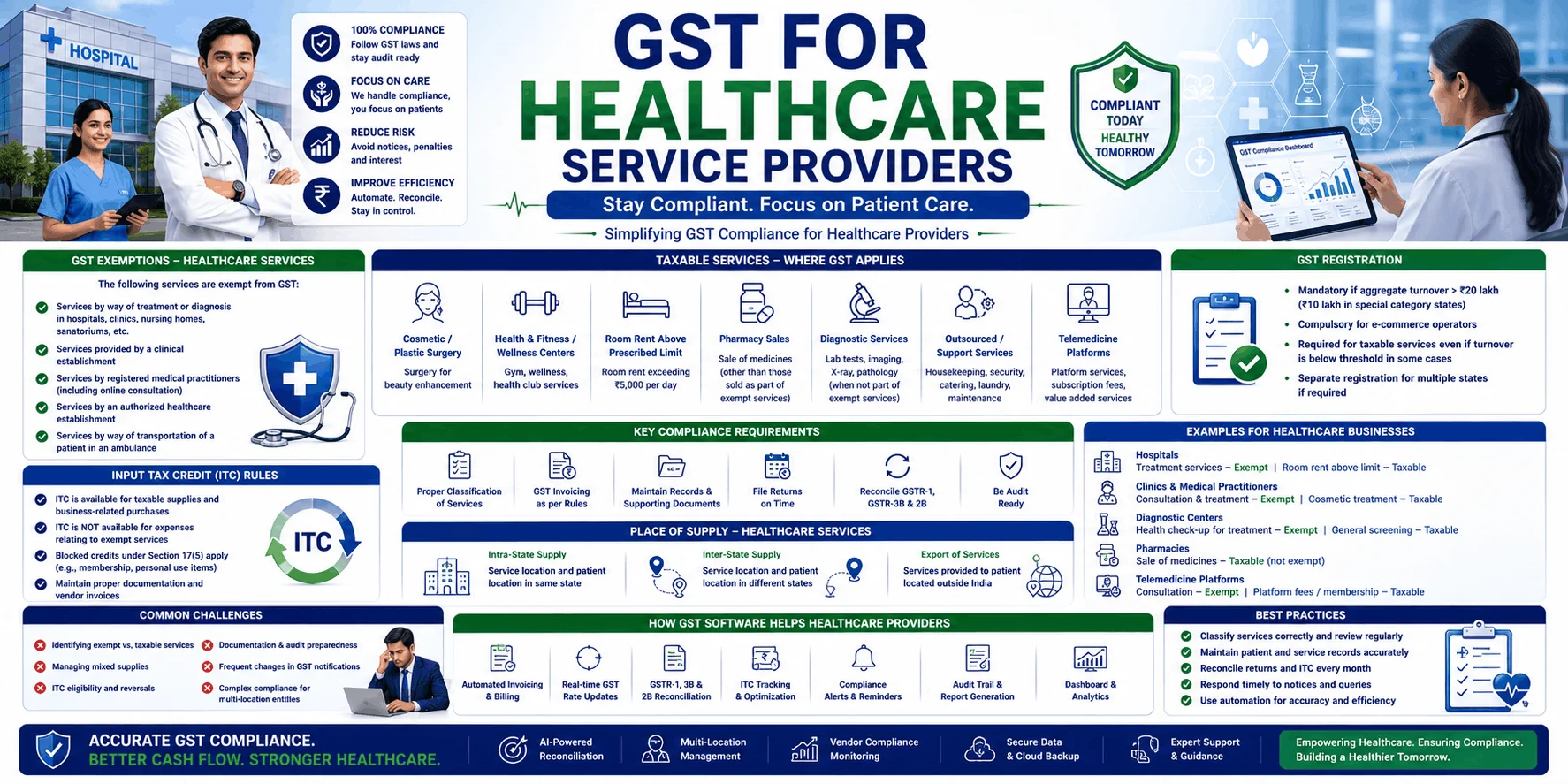
The Goods and Services Tax (GST) represents a significant shift in how healthcare services in India manage their financial transactions. Despite the sector's sensitivity and complexity, healthcare providers can navigate GST with clarity by understanding its applicability, exemptions, and compliance requirements. This article aims to clarify the nuances of GST for healthcare service providers, including exemption clauses, cases where GST applies, and compliance necessities.
Under GST law, healthcare services are generally exempt to prioritize accessibility and affordability of essential medical care. However, not all services fall under this umbrella. We'll delve into these exemptions and specific cases where GST is applicable.
Any healthcare entity with an annual turnover exceeding INR 20 lakh must register for GST. The process involves obtaining a GSTIN, which legitimizes the business’s operations under GST compliance.
Invoicing for healthcare services should adhere to the standard GST format, including details of the service provided, the applicable GST rate, and a clear demarcation of taxable and non-taxable services. Place of supply rules generally dictate that GST is applied to the destination where the service is consumed.
Healthcare providers can claim ITC on procurement related to taxable services, which involves careful accounting, especially since many healthcare services are exempt. When dealing with mixed supplies, accurate segregation based on definitive usage is vital for legitimate ITC claims.
Compliance for healthcare services involves proper record-keeping, regular GST return filing, and reconciliation exercises. This helps in ensuring that all supplies are correctly accounted for and discrepancies are avoided during audits.
Healthcare organizations can benefit significantly from using advanced accounting software and GST automation tools for enhanced compliance. These systems aid in streamlining billing, automating GST reconciliation, and managing return filings efficiently.
Navigating GST for healthcare doesn't have to be daunting. By understanding the scope of healthcare services under GST, leveraging the right automation tools, and adopting robust compliance practices, healthcare providers can effectively manage their GST obligations. Embracing these strategies not only aids in compliance but also enhances operational efficiency.
In summary, careful deliberation and adherence to guidelines ensure healthcare providers can cast a wider net in delivering services, all while staying within the legal tax framework.
