
PUGALENTHI
Updated on 30-07-2026
Indias tax system is something. The Goods and Services Tax is a thing because it tries to make paying taxes easier, for people and removes many other taxes.
The Goods and Services Tax started on July 1 2017. It takes all the taxes. Combines them into one tax.
The Goods and Services Tax has parts:
* the Central Goods and Services Tax
* the State Goods and Services Tax
* the Integrated Goods and Services Tax
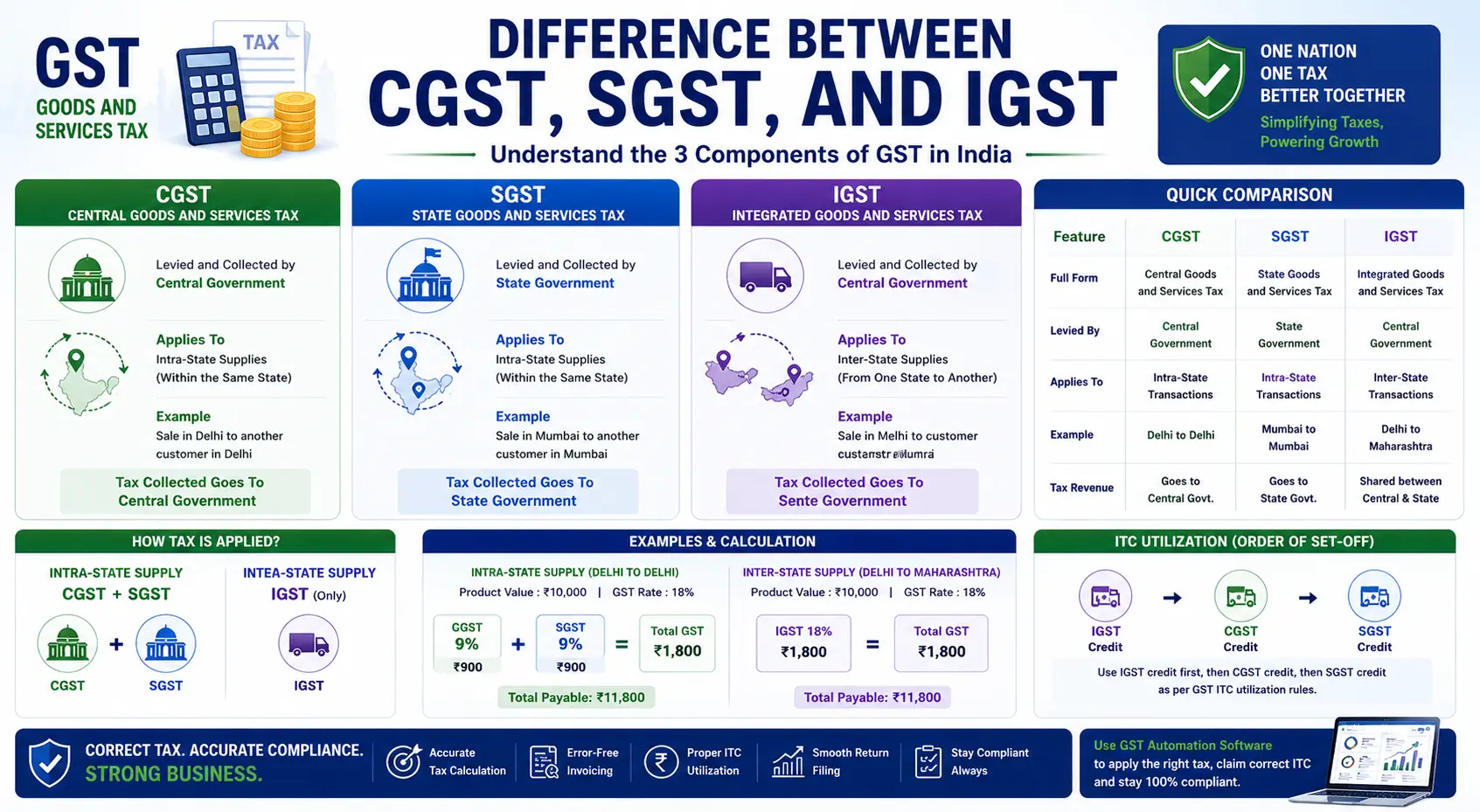
The GST regime in India replaces a multitude of taxes imposed by both the Central and State Governments. Its primary aim is to create a single, unified domestic market. GST is categorized into three main types:
The division of GST into CGST, SGST, and IGST aligns with the federal structure of the Indian government, ensuring revenue distribution between the Centre and the States. Here's why these components exist:
When a transaction happens within one state both Central Goods and Services Tax and State Goods and Services Tax are charged.
For example if a company in Pune sells a product to a buyer, in Mumbai they will have to pay both Central Goods and Services Tax and State Goods and Services Tax.
The Central Goods and Services Tax and State Goods and Services Tax each make up half of the Goods and Services Tax rate.
The Indian Goods and Services Tax or IGST for short is a tax that applies to transactions that cross state boundaries or involve imports and exports.
This really helps with collecting taxes and using tax credits in a way across all the states in India.
The Indian Goods and Services Tax makes sure that taxes are collected in a manner and that tax credits are utilized properly across states, which is very useful, for the Indian Goods and Services Tax system.
When we do business within our state the Central Government and our State Government get their share of tax money directly. This is how it works for Central Goods and Services Tax and State Goods and Services Tax.
When we talk about Integrated Goods and Services Tax the Central Government collects the tax first and then they give some of the money to the State Government where people actually use the goods or services.
Input Tax Credit (ITC) allows businesses to reduce their tax liability by offsetting tax paid on inputs. The rules for ITC utilization involve specific orders of credit adjustment:
Businesses often err by misclassifying transactions, leading to incorrect tax filings. This can result in:
It's vital to ensure proper classification and documentation to avoid compliance issues.
Ensure tax rates and correct classification of goods and services.
Maintain records of all transactions, returns and credits.
Here are some key things to do:
* Use audit trails for all transactions to prevent errors.
* Automate processes using GST software to ensure precision and accuracy, in tax rates and classification of goods and services.
Also GST software helps to maintain records of transactions, returns and credits.
Use GST software to avert errors.
Automation tools are essential for businesses to manage GST compliance efficiently. Key benefits include:
We have to figure out what kind of tax applies like CGST or SGST or IGST
This way we can reduce mistakes that people make and get the tax calculation right.
Filing GST returns is easier now. We can also manage ITC easily.
We can keep track of all transactions, which makes everything more accountable, for CGST and SGST and IGST.
To do business in India you need to know the difference between CGST, SGST and IGST. CGST, SGST and IGST are important for businesses to follow the rules. If you pick the tax for each type of deal you will be doing things legally and you can also get the best tax credits and avoid wasting money.
By staying informed and leveraging technology, businesses can mitigate common GST pitfalls, safeguard against penalties, and contribute to a robust and compliant tax system.
