




RAGU M
Updated on
12-01-2026
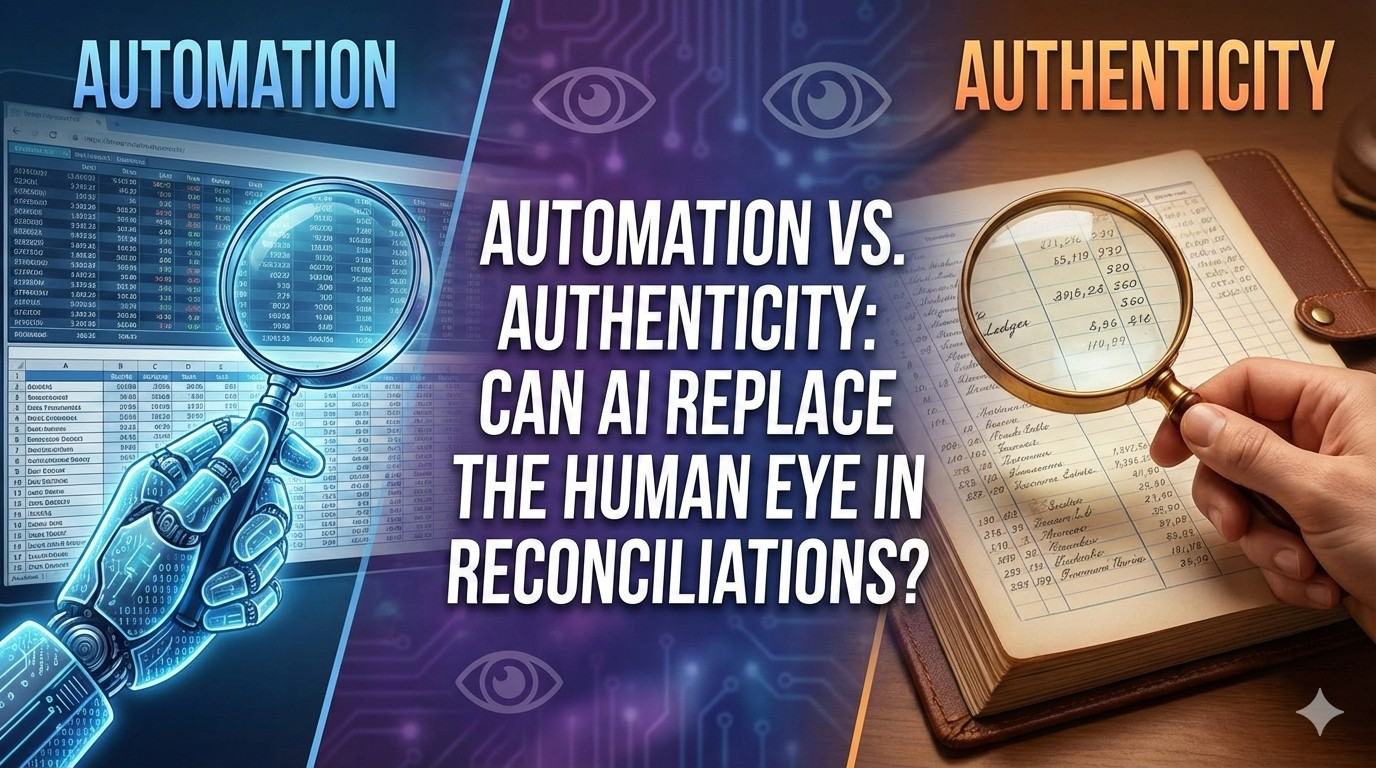
Automation vs. Authenticity: Can AI Replace the Human Eye in Reconciliations?
The technological revolution in finance has also resulted in a vast increase in the use of automated systems throughout most aspects of the finance ecosystem. As we analyze the process of financial reconciliation and ask if technology can automate this task or if there are still areas where human eyes are necessary, we find ourselves at an intersection: on one hand, the advantages of efficiency and accuracy provided by technology; on the other, the knowledge and depth that individual finance professionals possess. Therefore, it is critical to look at both sides of the argument in order to determine whether or not it is plausible that AI will really take over from the human aspect of financial reconciliation.
Understanding the Reconciliation Process
Reconciliation is a critical financial process that ensures accuracy and consistency within accounts. It involves several steps, including:
- Comparing data from various sources to ensure all transactions are accounted for.
- Identifying discrepancies that could indicate errors or fraudulent activities.
- Correcting any mismatches to ensure accurate financial reporting.
This process is vital for maintaining financial integrity and compliance with regulatory standards. The question arises: can AI deliver the same level of diligence and accuracy?
The Rise of Automation in Reconciliations
Automation in reconciliations offers numerous benefits that are hard to ignore:
- Speed: Automated processes can handle vast amounts of data quickly, much faster than a human ever could.
- Accuracy: Reduces human error, improving the precision of reconciliations.
- Cost-Efficiency: Saves time and labor costs, providing a financial incentive for businesses to automate.
- Scalability: Easily adjusts to increased workloads, proving beneficial for growing businesses.
The Need for Human Authenticity
Despite the evident advantages, the human eye offers unique qualities that automation struggles to duplicate:
- Judgment: Human professionals can apply critical thinking to identify subtleties or nuances that algorithms might miss.
- Ethical Consideration: Humans can recognize ethical issues in data that AI might overlook, ensuring ethical compliance.
- Adaptability: Humans can understand and react to context-specific situations with greater flexibility than AI.
Can AI Replace Human Intuition in Reconciliations?
While AI can process data rapidly and reduce errors, it fundamentally lacks the intuitive decision-making capabilities inherent to human professionals. Here are key points to consider:
- Complex Decision-Making: AI can follow programmed rules, but complex exceptions that require understanding context can be challenging for AI.
- Emotional Intelligence: Recognizing patterns of fraud or discrepancies sometimes requires emotional intelligence, which AI lacks.
- Continuous Improvement: While AI can learn from data, the iterative process of deep learning lacks the spontaneity and adaptability that human experience provides.
The Optimal Solution: Hybrid Models
Instead of considering automation and human input as mutually exclusive, businesses could merge these elements for optimal results:
- Efficiency: Automation handles repetitive, high-volume tasks efficiently while humans deal with exceptions requiring judgment.
- Accuracy and Insight: A thorough cross-verification from AI and human insight can enhance overall accuracy.
- Cost and Value Balance: The cost saved through automation can be allocated to more strategic tasks that require human judgment.
The Future of Financial Reconciliation
As technology advances, AI promises improvements, but the human element remains imperative in areas requiring complexity and ethical evaluation. The ability to interpret nuanced data and provide contextual understanding will continue to require human involvement, ensuring that AI serves as a tool rather than a replacement.
Checkout Ledgers.cloud for futuristic digital accounting and reconciliation.
Conclusion: Striking a Balance
In the debate of automation vs. authenticity: can AI replace the human eye in reconciliations? The answer isn't a simple yes or no. Instead, a hybrid approach integrating the strengths of both AI and human expertise proves to be the most effective strategy. This ensures businesses reap the benefits of technological advancements while maintaining the nuanced insights that only human intuition can provide. By finding this balance, organizations can optimize operations, enhance accuracy, and maintain compliance in a rapidly-evolving financial landscape.
Ultimately, as AI continues to develop, the challenge will be to harness its power without losing the irreplaceable value of human insight, ensuring that reconciliation processes remain both efficient and authentic.