




HARI KRISHNAN S
Updated on
30-07-2026
Using Ledgers APIs to Build Smarter Financial Workflows for Your Business
Financial operations Historically it has been one Most of all fragmented parts of running A business Invoices live in one system, In other bank transactions, in salary a third, And no one remembers the tax record anywhere. The result is a patchwork of spreadsheets, manual reconciliation, and end- of- quarter scrambles It price businesses thousands Of hours— and dollar- every year.
Ledger APIs changes it.
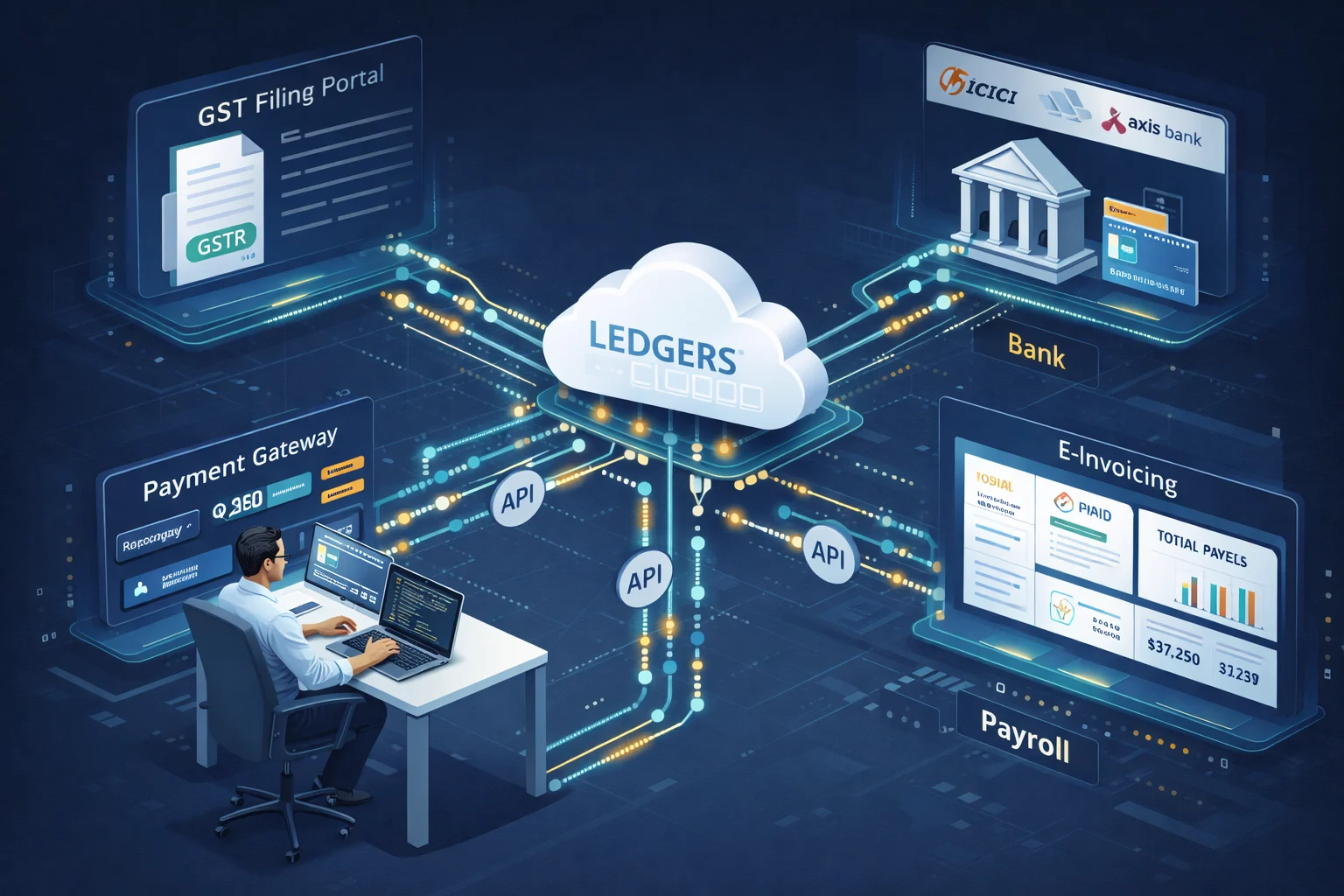
By revealing core accounting And financial data through programmable interfaces, They let the business sew. Together systems which were never designed to talk to each other, automate workflows Which was necessary. Human intervention, and construction real- time financial visibility which was once only available to businesses. Dedicated finance engineering teams. This article What goes through? Ledger APIs What they are, what they enable, and how you can start using them to develop. Smarter financial workflows to your business.
What Is a Ledger API?
But its core, It is a ledger a record Of financial transactions Organized by accounts— Debit, credit, balance etc the relationships between them. A Ledger API reveals this record Depending on the program, allows software systems Read from it, write to it and more trigger actions What is it based on? Modern Ledger APIs go far beyond simple data access. As platforms Plaid, merge, Codat, and dedicated accounting APIs for model from software QuickBooks, zero, and FreshBooks Allow to communicate with developers. Financial data But a granular level: creation journal entries, Reconciliation, synchronization of transactions bank feeds, to create financial statements, And more- all without logging in a dashboard or touch a spreadsheet. The key insight This is a ledger API changes your accounting system from a passive record- keeper I an active participant I your business logic.
Why Financial Workflows Need APIs
Most finance teams are still operating in a mode where software assists humans rather than the other way around. An accountant logs into a bank portal, downloads a CSV, imports it into accounting software, maps categories, and reconciles transactions by hand. This process works — barely — at small scale. It breaks down completely as transaction volume grows, as the business operates across multiple entities or currencies, or as reporting demands increase.
The problems with manual financial workflows are not just about speed. They are about accuracy, auditability, and agility. Every manual touchpoint is a potential error. Every human-to-human handoff is a potential delay. And every time the process depends on someone being available, the business is exposed to single points of failure.
Ledger APIs solve this by making financial data machine-readable and machine-actionable. Instead of a person downloading a bank statement, an API connection continuously syncs transactions in real time. Instead of an accountant manually creating a journal entry, a webhook fires when a payment is received and writes the entry automatically. Instead of a CFO waiting for month-end close to understand cash position, a dashboard pulls live ledger data and presents it on demand.
Core Capabilities of Ledger APIs
Understanding what Ledger APIs can do is the first step toward knowing where to apply them. Most mature ledger API platforms offer a consistent set of capabilities.
Transaction Ingestion and Categorization is the foundational layer. APIs can ingest transactions from bank accounts, payment processors, and invoicing platforms, then apply rules or machine learning models to categorize them automatically. A payment received from Stripe gets posted to the right revenue account. A vendor payment from your checking account hits the correct expense line. Manual categorization becomes the exception rather than the rule.
Journal Entry Automation allows systems to write structured accounting entries directly to the ledger. This is particularly powerful for businesses that generate high volumes of transactions — e-commerce companies, SaaS platforms, marketplaces — where the volume of accounting events far exceeds what any team could handle manually.
Account Reconciliation through APIs can match transactions against expected records — comparing what your bank shows against what your ledger expects — and flag discrepancies automatically. This turns a process that might take a finance team days each month into something that runs continuously in the background.
Financial Reporting endpoints allow applications to pull structured data for income statements, balance sheets, and cash flow statements without waiting for a human to generate them. This makes real-time financial dashboards genuinely feasible for businesses of any size.
Multi-Entity and Multi-Currency Support is increasingly standard in modern ledger APIs, allowing businesses with complex corporate structures or international operations to consolidate financials across entities while maintaining separate books for each.
Practical Financial Workflows You Can Build
Knowing the capabilities is one thing; knowing where to deploy them is another. Here are some of the highest-value workflows businesses are building on top of Ledger APIs.
Automated Revenue Recognition
For businesses with subscription billing, milestone-based contracts, or complex payment structures, revenue recognition is notoriously painful. When a customer pays a $12,000 annual contract upfront, that money is not revenue on day one — it gets recognized monthly over the contract term. Doing this manually means creating deferred revenue journal entries for every contract, every month.
With a Ledger API connected to your billing system, this process can be fully automated. When a payment is received, the API creates a deferred revenue liability. A scheduled job then creates the recognition entries each month, updating the revenue account and reducing the deferred liability — all without human intervention.
Real-Time Cash Flow Monitoring
Cash flow is the lifeblood of any business, yet most business owners only understand their cash position at a point in time, usually when they check their bank balance or wait for monthly reports. A Ledger API makes it possible to build a real-time cash flow view that aggregates bank balances, outstanding receivables, pending payables, and projected inflows and outflows into a single live picture.
By connecting to banking APIs for balance data and to your accounting ledger for receivables and payables aging, you can build a dashboard that answers the question "Can we make payroll next month?" with data rather than intuition.
Expense Management Integration
When employees submit expenses, each one needs to flow into the right account in the general ledger, get attached to the right project or cost center, and ultimately hit the right line on the P&L. Without API integration, this typically involves someone manually entering expenses from a PDF reimbursement report.
A workflow built on Ledger APIs can take a submitted expense from a tool like Expensify or Concur, route it through an approval flow, and — once approved — automatically post the journal entry to the ledger, complete with all the metadata needed for reporting and audit purposes.
Invoice-to-Payment Reconciliation
One of the most tedious tasks in accounts receivable is matching incoming payments to open invoices. A customer pays $8,400, but your invoices are $4,200 and $4,200 from two separate months. Identifying which invoices a payment satisfies, marking them as paid, and closing the AR balance is exactly the kind of structured, rule-based work that APIs can handle.
By connecting your payment processor to your ledger API, you can build logic that matches payments to invoices automatically, handles partial payments or overpayments, and escalates edge cases to a human for review. The volume of manual AR work drops dramatically.
Automated Tax Preparation Support
Tax preparation is largely an exercise in organizing ledger data — pulling transaction records, categorizing income and expenses correctly, and formatting everything the way tax authorities require. A well-structured ledger API integration can export tax-ready reports on demand, flag transactions that need additional documentation, and feed directly into tax preparation software, turning a multi-week ordeal into something much closer to a button press.
Choosing the Right Ledger API for Your Business
Not all Ledger APIs are the same, and the right choice depends on your existing software stack, the complexity of your financial operations, and where your integration points lie.
If your business runs on a major accounting platform like QuickBooks Online or Xero, their native APIs are often the best starting point. They are well-documented, widely supported by third-party tools, and maintained by the same company that manages your books. QuickBooks' API, for instance, covers everything from invoices and bills to journal entries and financial reports. Xero's is similarly comprehensive and has strong multi-currency support.
For businesses that need to connect multiple accounting systems or that are building products serving other businesses, a unified API layer like Codat or Merge provides a single integration point that normalizes data across accounting platforms. Instead of building separate integrations for QuickBooks, Xero, NetSuite, and Sage, you build once and the middleware handles the translation.
For banking data specifically — account balances, transaction history, bank account verification — Plaid remains the dominant option in the US, with strong international alternatives including TrueLayer and Nordigen in Europe.
If your needs are more advanced — complex multi-entity structures, programmatic ledger management, high-volume transaction processing — purpose-built ledger infrastructure platforms like Modern Treasury or Fragment offer APIs designed specifically for operating-level financial engineering, not just reporting.
Getting Started: A Practical Approach
Building financial API integrations can feel overwhelming, but a phased approach makes it manageable.
Start with a read-only integration. Before you write anything to your ledger, build confidence by reading from it. Connect your accounting platform's API and build a simple report or dashboard. Understand how the data is structured, what the latency looks like, and what edge cases exist. This gives you a foundation without any risk of creating bad data.
Automate the highest-volume, lowest-risk workflows first. Transaction categorization and bank feed sync are good starting points because the worst-case outcome — a miscategorized transaction — is easy to catch and correct. Save journal entry automation and reconciliation for after you have built trust in the system.
Build observability and alerting from day one. Financial systems need to fail loudly. If an API call fails, if a reconciliation finds a discrepancy, or if a journal entry can't be created because of a schema mismatch, the system needs to alert someone immediately. Silent failures in financial workflows can go undetected until audit time.
Maintain a human review step for exceptions. The goal is not to eliminate humans from financial workflows — it is to focus human attention where it adds value. Build exception queues for transactions that don't match expected patterns, amounts above thresholds, or entries that the automation isn't confident about. This keeps humans in the loop without requiring them to review everything.
Document everything. Financial systems need audit trails. Every automated action should be logged with enough context to reconstruct what happened and why — what data triggered the action, what rules were applied, what the outcome was, and when it occurred.
The Strategic Case for Financial API Investment
There is a short-term and a long-term case for investing in Ledger API integrations. The short-term case is straightforward: fewer hours spent on manual reconciliation, faster month-end close, reduced errors, and better cash visibility. Most businesses that do the math find that the staff time saved pays for the integration work within a single quarter.
The long-term case is more interesting. A business with well-integrated financial data systems is fundamentally more agile. It can close faster, respond to financial questions more quickly, support due diligence processes without heroic effort, and make decisions based on current data rather than data that is two weeks old. As the business scales, the infrastructure scales with it rather than requiring proportional growth in finance headcount.
In a competitive environment where speed and accuracy of financial decision-making increasingly separate successful businesses from struggling ones, the companies that have invested in financial API infrastructure have a structural advantage that compounds over time.
Conclusion
Ledger APIs is not a niche tool to fintech startups. They are a practical resource to any business It takes financial operations Seriously accounting data programmable, They unlock workflows that are faster, more accurate and more scalable than anything else. A manual process can obtain. The businesses It will be beneficial most are That approach the opportunity Procedure: Start with the highest value, low- risk integrations, The construction of observation I the system from the beginning, And thinking their financial infrastructure not Seam a cost center But like a competitive asset. Technology is smart, the documentation Effective, and the payoff is factual The question Not about Ledger APIs is capable of the investment. How early is it? your business Construction can begin.
Whether you're a startup optimizing for speed or an established business tackling the complexity of multi-entity reporting, there has never been a better time to take your financial workflows from manual to automated — and Ledger APIs are the lever that makes it possible.