




HARI KRISHNAN S
Updated on
30-07-2026
From Spreadsheets to Smart Systems: The Evolution of Cloud Accounting
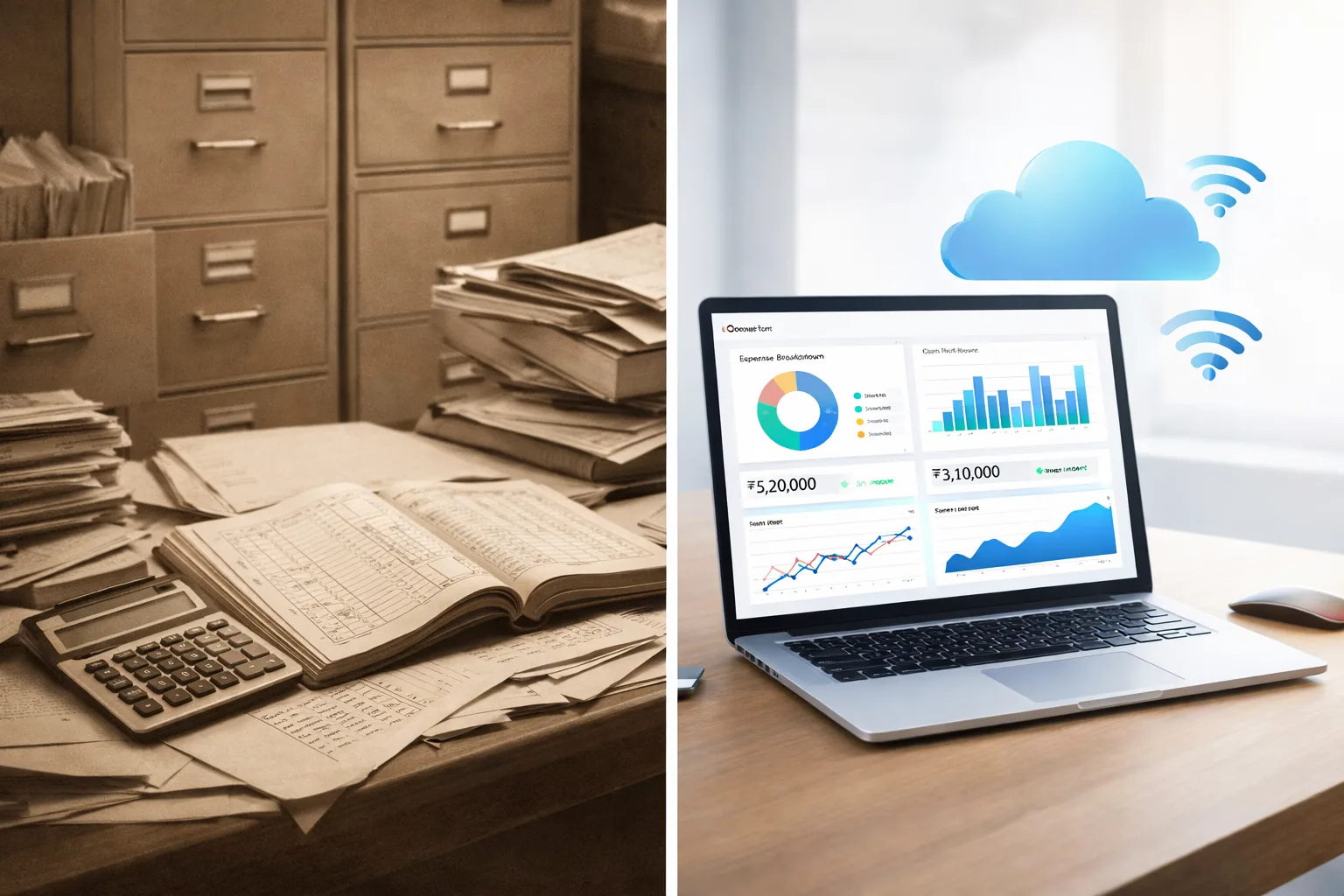
The accounting profession has passed a remarkable transformation over the past something decades. What started manual ledgers and calculators I got ready desktop spreadsheets, And now it has blossomed into sophisticated cloud- based systems that are reshaping how businesses are managed their finances. This journey from a spreadsheet smart systems Not only does it represent a technological shift, But a fundamental reimagining What can accounting do?
The Spreadsheet Era: Power and Limitations
When electronic spreadsheets Came late 1970s And quickly 1980s, He revolutionized accounting. Programs Appreciate VisiCalc And later Microsoft Excel Independent accountant from endless manual calculations And the team financial modeling accessible For the company all sizes. To the first time, to change one A variable can be updated immediately an entire financial projection.
Convey the spreadsheet anyway inherent limitations.
He was in solitude individual computers, to establish collaboration cumbersome. Emerge version control a nightmare As the files multiplied with the names of the email chains" Budget_Final_v3_ACTUAL_FINAL. Xlsx." Data entry remained largely manual, creating opportunities For errors that can occur through formulas. Security At best I was basic, with sensitive financial information Often nothing more a simple password.
Most notably, perhaps, spreadsheets are required substantial manual effort to maintain. Reconciliation of accounts, preparation of reports and ensuring compliance hours K repetitive work He focused on the accountant data entry instead of strategic analysis.
The Cloud Revolution Begins
When electronic spreadsheets Came late 1970s And quickly 1980s, He revolutionized accounting. Programs Value VisiCalc And later Microsoft Excel Independent accountant from endless manual calculations And the team financial modeling accessible For the corporation all sizes. To the first time, to change one A variable can be updated immediately an entire financial projection. Bring the spreadsheet anyway inherent limitations. He was in solitude individual computers, to make collaboration cumbersome. Transform version control a nightmare As the files multiplied with the names of the email chains" Budget_Final_v3_ACTUAL_FINAL. Xlsx." Data entry remained largely manual, creating opportunities For errors that can occur through formulas. Security At best I was basic, with sensitive financial information Often nothing more a simple password. Most notably, perhaps, spreadsheets are required substantial manual effort to maintain. Reconciliation of accounts, preparation of reports and ensuring compliance hours K repetitive work He focused on the accountant data entry instead of strategic analysis.
The Intelligence Layer: AI and Automation
Today's cloud accounting systems Represent a quantum leap beyond those early platforms. Artificial intelligence and machine learning have changed cloud accounting from passive record- keeping tools I active financial intelligence systems.
Modern platforms By learning from past behavior, it can automatically classify transactions by picking up inconsistencies that might indicate error or fraud, and even make predictions.
Cash flow Based on historical patterns And promises to come. Natural language processing Allows users to inquire questions inside plain English And gain insight without having to navigate comprehensive reports.
Automation has increased far beyond basic data entry. Smart systems can now match invoices Create, reconcile accounts for payments tax filings, And create customized reports with minimal human intervention.
Optical character recognition technology extracts data from photographs and receipts on smartphones, while API integrations Contact the accounting platform banking systems, payment processors, inventory management, And CRM Tools for making seamless financial ecosystems.
Real-Time Intelligence and Strategic Insights
Perhaps the most transformative aspect of modern cloud accounting is the shift from retrospective reporting to real-time intelligence. Traditional accounting, whether done on paper or spreadsheets, inevitably looked backward. You closed the books at month-end to see how you performed last month.
Smart cloud systems provide live dashboards showing current financial positions, alert business owners to concerning trends as they develop, enable scenario planning with instant what-if analyses, and offer predictive analytics that forecast future performance based on current trajectories.
This real-time visibility transforms accounting from a compliance function into a strategic tool. Business owners can make informed decisions based on current data rather than month-old reports. They can identify problems early enough to course-correct and spot opportunities while they're still relevant.
Collaboration and Accessibility
Modern cloud accounting has also revolutionized the relationship between businesses and their accountants. Rather than exchanging file exports or granting remote desktop access, accountants can be invited directly into their clients' cloud systems with appropriate permission levels.
This creates true collaboration. Accountants can see exactly what their clients see, answer questions with reference to live data, and make adjustments that are immediately visible. Clients maintain control while gaining expert guidance, and the traditional back-and-forth of information requests largely disappears.
The accessibility extends beyond just accountants and business owners. Cloud systems with role-based permissions allow appropriate team members to access the information they need without exposing sensitive data. Sales teams can view revenue reports, project managers can track budgets, and employees can submit expenses, all within a controlled, secure environment.
Security and Compliance in the Cloud
One of the initial concerns about cloud accounting was security. How could storing financial data on remote servers be safer than keeping it on your own computer? The answer, paradoxically, is that for most businesses, it's significantly safer.
Leading cloud accounting providers invest heavily in security measures that would be prohibitively expensive for individual businesses. This includes encryption both in transit and at rest, multi-factor authentication, regular security audits and penetration testing, redundant data centers with automatic backups, and compliance with international standards like SOC 2 and ISO 27001.
Moreover, cloud systems maintain detailed audit trails showing who accessed what data and when, making it easier to detect unauthorized access and maintain compliance with regulations.
The Integration Ecosystem
Modern cloud accounting platforms rarely operate in isolation. Instead, they serve as the financial hub of an integrated business ecosystem. Through APIs and pre-built connectors, accounting systems now link seamlessly with e-commerce platforms, point-of-sale systems, payment processors, payroll services, inventory management tools, project management software, and customer relationship management systems.
This integration eliminates duplicate data entry, ensures consistency across systems, and provides a holistic view of business operations. When a sale is made online, it automatically flows into the accounting system, updates inventory, triggers invoicing, and eventually records the payment, all without manual intervention.
Challenges and Considerations
Despite their many advantages, cloud accounting systems aren't without challenges. Businesses must consider ongoing subscription costs that can accumulate over time, dependence on internet connectivity for system access, the learning curve associated with new platforms, and the need to carefully vet providers for security and reliability.
There's also the question of data ownership and portability. What happens to your data if you want to switch providers or if a company goes out of business? Responsible businesses ensure they understand their contracts and regularly export backups of their financial information.
Looking Ahead: The Future of Cloud Accounting
The evolution from spreadsheets to smart systems continues to accelerate. Emerging technologies promise even more dramatic changes on the horizon. Blockchain technology may revolutionize audit trails and transaction verification. Advanced AI could provide conversational interfaces where you simply talk to your accounting system to get insights or complete tasks. Enhanced predictive capabilities will offer increasingly accurate financial forecasting, while deeper integration with IoT devices could automatically capture financial data from physical business operations.
Perhaps most intriguingly, we may see the emergence of autonomous accounting systems that handle routine financial operations with minimal human oversight, freeing accountants to focus entirely on strategy, planning, and advisory roles.
Conclusion: A Transformation in Progress
The journey From the spreadsheet smart cloud accounting systems Represents more than fair technological progress. It reflects a fundamental shift How do we assess? financial information: from static records to dynamic intelligence, from compliance burdens to strategic assets, And from isolated tools to integrated ecosystems.
For the business, this evolution Presentation unprecedented visibility I financial performance, More time to focus on development rather than bookkeeping, and better- informed decision- making on every level. For accountants, it means freedom from repetitive tasks and an opportunity To give more valuable advisory services.
We're Still inside the middle of this transformation. Many businesses continue to use spreadsheets significant portions of Their financial management, and even advanced cloud systems There is chamber to grow inside sophistication and accessibility.
But the direction is transparent: the future of accounting Tells lies better spreadsheets, But I smart systems It turns data into insight, compliance into opportunities and accounting competitive advantage.
The businesses Allocate them a hug this evolution, While managing with care the transition And its challenges, You will ascertain yourself a powerful advantage: Not just knowing where they've been, but understanding where they are and intelligently predicting where they're going.
For more Information visit : Ledgers.Cloud