




SWATHI S
Updated on
14-01-2026
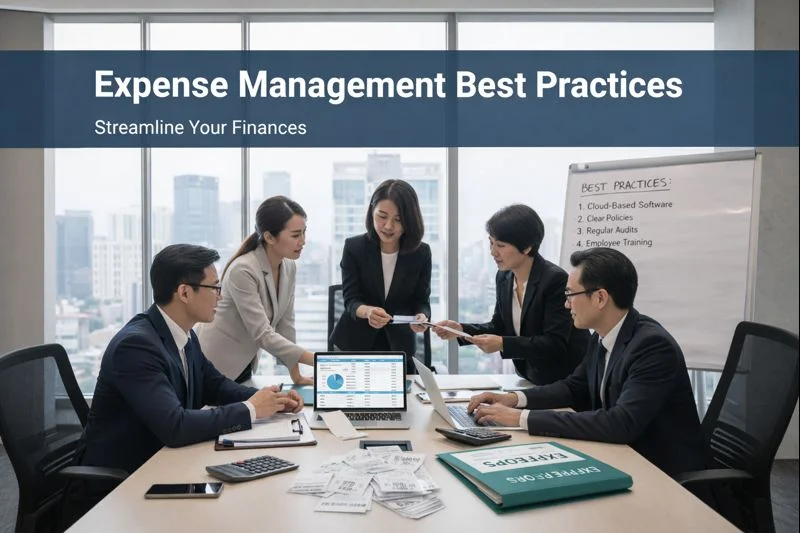
Expense Management Best Practices: The Operating System for Your Business's Financial Health
Imagine running a business where you lack visibility over your financial flows. This scenario often arises when expense management is relegated to an end-of-year audit rather than becoming an integral daily routine. Managing expenses is not merely about slashing costs; it's about ensuring financial liquidity when necessary, allowing smarter decision-making, and differentiating successful enterprises from those perpetually scrambling to catch up. Effective expense management is indispensable to running a company smoothly.
The Foundation: Culture Before Controls
Before implementing systems or policies, reshaping the organizational mindset is crucial. If employees don't believe in your processes or policies, they will fail to perform. The cornerstone of successful policy implementation is a workforce that buys into the concept and purpose. This cultural shift encourages buy-in and drives adherence to policies.
The Trust vs. Control Balance
Supervising each of the minor expenditures might create a lack of trust; therefore, provide your team with well-defined guidelines for decision-making, and allow your team to operate under these frameworks. For example, if you were to give the Client Development Team a monthly budget that has no or very little reporting requirements, you can increase both their accountability and productivity without having to use micromanagement methods.
When you allow employees to make financial decisions, they tend to spend money like the owners of the company and exercise discretion and responsibility. However, when micromanaged, the employees are not able to exercise or develop those skills; therefore, providing them with autonomy will increase their level of accountability. An important mindset to adopt is what is referred to as the "Spend Like It's Your Money" mindset. This perspective encourages responsible spending by assessing every expenditure in terms of its potential for return on investment (ROI).
The 7 Non-Negotiable Best Practices
1. Separate Personal & Business Finances Absolutely, Completely
Using personal funds for business purposes is a recipe for financial confusion. Establishing dedicated business accounts and cards ensures clear financial boundaries. Enforce a Zero Exceptions Policy to prevent any business spending outside official channels, thus streamlining monthly reconciliations.
2. Implement the "Capture at Point of Spend" Rule
The chore of collecting receipts can lead to unnecessary confusion. Embrace technology like Optical Character Recognition (OCR) for instant data capture, reducing administrative efforts by up to 80% and minimizing uncertainty around expenses.
3. Create a Living, Breathing Expense Policy (Not a Binder)
Lengthy policy documents are often ignored. Create a concise, visual one-page policy and embed these guidelines into your expense management software. Regular reviews based on actual usage keep the policy relevant and effective.
4. Standardize Before You Scale
A unified system is crucial for maintaining order. Implement consistent approval workflows and centralized vendor management, which scales effortlessly from a handful of employees to hundreds, ensuring procedural uniformity and reducing reconciliation chaos.
5. Implement Strategic Approval Thresholds
Don't let leaders become bottlenecks. Use a tiered approval matrix to streamline processes while focusing leadership's attention on significant expenditures, enhancing overall operational efficiency.
6. Embrace Real-Time Reconciliation (Not Month-End Panic)
Monthly reconciliations are often reactive and inefficient. Instead, adopt daily bank feeds and weekly reconciliations to immediately address discrepancies, facilitating a proactive approach to financial management.
7. Analyze to Optimize (Data Over Gut Feel)
Actual data should drive expense decisions, not intuition. Regularly review expense outcomes, linking them to business results like client acquisition. Utilize vendor rationalization to streamline supplier terms, ensuring every expenditure serves strategic objectives.
The Digital Stack: Tools That Really Work
Layer 1: Capture & Documentation
- Mobile OCR App: For instant receipt capture and data extraction
- Bulk Upload Capability: Efficient vendor invoice processing
- Cloud Storage: Secure, searchable, and accessible documentation
Layer 2: Processing & Approval
- Automated Workflow Engine: Routes expenses based on predefined rules
- Policy Enforcement: Flags violations pre-submission
- Multi-level Approval: Supports organizational hierarchies
Layer 3: Accounting & Compliance
- Direct GL Integration: Eliminates manual journal entries
- GST/TDS Automation: Automatically calculates and tracks
- Audit Trail: Complete transaction histories
Layer 4: Analysis & Optimization
- Real-Time Dashboards: Financial insights by category, department, project
- Budget vs. Actual: Early warnings for overspending
- Forecasting Tools: Predict spending trends
The Implementation Roadmap: Start Small, Scale Smart
Phase 1: Foundation (Month 1)
- Segregate business and personal finances
- Create and distribute a one-page expense policy
- Implement receipt capture for decision makers
Phase 2: Standardization (Months 2-3)
- Institution-wide rollout with training sessions
- Set strategic approval thresholds
- Establish regular reconciliation habits
Phase 3: Optimization (Months 4-6)
- Analyze initial spending patterns
- Negotiate terms with main suppliers
- Introduce budget tracking systems
Phase 4: Strategic (Ongoing)
- Quarterly reviews focused on expense optimization
- Align expenses with strategic goals
- Implement predictive budgeting based on past patterns
Conclusion: From Chore to Strategic Advantage
Expense management transcends mere bookkeeping; it's an operational competency that can position your company ahead of the competition. By embracing these best practices, companies can enjoy improved time efficiency, cash flow, compliance, and decision quality, while elevating team morale and ensuring scalability. Transform your organization by integrating effective expense management as a strategic tool rather than a mundane task.
Ready to transform expense management from a chore into a strategic advantage? LEDGERS builds these best practices into your daily workflow, so you focus on growing your business, not just tracking its spending.