




ATCHAYA M
Updated on
13-02-2026
API-Based e-Invoice Automation for Enterprises Using LEDGERS
When companies increase their size as well as their volume of transactions, manual or semi-automated processes related to e-Invoicing quickly become inadequate. Businesses that produce hundreds or thousands of invoices each day can't use individual uploads or manual validation processes, nor can they rely on portal submissions. For these types of businesses, e-Invoicing/e-invoicing must be handled in a background (or support) manner by a system that is reliable, has sufficient capacity to handle any expected workload, and is well integrated with current business systems.
API-based automation of e-Invoices allows businesses to connect their billing, ERP systems, and accounting software directly to the Invoice Registration Portal (IRP). This capability is provided by LEDGERS using a well-defined, secure, and robust automation framework that creates invoice processing without interrupting operations.
Why Businesses Use API-Based Automation of e-Invoices
Most large organizations do business in many locations, across several different departments, and using multiple platforms. These businesses have invoices created from various systems, including:
- ERP platforms
- Sales Management Systems
- Subscription Billing Engines
- Logistics/Supply-Chain Software
- Partner Integration Portals
When these systems operate independently, consolidation of the data needed for generating IRNs (Interstate Road Network) will be very complicated. The longer that an organization has to rely on manual/physical intervention means that they would have longer processing times and a greater chance of being out of compliance.
By using API-based automation of e-Invoices, invoices are able to flow directly from the original systems into the e-Invoicing workflows, thereby providing consistency, speed, and accuracy
How LEDGERS Enables System-to-System Integration
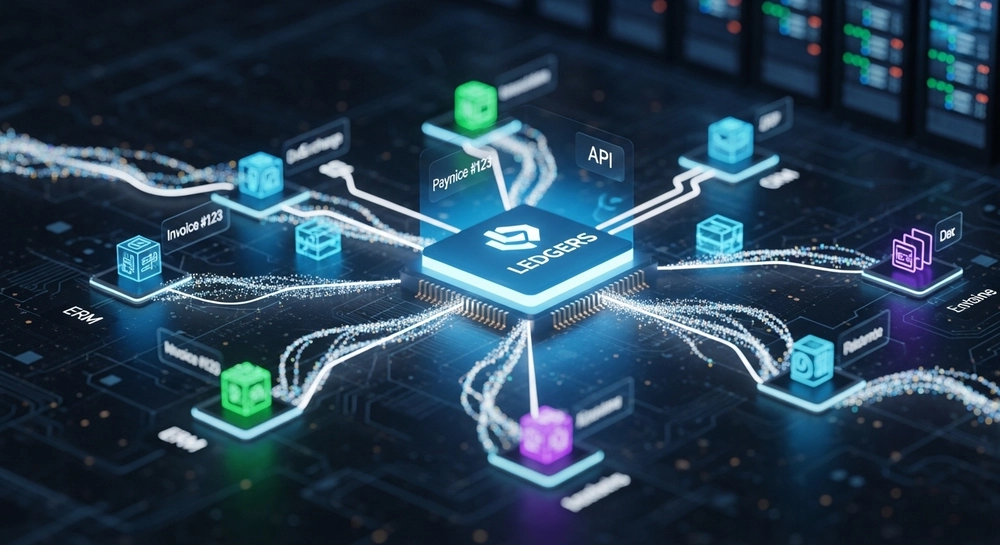
LEDGERS acts as a central compliance layer between enterprise systems and the IRP. Through secure APIs, businesses can transmit invoice data directly to the platform for validation and registration.
This integration enables:
- Real-time or scheduled invoice submission
- Centralized compliance processing
- Standardized validation across all sources
- Unified monitoring and reporting
Enterprises can continue using their preferred internal systems while LEDGERS manages regulatory communication.
Automated Validation and Pre-Processing
Before submitting invoices to the IRP, LEDGERS applies automated validation rules across all incoming data. These checks ensure that:
- Mandatory fields are present
- GSTIN and tax structures are correct
- Document numbering is compliant
- Schema requirements are met
By performing these validations programmatically, enterprises avoid high rejection rates and repeated submissions.
Background Processing and Queue Management
One of the biggest advantages of API-based automation is background processing. Instead of waiting for individual confirmations, invoices are placed in structured processing queues.
LEDGERS manages:
- Submission queues for IRP requests
- Priority handling for time-sensitive invoices
- Controlled request flow to avoid overload
- Parallel processing for large batches
This approach ensures stability even during peak billing periods.
Retry Logic and Failure Recovery
In real-world environments, network interruptions, temporary IRP outages, or API timeouts are unavoidable. Without proper recovery mechanisms, such issues can disrupt compliance operations.
LEDGERS includes intelligent retry mechanisms that:
- Automatically reattempt failed submissions
- Isolate problematic invoices
- Prevent duplicate IRN generation
- Maintain transaction integrity
This ensures continuity without requiring constant manual supervision.
High Availability and Uptime Management
Enterprises depend on uninterrupted invoicing operations. System downtime can delay shipments, payments, and customer processing.
LEDGERS supports uptime-friendly architecture through:
- Load balancing and redundancy
- Distributed processing
- Health monitoring systems
- Failover handling
These measures ensure that e-Invoice automation remains reliable even under heavy load.
Monitoring and Operational Visibility
Automation does not mean loss of control. LEDGERS provides centralized dashboards and logs that allow enterprises to:
- Track submission success rates
- Monitor pending and failed requests
- Review IRP responses
- Analyze processing trends
This visibility helps IT and compliance teams maintain oversight and respond quickly when needed.
Security and Data Protection
API-based systems handle sensitive financial and tax data. LEDGERS implements strong security measures including:
- Encrypted data transmission
- Secure authentication protocols
- Access controls
- Activity logging
These controls protect enterprise data while enabling seamless integration.
Scalability for Growing Organizations
As transaction volumes increase, automation systems must scale without requiring frequent reconfiguration. LEDGERS is designed to accommodate:
- Increasing invoice volumes
- Additional business units
- New GST registrations
- Expanded system integrations
This allows enterprises to grow without rebuilding compliance infrastructure.
Conclusion
For enterprises, e-Invoicing must function as a dependable operational backbone rather than a manual compliance task. API-based automation enables organizations to generate IRNs continuously, maintain compliance accuracy, and support high-volume operations without disruption.
LEDGERS delivers this capability through secure integrations, background processing, intelligent retries, and enterprise-grade stability. By adopting API-driven e-Invoice automation, businesses can strengthen compliance while improving operational efficiency and scalability in an increasingly digital regulatory environment.