




ATCHAYA M
Updated on
30-07-2026
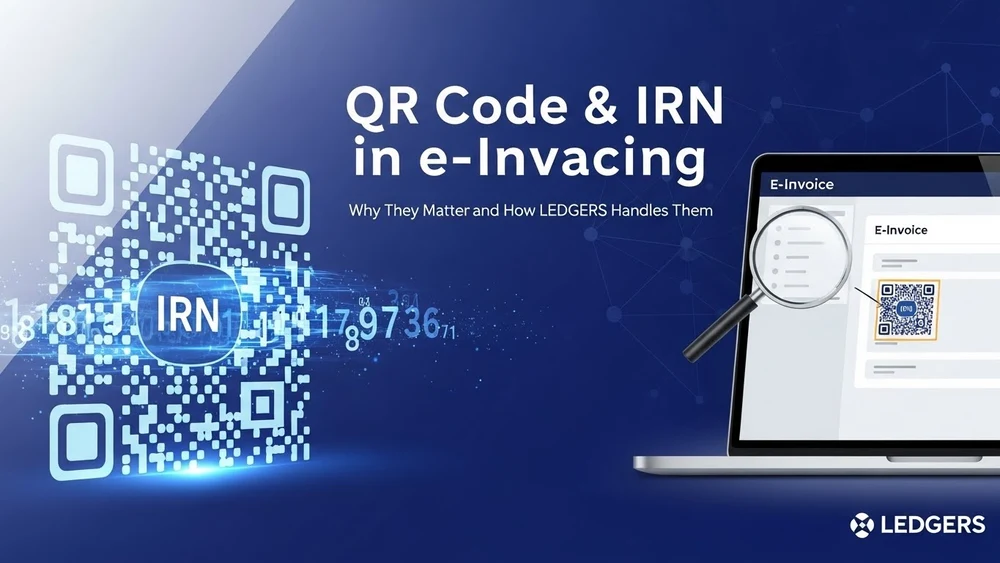
QR Code & IRN in e-Invoicing — Why They Matter and How LEDGERS Handles Them
With the introduction of e-Invoicing under GST, invoices are no longer just accounting documents — they are now digitally authenticated records registered with the government. Two key components that make this possible are the Invoice Reference Number (IRN) and the QR Code. Together, they ensure invoice authenticity, traceability, and compliance across the GST ecosystem.
For businesses, understanding the role of IRN and QR code is essential not only for compliance but also for smooth audits, verification, and downstream GST return filing. LEDGERS integrates these elements directly into the invoicing workflow, making e-Invoicing reliable and easy to manage.
What Is an IRN and Why Is It Important?
The Invoice Reference Number (IRN) is a unique identifier generated by the Invoice Registration Portal (IRP) for every valid e-Invoice. It is created by hashing key invoice details such as supplier GSTIN, invoice number, document type, and financial year.
Once an IRN is generated:
- The invoice is officially registered with the IRP
- The same invoice cannot be registered again
- The IRN acts as a permanent reference for the transaction
In practical terms, the IRN becomes the digital identity of the invoice. Any future reference — whether for cancellation, credit notes, reconciliation, or audit — relies on this IRN.
LEDGERS automatically associates the IRN with the corresponding invoice record, ensuring that users never lose track of which invoices are officially registered.
Understanding the Role of QR Code in e-Invoicing
Along with the IRN, the IRP generates a QR Code containing critical invoice details in encrypted form. This QR code enables quick verification of invoice authenticity without accessing the GST portal directly.
Typically, the QR code contains:
- Supplier GSTIN
- Recipient GSTIN
- Invoice number and date
- Invoice value
- IRN
The QR code allows tax officers, customers, and auditors to verify the invoice instantly using a scanner or verification tool. This makes e-Invoices tamper-proof and reduces the risk of fake or altered invoices entering the system.
Significance of QR Code and IRNs for Businesses
Businesses view QR Codes and IRNs from a compliance standpoint only. However, both documents serve multiple other purposes:
- Authenticity: Confirms that the invoice is officially registered
- Traceability: Links the invoice across e-Invoicing, GST returns, and audits
- Verification: Enables instant validation without manual checks
- Dispute reduction: Provides a clear reference during customer or departmental queries
Without these documents, an invoice will not have any legal support under e-Invoicing regulation.
How LEDGERS Handles IRN Generation
In LEDGERS, IRN generation is not treated as a separate technical task. Once an invoice is created and validated, the system securely communicates with the IRP using an API-based workflow.
LEDGERS:
- Sends invoice data in IRP-compliant format
- Receives IRN, signed payload, and acknowledgement details
- Automatically updates the invoice with IRN status
- Prevents duplicate IRN generation attempts
For users, this process feels seamless — the invoice simply moves from “prepared” to “IRN generated” status without manual uploads or file handling.
QR Code Integration Inside LEDGERS
The inclusion of QR code technology into LEDGERS allows us to offer customers several key benefits. First, once the QR code is generated by the IRP, it is embedded into the customer's invoice document.
- Printed invoices carry a scannable QR code
- Digital copies remain verifiable when shared
- Customers receive fully compliant invoices
- Audit and verification processes become simpler
Through the access to the IRN data and the embedded QR code, LEDGERS creates a full digital history of each e-Invoice.
Verification, Audits, and Return Mapping
In addition to supporting the issuance of invoices, the IRN and QR code information stored in LEDGERS also support all of the following:
- e-Invoice to GSTR-1 data mapping
- Invoice-level audit checks
- Reference during cancellation or credit note issuance
- Historical compliance tracking
The centralized access of information stored in LEDGERS allows businesses to avoid having to manually reconcile or have mismatched documents in the future.
Conclusion
The IRN and QR codes are essential components of India's electronic invoicing system. Businesses can now experience a seamless operation with confidence that each electronic invoice issued is accurate, verifiable, and can be audited.
LEDGERS makes very simple the difficulty of manually managing the IRN and QR code elements of invoicing systems, especially for businesses with large volumes of invoices, by integrating the generation of the IRN and the QR codes into the digital invoicing process. This provides business confidence to know that every electronic invoice that has been issued will be compliant and ready for audit purposes.