
ATCHAYA M
Updated on 12-10-2026
Creating best e invoicing software is the first step for most businesses toward compliance with GST regulations. The true challenge occurs when e-invoice data must be reconciled against the corresponding accounting records and GST returns. Differences between e-invoices, accounting records, and filed returns can create mismatches, ITC issues, audit inquiries, and excessive follow-ups with customers and/or the tax authority.
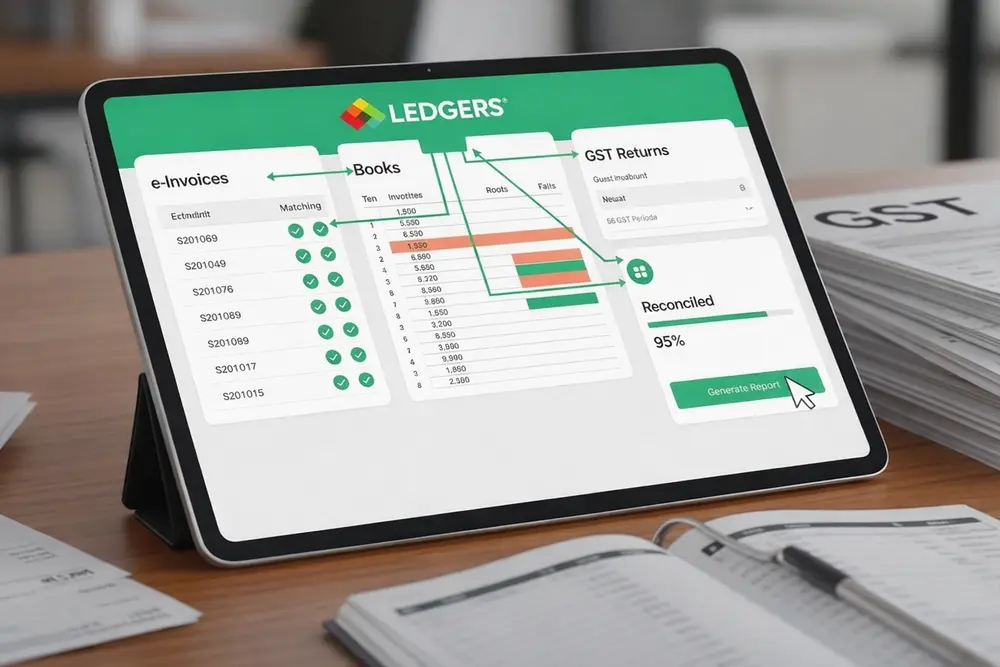
Reconciliation is simply ensuring that all three systems (e-invoice, accounting record, and GST return) are showing the same value and reference for a given transaction. Due to the difficulty in tracking and/or correcting mistakes associated with manually reconciling these records or using separate systems, LEDGERS has simplified the reconciliation process through a single connected workflow where all compliance data is part of one system.
There are several systems under GST working in conjunction to complete the GST compliance process:
Each of the three systems plays a unique role in complying with the GST; however, all three will need to have the same information. Businesses will encounter problems when multiple systems don't agree on the same information, including:
Even small inconsistencies, such as a difference in invoice value or tax amount, can create compliance complications over time.
In real-world operations, mismatches usually arise due to practical reasons rather than intentional mistakes. Some common causes include:
When businesses rely on spreadsheets or manual tracking, identifying these issues becomes time-consuming and unreliable.
LEDGERS maintains a single source of truth for invoices, IRN details, accounting entries, and return data. Once an invoice is created and registered, all related information is stored within the same system.
This unified structure ensures that:
Instead of reconciling between multiple platforms, businesses work within one integrated environment.
LEDGERS automatically matches registered e-Invoices with corresponding accounting entries. This helps identify:
By highlighting mismatches early, businesses can resolve them before return filing, reducing the risk of compliance errors.
When preparing GSTR-1, LEDGERS uses reconciled e-Invoice and accounting data to populate return sections. Because the invoices have already been validated and matched, the chances of incorrect reporting are significantly reduced.
Users can review:
This structured review process ensures that outward supply reporting remains accurate.
Over time, businesses issue credit notes, debit notes, or amendments. These adjustments must also be reconciled with original invoices and return values.
LEDGERS maintains reference links between original invoices and adjustment documents, allowing users to track:
This prevents confusion during audits or financial reviews.
Reconciliation is not a one-time activity. It continues across multiple return periods and financial years. LEDGERS provides status indicators that help businesses monitor:
This visibility helps teams stay proactive rather than reactive.
By managing reconciliation through LEDGERS, businesses gain several operational advantages:
Instead of spending time searching for mismatches, teams can focus on compliance review and planning.
During annual return preparation and departmental audits, reconciliation becomes even more important. Authorities often compare IRP data, GST returns, and accounting records together.
With LEDGERS, businesses can easily present:
This transparency reduces audit stress and improves response efficiency.
Reconciliation between best e invoicing software, accounting books, and GST returns is one of the most important aspects of long-term GST compliance. When handled manually, it becomes a repetitive and error-prone process that drains time and resources.
LEDGERS simplifies reconciliation by connecting invoicing, accounting, and return filing into a single workflow. By maintaining consistent data, tracking mismatches early, and preserving audit trails, the platform helps businesses maintain compliance confidence while reducing operational burden.
