




HARI KRISHNAN S
Senior Developer
Updated on
27-03-2026
Why Integrated Financial Platforms (Invoicing, Banking, Payroll) Are the Future of Business Operations
The modern business landscape passes through a fundamental transformation How companies manage their financial operations. Away. The days For business invoicing, banking services, and payroll. Today, integrated financial platforms appears as the cornerstone Of efficient business operations, And with superior reason.
The Problem with Fragmented Systems
Traditional business financial management has long been plagued by inefficiency. A typical small to medium-sized business might use one software for invoicing, another for banking, a third for payroll, and perhaps additional tools for accounting and expense management. This fragmented approach creates a cascade of problems:
Data silos force finance teams to manually transfer information between systems, increasing the risk of errors and creating discrepancies that can take hours to reconcile. Redundant data entry means the same information—employee details, vendor information, transaction data—gets entered multiple times across different platforms. Limited visibility prevents business owners from seeing their complete financial picture in real-time, making strategic decision-making more difficult.
The cumulative effect? Wasted time, increased operational costs, higher error rates, and missed opportunities for financial optimization.
The Rise of Integrated Financial Platforms
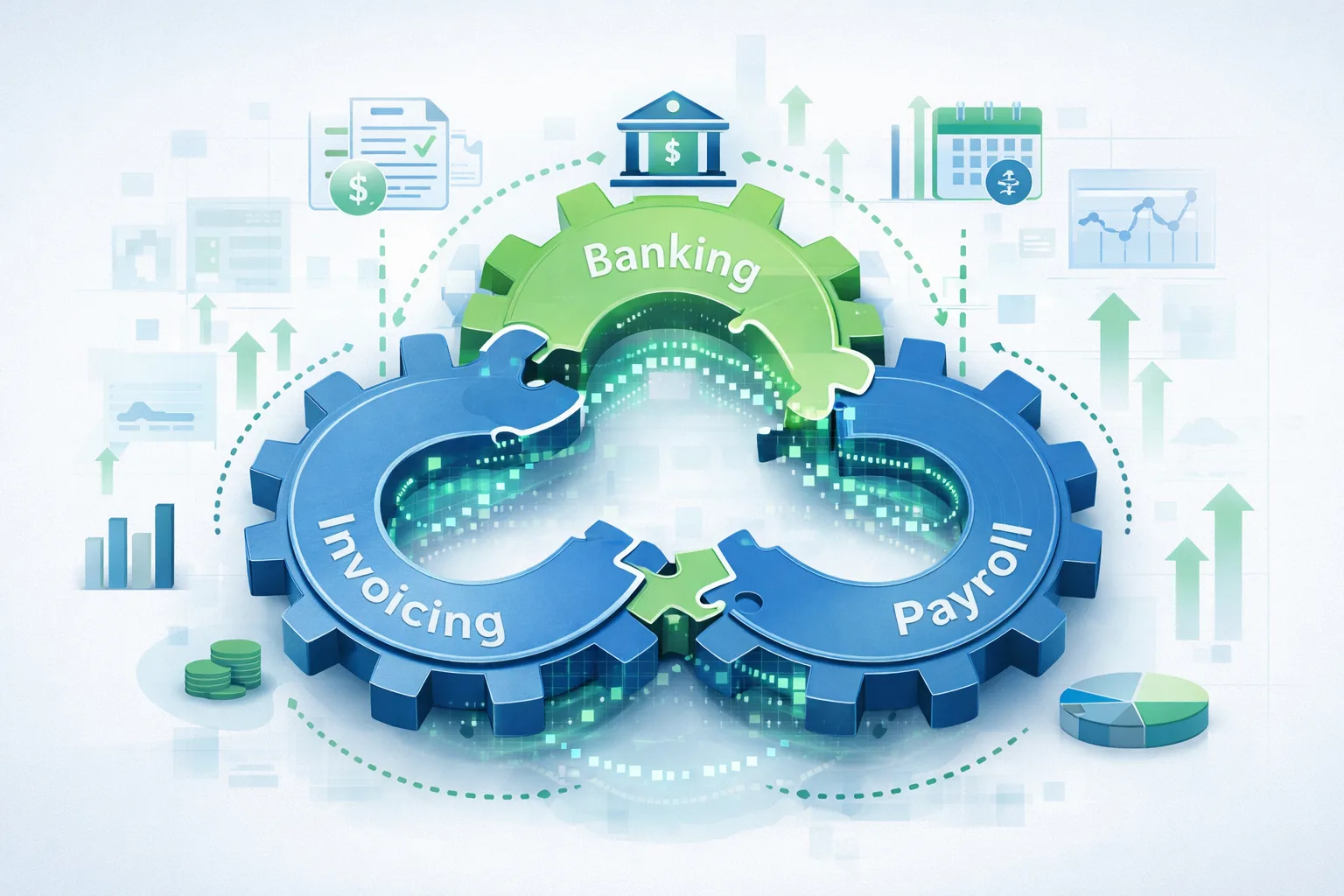
Integrated financial platforms solve these challenges by unifying all core financial functions into a single, interconnected ecosystem. When invoicing, banking, and payroll systems communicate seamlessly, the benefits multiply exponentially.
Automated workflows become the norm rather than the exception. When a client pays an invoice, that payment automatically reconciles with your bank account, updates your cash flow projections, and triggers any dependent payroll or vendor payments. No manual intervention required.
Real-time financial visibility transforms how businesses operate. Instead of waiting for month-end reports, business owners can see their current financial position at any moment. Cash flow becomes predictable, not mysterious. Financial forecasting shifts from guesswork to data-driven precision.
Reduced errors and compliance risks emerge naturally when systems are integrated. Payroll tax calculations automatically align with your banking information. Invoice data flows directly into financial reports without manual transcription. Audit trails are comprehensive and automatic.
The Business Impact
The shift to integrated platforms isn't just about convenience—it's about competitive advantage. Companies using integrated financial systems report significant measurable benefits:
Time savings are substantial. Finance teams report spending 40-60% less time on routine administrative tasks, freeing them to focus on strategic financial planning and analysis. What once took days now takes hours; what took hours now takes minutes.
Cost reduction comes from multiple sources. Fewer software subscriptions to manage and pay for. Reduced need for specialized accounting staff to handle reconciliation. Lower error rates mean fewer costly mistakes and compliance penalties.
Improved cash flow management stems from better visibility and automation. Businesses can identify payment delays faster, optimize payment timing to vendors, and make more informed decisions about investments and expenses. Many companies report improved working capital positions simply from better financial coordination.
Scalability becomes significantly easier. As businesses grow, integrated platforms scale naturally without requiring wholesale system replacements or complex new integrations. Adding new employees, vendors, or revenue streams doesn't mean adding new complexity to your financial operations.
Key Features Driving Adoption
Modern integrated financial platforms share several characteristics that make them indispensable:
Bank-level security ensures that sensitive financial data remains protected while still being accessible to authorized users. Multi-factor authentication, encryption, and compliance with financial regulations are built-in, not afterthoughts.
Intelligent automation goes beyond simple rule-based workflows. AI and machine learning help categorize expenses, detect anomalies, predict cash flow, and even suggest optimal payment timing. The system gets smarter over time, learning from your business patterns.
Mobile accessibility means business owners and finance teams can manage critical financial tasks from anywhere. Approve invoices during a commute, process payroll from a coffee shop, or check cash flow from a client meeting.
Customizable reporting provides insights tailored to your specific business needs. Whether you need detailed departmental breakdowns, project-based profitability analysis, or investor-ready financial statements, integrated platforms can generate them on demand.
Open APIs and extensibility allow businesses to connect other essential tools—CRM systems, project management software, e-commerce platforms—creating an even more comprehensive business management ecosystem.
The Human Element
Perhaps the most underappreciated benefit of integrated financial platforms is their impact on people. Finance teams report higher job satisfaction when freed from tedious manual tasks. Business owners sleep better knowing their financial operations are reliable and transparent. Employees appreciate faster, more accurate payroll processing.
The reduction in financial stress and administrative burden creates space for more strategic thinking, better customer service, and innovation. When your financial systems work seamlessly in the background, your team can focus on what actually drives business growth.
Looking Ahead
The trajectory is transparent: integrated financial platforms is not a temporary trend But a permanent evolution how I businesses Occupation as artificial intelligence, Blockchain technology, and open banking regulations preserve moving forward, these platforms will develop even more powerful and necessary. Businesses Those who embrace integration are now positioning themselves for it. Sustainable competitive advantage. The ones that are wrapped. Fragmented systems You will identify yourself more and more marginalized, and use more resources. Financial administration During the acquisition less insight and control. The future of business operations Integrated, automated and intelligent. The only inquiry is how soon your business will do the transition.
The Bottom Line
Integrated financial platforms represent more than a technological upgrade– they are a fundamental reimagining How should a business be organized? their financial operations. By combining invoicing, banking, and payroll to an even whole, these platforms Eliminate inefficiencies, reduce errors, improve visibility and more free businesses Focus on development rather than management. A quick one competitive business environment, Integration is not just an advantage– it is becoming one. A necessity.