
VAIRAVAN K
Updated on 30-07-2026
If you conduct business in India and your turnover exceeds a certain limit, then GST e-Invoicing is not a choice anymore; it becomes mandatory. But GST e-Invoicing is that special kind of government regulation that not only helps you become compliant but also makes the process quicker once you get used to it.
In this guide, we have explained what GST e-Invoicing is, for whom it is mandatory, and how you can keep yourself on track without having to work over the weekends.
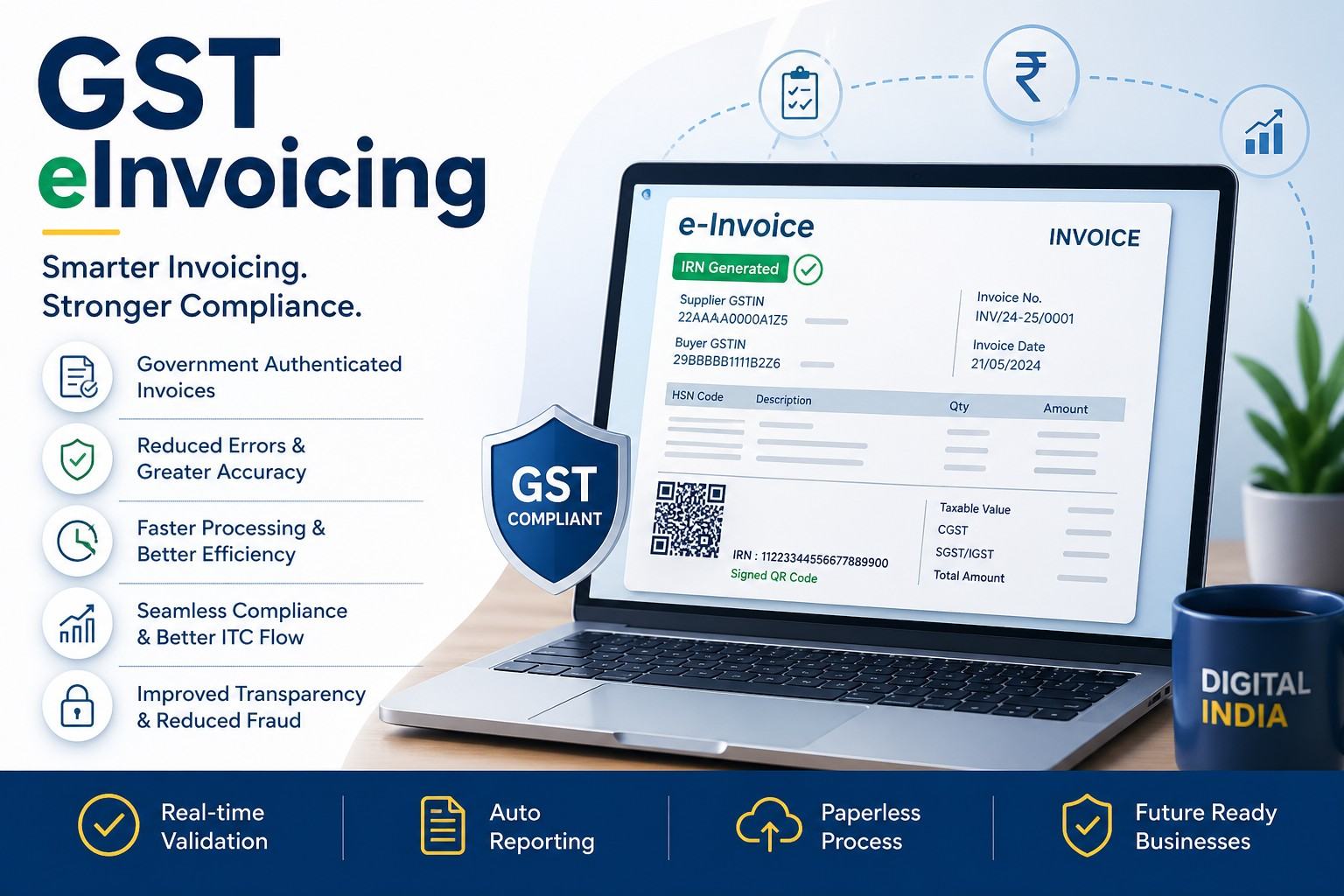
GST eInvoicing is a process wherein the invoices between the business-to-business transactions are uploaded in the government website named as Invoice Registration Portal (IRP) before sending them to the buyer. The invoice is validated through this portal, an Invoice Reference Number (IRN) is generated, and a QR code is received back from the portal. Only then will the invoice be deemed to be valid according to the GST rules.
There are several things that must be clarified regarding the concept of eInvoicing. First of all, it is not a new type of invoice and also not something that will be prepared by the government on your behalf. Instead, you will continue using the same system to generate invoices.
The eInvoicing mandate has been rolled out in phases since 2020, starting with very large companies and gradually covering smaller ones. As of the latest notification, businesses with an aggregate annual turnover of more than five crore rupees in any financial year from 2017 onwards must issue eInvoices for their B2B transactions, exports, and credit or debit notes.
Some categories are exempt regardless of turnover. These include banks, insurers, non banking financial companies, goods transport agencies, passenger transport services, and SEZ units, though SEZ developers must comply. B2C invoices are currently outside the scope, although a dynamic QR code is required for large B2C transactions by notified taxpayers.
If you are unsure whether you fall within the threshold, calculate your aggregate turnover across all GSTINs registered under the same PAN. That total decides your eligibility.
Here is a simple way to picture the flow:
The whole process happens in seconds when integrated through an API. Manual upload is also possible for low volume taxpayers, but most businesses prefer software that handles it quietly in the background.
Compliance aside, the benefits of eInvoicing are real and measurable.
Faster input tax credit is probably the biggest win. Since the invoice is reported to the government in real time, your buyer can claim ITC sooner without waiting for you to file your monthly return. This often improves customer relationships because their cash flow improves alongside yours.
Reconciliation headaches reduce drastically. Mismatches between GSTR-1 and GSTR-3B used to cause months of follow up. With eInvoicing, the data is auto populated, so errors and disputes drop sharply.
Fraud prevention is another quiet benefit. Fake invoices and circular trading have been a long standing problem in the GST system. Real time reporting makes it much harder to issue invoices that do not match actual business activity.
And then there is e-way bill integration. If your invoice involves goods movement above the threshold, the eInvoice data can directly generate the e-way bill, saving an entire step.
Even seasoned accounting teams trip up on eInvoicing in the first few months. Here are the issues we see most often.
Generating an eInvoice after the buyer has already received the printed copy. The IRN should be obtained before sharing the invoice, not after the goods have left your warehouse.
Cancelling an eInvoice incorrectly. You can cancel an eInvoice within 24 hours of generation, but only fully. Partial cancellation is not allowed. After 24 hours, you must issue a credit note instead.
Ignoring HSN code accuracy. The IRP validates HSN codes strictly. A wrong code triggers rejection, which means you cannot issue the invoice until you fix it.
Forgetting about credit and debit notes. Many businesses report the original invoice but skip eInvoicing for related credit notes. Both are mandatory under the rules.
Missing the time limit. Notified taxpayers must report invoices to the IRP within 30 days of the invoice date. Late reporting means the IRP will reject the document outright.
This is where having the right software makes a real difference. With Ledgers GST invoicing software, eInvoicing happens quietly in the background. You create the invoice the way you always have, and the platform handles the IRP communication, IRN generation, QR code embedding, and return filing.
You also get bulk eInvoicing for businesses that issue hundreds of invoices a day, automatic e-way bill generation, and built in error checks that catch problems before the IRP ever sees the file. For accountants managing multiple clients, the multi GSTIN dashboard is a real time saver.
Initially an imposition to comply, GST eInvoicing has slowly but surely become an effective tool that ensures clean books of accounts, faster ITC, and lesser disputes. Those who have embraced it properly consider it a regular task that comes along the usual course of business.
If you are one who still struggles with spreadsheets and traditional billing tools which do not sync with the IRP system, then perhaps now is the time for you to change. The limits keep shrinking while the cost of being non-compliant on your invoices is always much more expensive.
Do it once correctly, and save yourself all the hassle and let yourself focus on what really counts in your business.
