
Jyothishwar M
Updated on 30-07-2026
Payroll encompasses wages, salaries, bonuses, and commissions paid to employees, managing financial aspects to ensure accuracy and timeliness. Effective payroll management impacts net income and compliance with laws and regulations. Timely and accurate payroll enhances employee satisfaction, boosting morale and productivity.
What is Payroll?
Payroll encompasses wages, salaries, bonuses, and commissions paid to employees, managing financial aspects to ensure accuracy and timeliness. Effective payroll management impacts net income and compliance with laws and regulations. Timely and accurate payroll enhances employee satisfaction, boosting morale and productivity.
HR ensures fair compensation and policy adherence, while payroll management controls expenses and aids in financial forecasting.
Coordination among HR, finance, and legal teams ensures compliance and effective payroll management. Effective payroll management oversees employee compensation, tax deductions, legal compliance, and record-keeping.
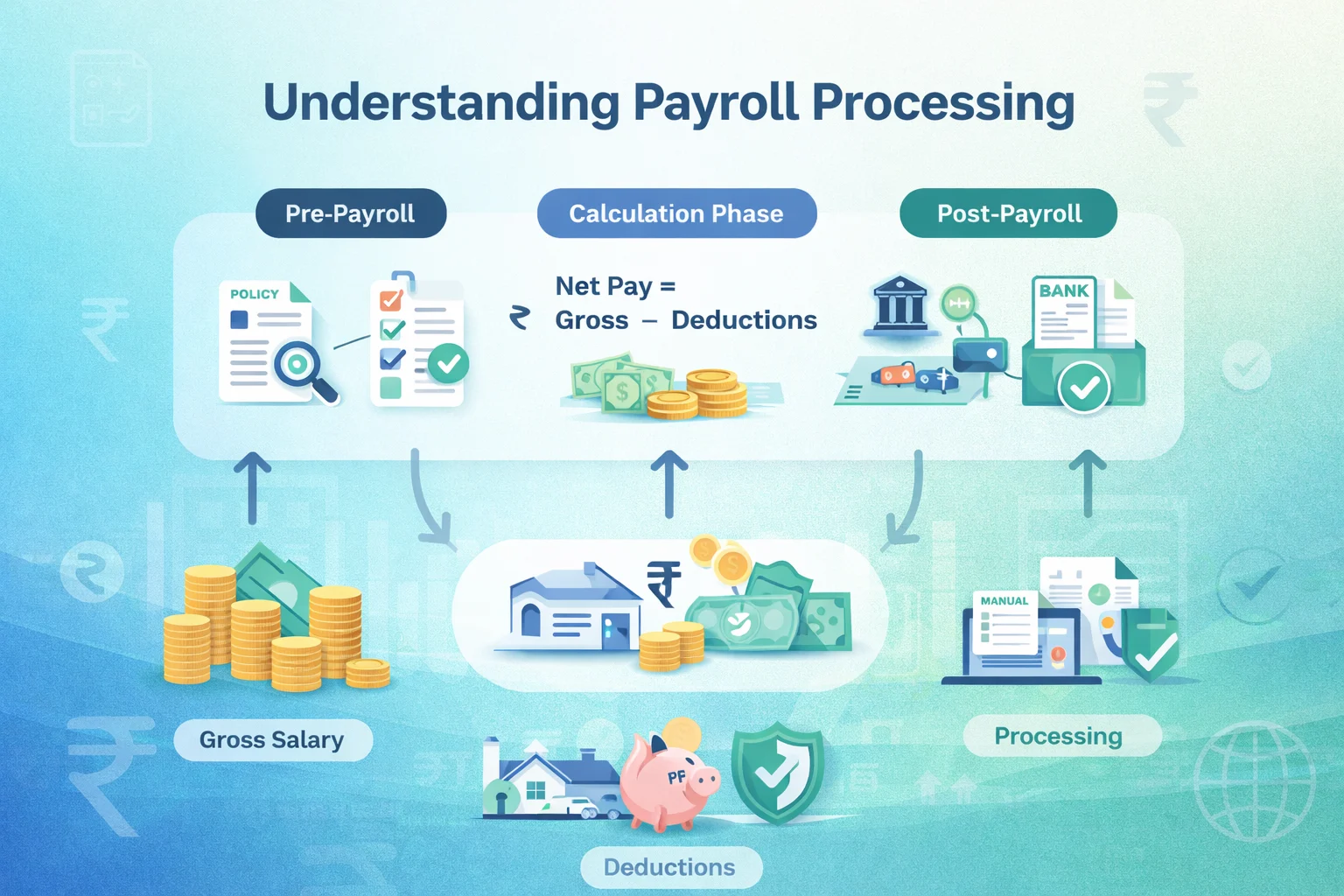
Pre-payroll activities lay the foundation for the payroll process, including onboarding employees, preparing eligible lists, and establishing standardized payroll policies. Essential employee details, including name, address, social security number, and job title, are collected, along with income tax-saving declarations and chosen benefits.
Company policies on pay, leave, employee benefits, and attendance affect the net payable amount.
Validating inputs ensures accuracy by checking active employees and excluding inactive ones before payroll processing. Required inputs for payroll processing include attendance registers, conveyance records, and HR data on salary revisions.
The payroll calculation phase determines each employee’s salary using the formula: Net pay = Gross pay - Deductions. Gross salary includes basic salary, allowances, and overtime pay. Hourly employees’ gross pay is hours worked times hourly rate; salaried employees’ gross pay is annual salary divided by pay periods.
Net salary is calculated by deducting Professional Tax, Provident Fund, Employee State Insurance, and Income Tax from the gross salary.
For an employee with a $50,000 annual salary paid biweekly, gross pay is $1,923.08. Net pay is derived by subtracting deductions from gross salary.
Post-payroll activities ensure timely and accurate salary payments, with the payroll department primarily responsible for disbursement. Companies must verify sufficient bank funds before processing salary payments, which can be made via cash, cheque, or bank transfer. A bank advice statement with employee ID, bank account number, and wage amount is sent for salary disbursement.
Maintaining payroll records, documenting earnings, deductions, and payslips is critical. Payroll accounting ensures salaries are accurately recorded as major expenses.
Gross salary includes total earnings before deductions, covering base salary, bonuses, overtime, and commissions. Gross salary is essential in payroll calculations, directly impacting net salary.
Allowances are extra payments beyond base salary for work-related expenses, commonly including housing and transportation. Meal allowances are also typical. The taxability of these allowances varies, affecting net salary.
Vacation or sick leave pay and overtime are factored into gross salary calculations.
Deductions are amounts subtracted from gross salary, including mandatory taxes and social security and voluntary health insurance and retirement contributions. Pre-tax deductions and income tax deductions are subtracted before calculating taxable income, potentially lowering it.
Accurate payroll computations and tax compliance rely on proper deductions.
Effective payroll management maintains accurate financial records and ensures tax compliance. Adhering to payroll regulations builds government trust and avoids financial penalties. Misclassifying employees or failing to report all taxable compensation can result in penalties for both the organization and employees.
Regular payroll audits identify discrepancies and ensure regulatory compliance. Payroll software often includes compliance updates to adhere to tax laws. Failing to follow payroll laws can result in fines, penalties, and business threats.
Ensuring compliance with payroll regulations is vital for businesses.
Payroll can be used to process payroll manually, via spreadsheets, or using automated software, each with distinct advantages and disadvantages.
Choosing a method depends on budget, organization size, and business needs.
Manual payroll systems, lacking automation, can be inefficient and time-consuming. Drawbacks include increased mistakes, information mishandling, and compliance challenges with changing tax laws.
Some small businesses use manual systems despite these challenges due to budget constraints.
Start-ups and small businesses often use spreadsheet-based payroll management for its simplicity and low cost. Convenient for small teams, it can cause data reconciliation and error challenges.
Spreadsheets become less suitable for larger workforces as businesses grow.
Automated payroll software streamlines managing employee payments. Examples like RazorpayX Payroll offer fully-automated solutions to simplify payroll tasks. Cloud-based software reduces spreadsheet dependency and automates tasks, ensuring tax compliance. Features like printable tax forms and withholding tables ensure confidentiality and accuracy.
Automated payroll software reduces manual efforts, enhances efficiency, and eliminates errors. It’s particularly beneficial for larger organizations with complex needs.
Automated payroll systems present several advantages, making them ideal for businesses of all sizes. Advantages include time-saving, enhanced accuracy, and cost efficiency.
Automated payroll system significantly reduce manual task time. Automated systems perform most manual tasks quickly, allowing payroll staff to focus on strategic activities.
This ensures accurate and timely employee payments.
Automation significantly reduces payroll calculation errors. Automated systems minimize human errors, ensuring correct compensation and legal compliance.
Overall, automated payroll systems enhance accuracy, efficiency, and compliance.
Automation leads to cost reductions by decreasing penalties, fines, and labor costs. Time tracking systems integrated with payroll software enhance efficiency and reduce administrative burden.
Cost-efficient payroll management is crucial for optimizing operational expenses.
Payroll is a critical function that goes beyond simply paying employees—it plays a vital role in ensuring financial accuracy, legal compliance, and overall employee satisfaction. From pre-payroll activities like data collection and validation, through precise salary calculations, to post-payroll processes such as disbursement and record-keeping, each stage contributes to a smooth and reliable payroll system.
A well-structured salary framework—including components like gross salary, allowances, and deductions—directly impacts net pay and helps organizations maintain transparency and trust with employees. At the same time, strict adherence to payroll compliance and regulations protects businesses from penalties and legal risks.
As organizations grow, shifting from manual or spreadsheet-based systems to automated payroll software becomes increasingly important. Automation not only improves efficiency and accuracy but also reduces administrative workload and operational costs.
In summary, effective payroll management is essential for organizational success, supporting both financial stability and employee well-being while enabling businesses to scale confidently and compliantly.
