




RAGU M
Updated on
30-07-2026
Understanding the Profit & Loss Statement: Key Insights
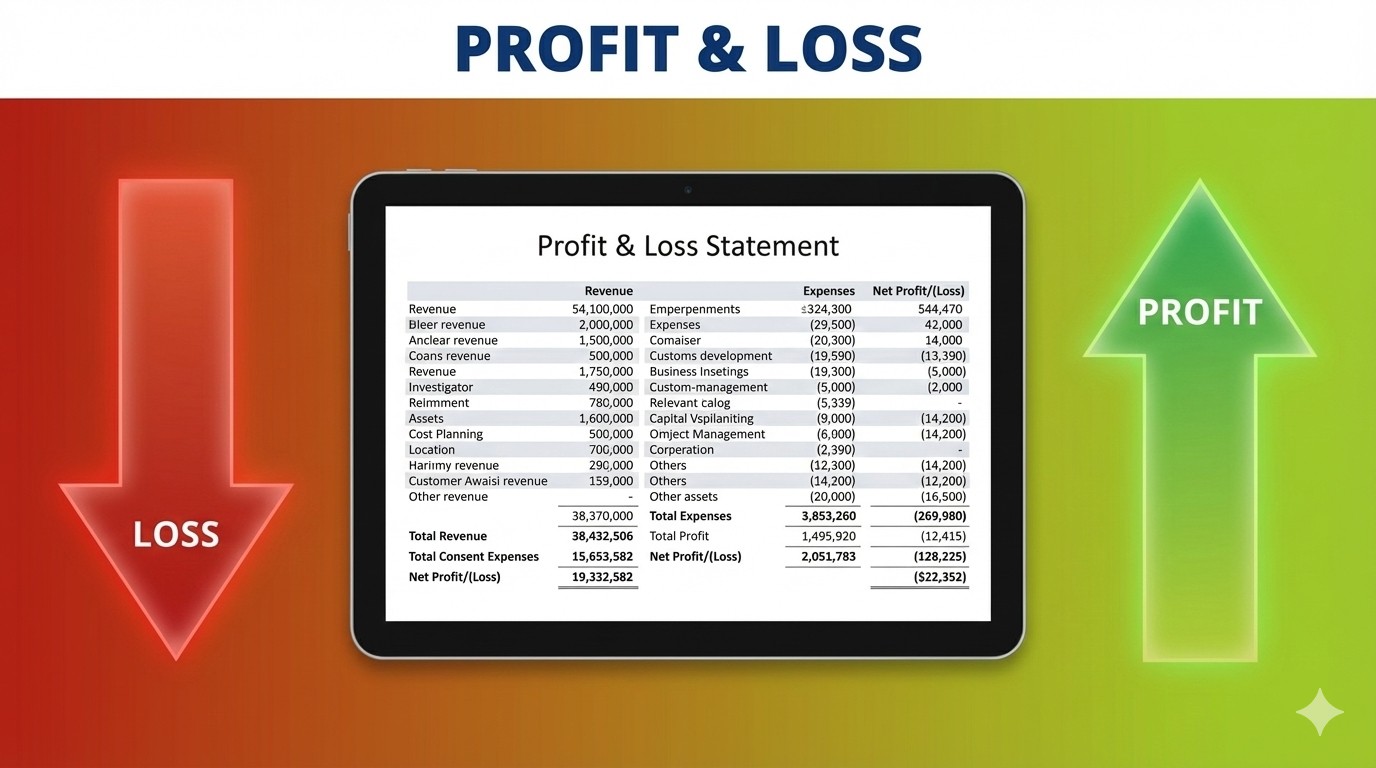
The P&L Statement, or income statement, is a vital part of finance and a company’s financial performance. This is very useful when determining how profitable a company is; therefore, stakeholders use this information to make educated financial decisions. In this article, we will be explaining what is included in a Profit & Loss Statement and how it benefits business finance.
What is a Profit & Loss Statement?
A Profit & Loss Statement often abbreviated as P&L Statement is a financial document that summarizes a company's revenues, costs, and expenses during a specific period. It is a key part of a company's financial statements, alongside the balance sheet and cash flow statement, and provides a snapshot of a company's operational efficiency and profitability.
Key Components of a Profit & Loss Statement
Understanding the structure of a P&L Statement is essential for interpreting its data effectively. Here are its major components:
1. Revenue: The total income generated from normal business operations, often referred to as sales or turnover.
2. Cost of Goods Sold (COGS): Direct costs attributable to the production of the goods sold by a company. It includes raw materials and labour used in production.
3. Gross Profit: Calculated as revenue minus COGS. It reflects the efficiency of production and sales processes.
4. Operating Expenses: Expenses that are not directly tied to production. They include rent, utilities, salaries, and marketing expenses.
5. Operating Income: Also known as operating profit or EBIT (Earnings Before Interest and Taxes), it is calculated as gross profit minus operating expenses.
6. Net Income: The bottom line of a P&L Statement, representing the total profit or loss after all expenses, taxes, and interest have been deducted from total revenue.
Importance of a Profit & Loss Statement
Understanding a P&L Statement is crucial for business owners, investors, and stakeholders. Here are several reasons why it is important:
1. Financial Health Assessment: The P&L Statement offers insights into the company's profitability and can highlight trends over time.
2. Decision-Making: By analysing different income and expense components, management can make informed strategic decisions.
3. Investor Attraction: Investors and creditors often rely on P&L statements to evaluate the company's performance and growth potential.
4. Regulatory Compliance: Regularly prepared P&L Statements are a requirement for publicly traded companies to remain compliant with financial reporting regulations.
How to Analyse a Profit & Loss Statement
Analysing a P&L Statement involves evaluating various ratios and metrics that can provide deeper insights into a company's financial health:
1. Gross Margin: This ratio, calculated as gross profit divided by revenue, measures how efficiently a company uses its resources in production.
2. Operating Margin: An indicator of the company's operational efficiency, calculated as operating income divided by total revenue.
3. Net Profit Margin: Indicates the overall profitability of a company, calculated as net income divided by total revenue.
4. Year-Over-Year Comparison: Evaluating changes in revenues and expenses over different periods can highlight growth trends and potential issues.
Recent Developments and Trends
Recent trends indicate a shift towards more detailed and segmented reporting within Profit & Loss Statements, fuelled by the rise of data analytics and digital technologies. Companies are now integrating more non-financial metrics and advanced forecasting techniques to provide a comprehensive view of future performance potentials. Furthermore, the increased emphasis on environmental, social, and governance (ESG) factors necessitates the inclusion of related expenses and impacts in financial reporting.
Best Practices for Managing Profit & Loss Statements
Ensuring accuracy and reliability in P&L Statements is fundamental. Here are some best practices:
1. Regular Updates: Consistently updating the P&L Statement ensures it remains a relevant tool for decision-making.
2. Detailed Segmentation: Breaking down revenue and expenses into more detailed categories can provide better insights.
3. Technology Integration: Utilize accounting software to automate data gathering and report generation to minimize errors and improve accuracy.
4. Professional Audits: Regular audits by financial professionals can ensure the credibility of a P&L Statement.
Conclusion
All businesses must maintain and understand the components of their Profit & Loss Statement to assess the company’s financial situation. It will help you understand what has occurred in your Profit & Loss Statement to help you identify where to take your business to achieve sustained growth. If you want to grow your company at a rapid pace then you must know how to read and interpret the Profit & Loss Statement because it is an integral part of being a successful investor or entrepreneur.