




VAIRAVAN K
Updated on
30-07-2026
Excise Tax in UAE: A Complete Business Guide
If you run a business in the UAE that deals with tobacco, energy drinks, or sugary beverages, excise tax is something you cannot afford to ignore. Introduced by the UAE federal government in 2017, excise tax is a form of indirect tax levied on specific goods that are considered harmful to human health or the environment. Unlike VAT, which applies broadly across most goods and services, excise tax is narrow and targeted. But what it lacks in scope, it more than makes up for in rate.
Here is a clear, no-nonsense breakdown of how excise tax works in the UAE and what it means for your business.
What Is Excise Tax?
Excise tax in the UAE is governed by Federal Decree-Law No. 7 of 2017. It is administered by the Federal Tax Authority (FTA) and applies to goods at the point of production, import, or release from a designated zone. The core idea is simple: the government taxes goods that have a social or health cost, making them more expensive and discouraging excessive consumption.
The tax is ultimately passed on to the end consumer through higher prices, but the legal obligation to register, report, and pay the tax lies with businesses in the supply chain.
Which Goods Are Subject to Excise Tax?
The UAE applies excise tax to the following categories:
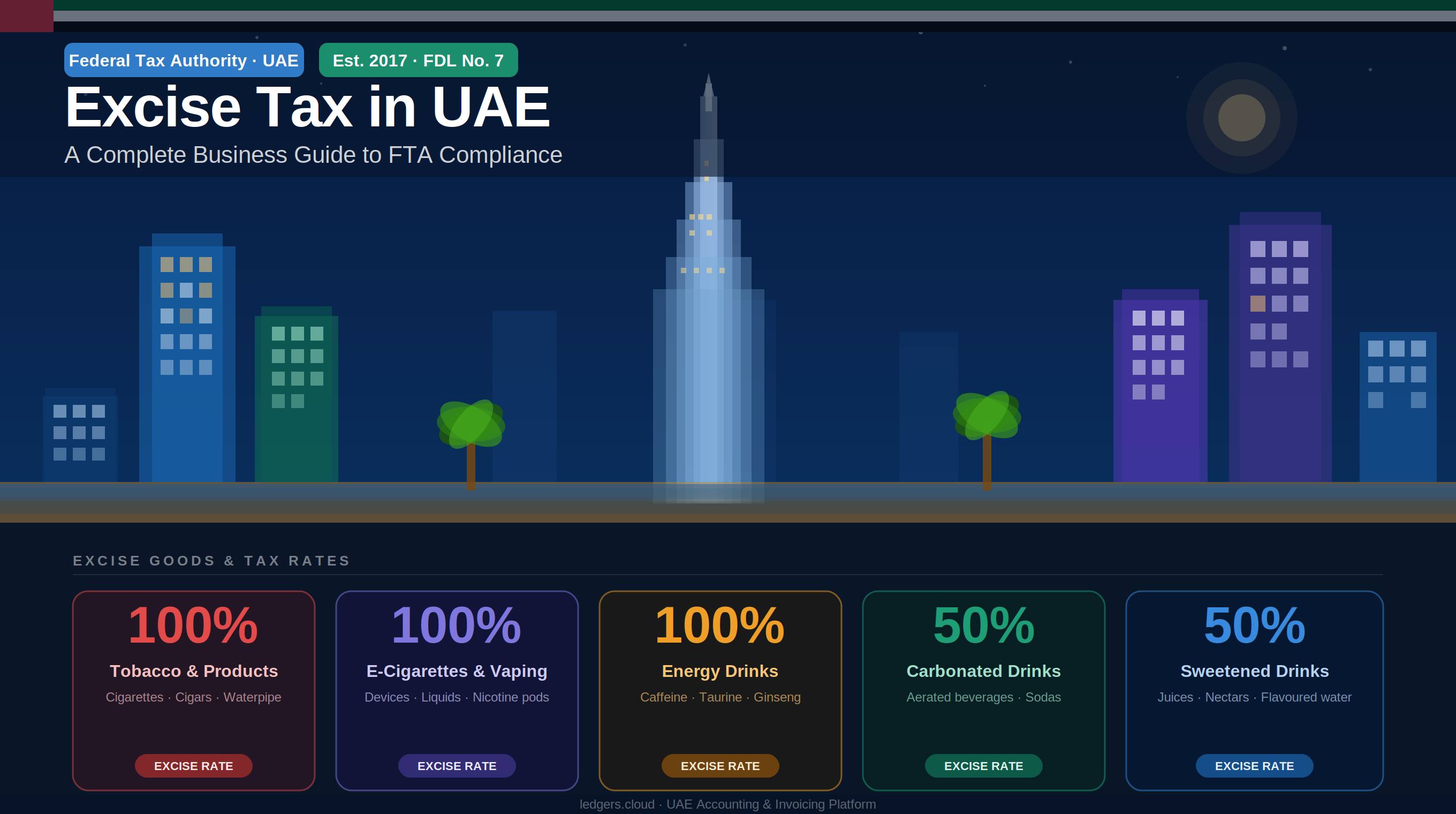
Tobacco and tobacco products — taxed at 100% of the retail selling price. This includes cigarettes, cigars, waterpipe tobacco, and electronic cigarettes.
Electronic smoking devices and liquids — also taxed at 100%. This covers vaping devices, e-cigarettes, and the liquids used in them, regardless of whether they contain nicotine.
Energy drinks — taxed at 100%. Any beverage that contains stimulants such as caffeine, taurine, ginseng, or similar substances falls under this category.
Carbonated drinks — taxed at 50%. This includes any aerated beverage except for unflavoured sparkling water.
Sweetened drinks — taxed at 50%. This applies to any beverage with added sugar or other sweeteners, including ready-to-drink juices, nectars, flavoured water, and concentrated drinks.
It is worth noting that some products may fall under multiple categories. In that case, the higher rate applies.
Who Needs to Register for Excise Tax?
Not every business in the UAE needs to deal with excise tax. Registration is mandatory if your business is involved in any of the following activities related to excise goods:
- Importing excise goods into the UAE
- Producing excise goods within the UAE
- Releasing excise goods from a designated zone
- Stockpiling excise goods for business purposes (in some cases)
If you are a retailer who simply buys excise goods from a registered importer or producer, the excise tax would already have been paid upstream. However, if you are importing directly, even for your own retail use, you are required to register.
Registration is done through the FTA's EmaraTax portal. There is no minimum threshold for excise tax unlike VAT, which has a registration threshold of AED 375,000. You must register before you begin any taxable activity.
How Is Excise Tax Calculated?
The tax is calculated based on the higher of two values: the published retail selling price (as listed with the FTA) or the standard price set by the FTA itself. This prevents businesses from artificially lowering the declared retail price to reduce their tax liability.
For example, if a pack of cigarettes has a standard price of AED 20, the excise tax at 100% would be AED 20. If the actual retail price is AED 25, the tax is calculated on AED 25. The FTA publishes and maintains a price list for registered excise goods.
Filing and Payment
Excise tax returns must be filed monthly through the EmaraTax portal. The return covers all taxable activity during the month, including imports, local production, and any stock releases. Payment is due on the 15th of the month following the tax period.
Failing to file on time or underpaying can attract penalties. The FTA takes compliance seriously, and businesses have faced fines for late registration, late filing, and incorrect declarations.
Excise Tax and Designated Zones
The UAE has specific designated zones, typically free zones with strict customs controls, where excise goods can be stored without immediate tax liability. Excise tax becomes payable only when goods leave the designated zone and enter the UAE mainland market. This is particularly relevant for businesses that warehouse goods in free zones before distribution.
Keeping Your Records in Order
One of the less glamorous but critically important aspects of excise tax compliance is documentation. Businesses are required to maintain records of all excise goods imported, produced, or sold, along with supporting invoices, customs documents, and tax calculations, for at least five years.
This is where having the right invoicing and accounting software makes a real difference. If your business operates in the UAE and deals with excise goods, using a purpose-built tool that handles UAE tax requirements can save you hours of manual reconciliation. Platforms like Ledgers are built to handle UAE invoicing and compliance workflows, keeping your records clean and your filings accurate.
Common Misconceptions
"Only large companies need to worry about excise tax." Not true. Even a small importer of energy drinks or vaping products is required to register and comply.
"Excise tax and VAT are the same." They are not. VAT is charged at the point of sale to the consumer. Excise tax is charged earlier in the supply chain, at the point of import or production. Both can apply to the same product.
"If I sell to a retailer, it is their problem." Also not true. If you are the importer or producer, the legal liability sits with you.
Final Thoughts
Excise tax in the UAE is a targeted, high-rate tax designed to reduce consumption of harmful goods while generating government revenue. For businesses in the affected categories, compliance is non-negotiable. Understanding when tax is due, how it is calculated, and what records you need to maintain is the foundation of staying on the right side of the FTA.
The good news is that with clear processes and the right tools in place, managing excise tax does not have to be painful. Stay registered, file on time, and keep your documentation tight.