




VAIRAVAN K
Updated on
12-06-2026
The Financial Statements Every Small Business Owner Needs to Understand
Being an entrepreneur is great, no doubt about that; however, the finances part of entrepreneurship can seem overwhelming. From customer management to vendor payments and maintaining a happy team, analyzing your financial statements often becomes the lowest priority task of your daily routine. However, the sad reality is that for any entrepreneur who hopes for growth, understanding the financials should become one of the top priorities. Here, we explain everything you ever wanted to know about finance, but didn't dare to ask. In other words, this manual will make sure you understand your financial statements when walking into your next accountant's office or checking the data on ledgers.cloud dashboard.
What Are Financial Statements?
Financial statements refer to formal accounting statements that document your business financial transactions. You can consider them as report cards for your business. Financial statements show the amounts of income generated, the expenditures incurred, assets owned, and liabilities owed. Every small business owner should be familiar with three major financial statements: the Income Statement (Profit and Loss Statement), Balance Sheet, and Cash Flow Statement. Each financial statement provides an insight into one aspect of the same situation.
1. The Profit and Loss Statement (P&L)
Also called the Income Statement, the P&L is probably the one you already check most often. It summarizes your revenue and expenses over a specific period, typically a month, quarter, or year.
Here is what it includes:
Revenue is the total money your business earned from sales or services. This is your top line.
Cost of Goods Sold (COGS) covers the direct costs of producing what you sell, like raw materials or manufacturing labor.
Gross Profit is Revenue minus COGS. It tells you how efficiently you are producing or delivering your product.
Operating Expenses include everything else: rent, salaries, marketing, software subscriptions, and more.
Net Profit (or Net Loss) is what remains after all expenses are subtracted. This is your bottom line.
Where your income looks good but your bottom line shows very little, your income statement will reveal precisely how your dollars are being lost. This is an extremely helpful insight when trying to grow.
2. The Balance Sheet
While the P&L tells you how your business performed over time, the Balance Sheet gives you a snapshot of where things stand at a specific moment. It is built on a simple equation:
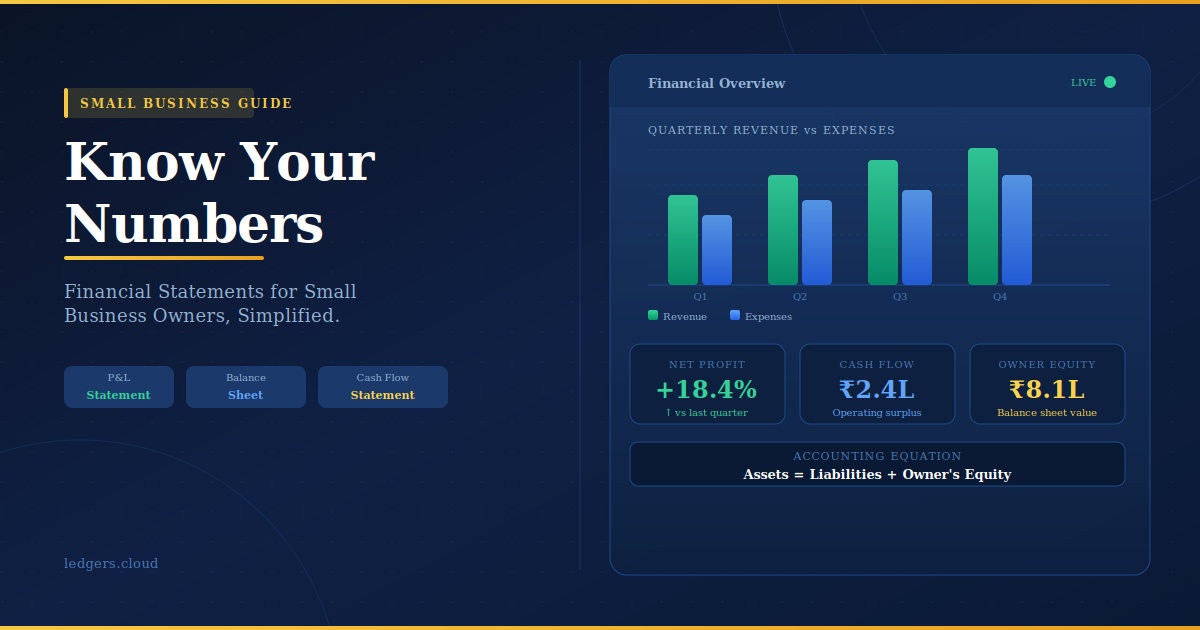
Assets = Liabilities + Owner's Equity
Assets are everything your business owns, from cash in the bank to equipment, inventory, and accounts receivable (money owed to you by customers).
Liabilities are everything your business owes, such as loans, credit card balances, and accounts payable (money you owe to suppliers).
Owner's Equity is what is left after you subtract liabilities from assets. It represents the net worth of your business and reflects your investment plus any retained earnings over time.
A healthy balance sheet shows growing equity, manageable debt, and enough liquid assets to cover near-term obligations. If liabilities are consistently outpacing assets, that is a red flag worth addressing early.
3. The Cash Flow Statement
Here is one that surprises a lot of new business owners: you can be profitable on paper and still run out of cash. That is why the Cash Flow Statement matters so much.
This statement tracks the actual movement of money in and out of your business, broken into three sections:
Operating Activities show cash generated from your core business operations, like collecting payments from customers and paying suppliers.
Investing Activities cover cash spent or received from buying or selling assets, like equipment or property.
Financing Activities reflect borrowing, repaying loans, or bringing in investors.
A positive operating cash flow means your business is generating real money from its day-to-day work. Negative cash flow from operations, even with high revenue, usually signals a problem with how quickly you are collecting payments or how much working capital is tied up in inventory.
Why These Three Statements Work Together
One sentence doesn’t give you the full story. Profit & Loss gives you information about profitability, Balance Sheet provides information about financial standing, and Cash Flow Statement reveals liquidity. All three help you to answer the crucial questions like: am I able to hire a person? Should I accept this new order? Is there a need for a line of credit?
By analyzing all these documents together, one can easily see where the problem lies. For example, an organization may have excellent profitability but worsening cash flows, which indicate late payments by customers and overstocked inventories.
Making Financial Statements Work for You
The biggest oversight small business owners have is considering the use of financial statements as something that only the accountant can deal with. In reality, financial statements can be seen as your most important management tool.
Make sure you analyze your finances once a month, looking for certain trends. For example, is the gross margin increasing or decreasing? Are expenses outpacing income growth? Or does cash flow become more difficult despite rising revenues?
The use of financial reporting platforms such as ledgers will help you automate your accounting and analyze your finances on the spot. It will keep all your financial data neat and up-to-date for GST purposes. Clean data equals clear information from your financial reports.
Final Thoughts
An accounting background is not necessary to understand financial statements. You simply need to understand what each statement says and why it is important. P&L shows performance, Balance Sheet indicates health, and Cash Flow Statement is used to analyze liquidity. These are the three pillars on which all intelligent business decisions rest.
Start by learning to read them every day, asking questions if figures seem wrong, and using software to ease the process. Your future self - the one who has built the business but did not run out of money along the way – will thank you for it.