




VAIRAVAN K
Updated on
30-07-2026
How to Prepare and Read a Balance Sheet: A Complete Guide for Businesses
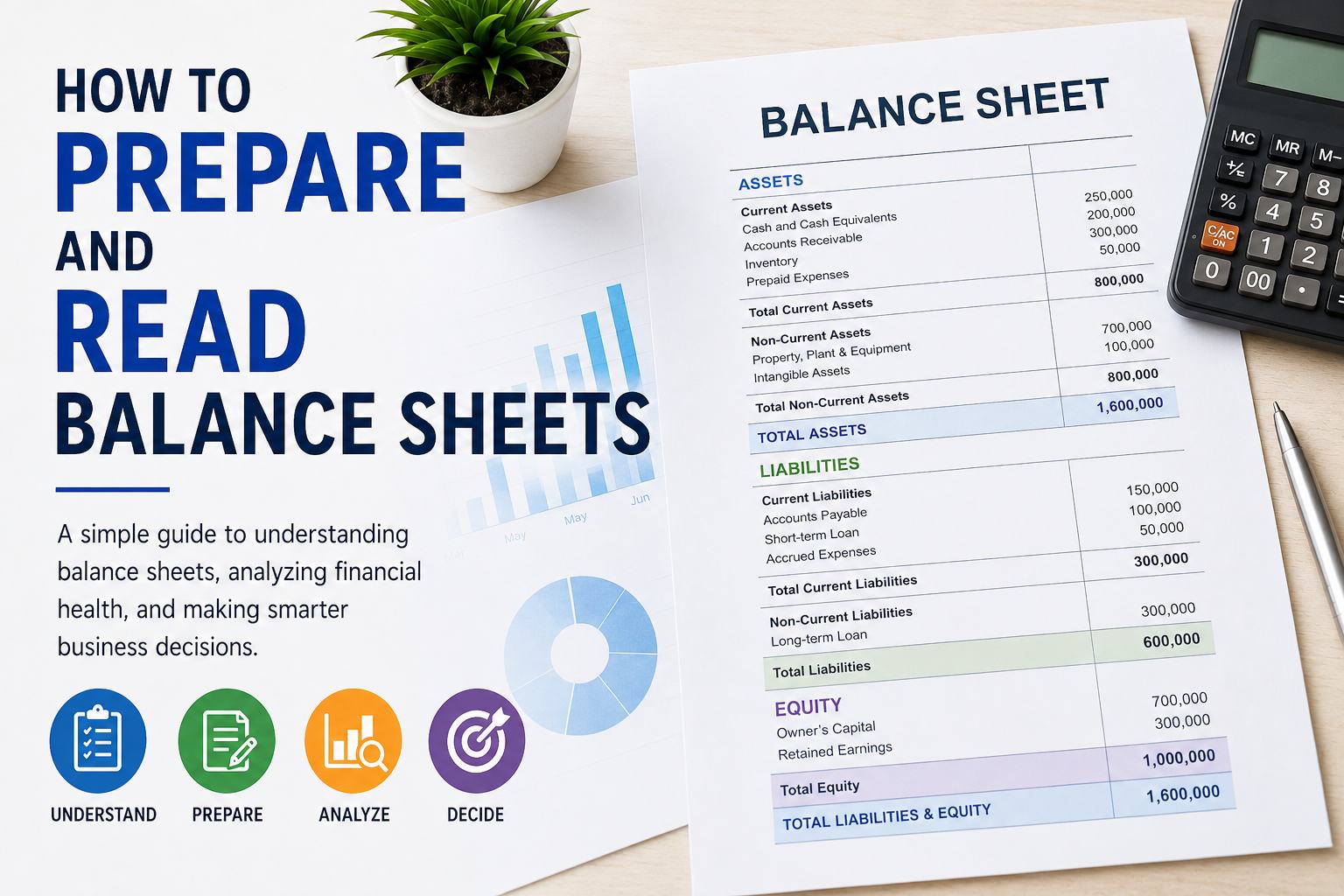
A balance sheet is one of the most important financial statements for any business. It provides a snapshot of a company's financial position at a specific point in time by showing what the business owns, what it owes, and the value left for its owners. Whether you are a startup founder, small business owner, accountant, or investor, understanding how to prepare and read a balance sheet is essential for making informed financial decisions.
In this guide, we will explain the fundamentals of balance sheets, how to prepare one, and how to interpret the information it contains.
What Is a Balance Sheet?
A balance sheet is a financial statement that summarizes a company's assets, liabilities, and equity on a particular date. It follows a simple accounting equation:
Assets = Liabilities + Equity
This equation ensures that the balance sheet always remains balanced. Every transaction recorded by a business affects at least two accounts, maintaining the integrity of this equation.
The balance sheet helps stakeholders understand the financial health of a business and evaluate its ability to meet short term and long term obligations.
Why Is a Balance Sheet Important?
A balance sheet serves several important purposes:
- Shows the financial strength of a business
- Helps evaluate liquidity and solvency
- Assists in obtaining loans and investments
- Supports strategic business planning
- Provides insights into asset management
- Helps monitor debt levels and owner equity
Investors, lenders, business owners, and management teams often rely on balance sheets when making financial decisions.
Components of a Balance Sheet
A balance sheet consists of three main sections:
1. Assets
Assets represent everything a business owns that has economic value.
Current Assets
Current assets are expected to be converted into cash or used within one year.
Examples include:
- Cash and cash equivalents
- Accounts receivable
- Inventory
- Prepaid expenses
- Short term investments
Non Current Assets
These are long term resources used in business operations.
Examples include:
- Property and buildings
- Machinery and equipment
- Vehicles
- Furniture
- Intangible assets such as trademarks and software
2. Liabilities
Liabilities are the obligations a business owes to others.
Current Liabilities
These are debts due within one year.
Examples include:
- Accounts payable
- Short term loans
- Accrued expenses
- Tax liabilities
Non Current Liabilities
These are obligations payable beyond one year.
Examples include:
- Long term loans
- Mortgage obligations
- Deferred tax liabilities
3. Equity
Equity represents the owner's claim on the business after liabilities are deducted from assets.
Examples include:
- Owner's capital
- Retained earnings
- Additional paid in capital
- Reserves
Equity reflects the net worth of the business.
How to Prepare a Balance Sheet
Preparing a balance sheet becomes easier when you follow a structured process.
Step 1: Gather Financial Information
Collect all relevant financial records, including:
- Bank statements
- Sales records
- Purchase invoices
- Loan documents
- Asset registers
- Expense reports
Accurate data is critical for creating a reliable balance sheet.
Step 2: List All Assets
Record every asset owned by the business and categorize them into current and non current assets.
For example:
Current Assets
- Cash: ₹2,00,000
- Accounts Receivable: ₹1,50,000
- Inventory: ₹3,00,000
Total Current Assets: ₹6,50,000
Non Current Assets
- Equipment: ₹4,00,000
- Furniture: ₹1,00,000
Total Non Current Assets: ₹5,00,000
Total Assets: ₹11,50,000
Step 3: Record All Liabilities
List all financial obligations.
Current Liabilities
- Accounts Payable: ₹1,00,000
- Tax Payable: ₹50,000
Total Current Liabilities: ₹1,50,000
Non Current Liabilities
- Bank Loan: ₹3,00,000
Total Liabilities: ₹4,50,000
Step 4: Calculate Equity
Apply the accounting equation:
Equity = Total Assets − Total Liabilities
₹11,50,000 − ₹4,50,000 = ₹7,00,000
Step 5: Verify the Balance
Ensure:
Assets = Liabilities + Equity
₹11,50,000 = ₹4,50,000 + ₹7,00,000
The balance sheet is complete only when both sides are equal.
How to Read a Balance Sheet
Creating a balance sheet is only half the process. Understanding what the numbers mean is equally important.
Analyze Liquidity
Liquidity measures a company's ability to pay short term obligations.
Compare current assets with current liabilities.
If current assets significantly exceed current liabilities, the business generally has a healthy liquidity position.
Review Debt Levels
Examine the ratio of liabilities to equity.
A business with excessive debt may face financial risks during economic downturns.
A balanced debt structure often indicates better financial stability.
Assess Asset Utilization
Review how assets are distributed.
Businesses with large investments in productive assets such as machinery and technology may have stronger growth potential.
Evaluate Equity Growth
Increasing equity over time usually indicates profitability and business growth.
Consistent retained earnings show that a company is generating value and reinvesting profits effectively.
Compare Over Multiple Periods
A single balance sheet provides a snapshot, but comparing balance sheets across months or years reveals trends.
Look for:
- Growth in assets
- Reduction in liabilities
- Improved equity
- Better working capital
Trend analysis helps business owners make smarter decisions.
Common Mistakes to Avoid
Many businesses make errors while preparing or interpreting balance sheets.
Some common mistakes include:
- Omitting liabilities
- Incorrect asset valuation
- Not recording depreciation
- Misclassifying current and non current items
- Failing to reconcile accounts
- Ignoring balance sheet trends
Regular reviews and proper accounting practices help prevent these issues.
Benefits of Using Accounting Software for Balance Sheets
Modern accounting software simplifies balance sheet preparation by automatically recording transactions and generating financial statements.
Benefits include:
- Real time financial reporting
- Improved accuracy
- Faster reconciliation
- Automated calculations
- Better compliance and audit readiness
Businesses can save time while gaining deeper visibility into their financial performance.
Final Thoughts
A balance sheet is much more than a financial report. It is a powerful tool that reveals the true financial position of a business. By understanding how to prepare and read a balance sheet, business owners can make informed decisions, manage cash flow effectively, reduce financial risks, and plan for future growth.
For businesses looking to simplify accounting and generate accurate balance sheets effortlessly, Ledgers offers a modern cloud-based accounting solution. With automated bookkeeping, real time financial reporting, and comprehensive accounting tools, businesses can maintain accurate records and access financial statements whenever needed. Learn more about balance sheet management and accounting automation at https://ledgers.cloud and take control of your business finances with confidence.