
MONISHA D
Updated on 30-07-2026
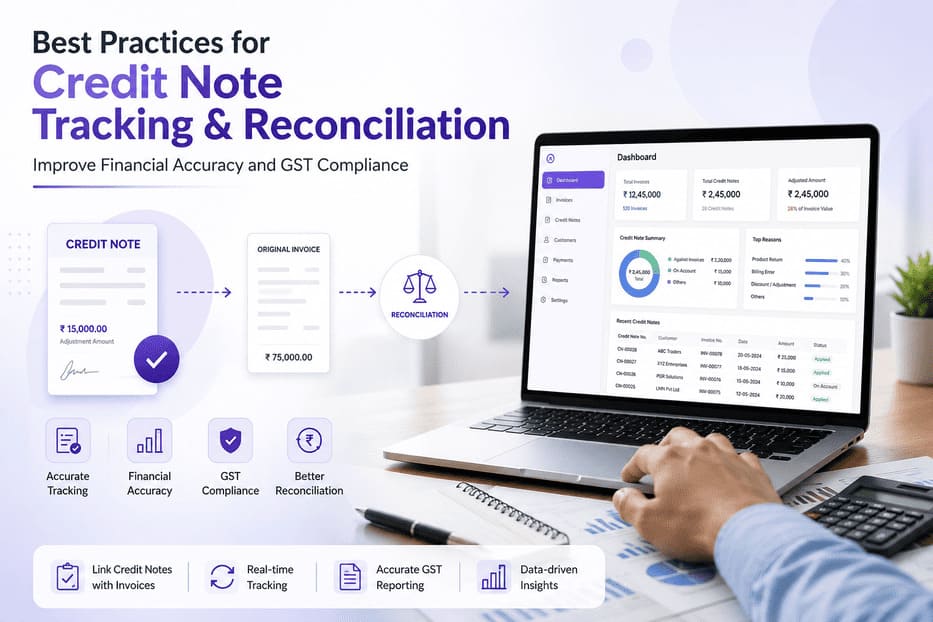
Credit notes play a critical role in maintaining accurate financial records and ensuring GST compliance. Businesses frequently issue credit notes to correct invoice errors, account for returned goods, provide post-sale discounts, or adjust billing discrepancies. While creating a credit note is important, properly tracking and reconciling credit notes is equally essential for maintaining financial accuracy and avoiding compliance issues.
Many businesses struggle with credit note management because credit notes impact invoices, customer balances, tax calculations, accounts receivable, and GST reporting. Without proper tracking and reconciliation processes, businesses may face accounting mismatches, incorrect tax filings, and customer disputes.
Modern accounting platforms such as LEDGERS help businesses manage credit notes, reconcile transactions, maintain GST compliance, and automate accounting processes through a centralized system.
This guide explains the importance of credit note tracking, common challenges businesses face, and best practices for effective credit note reconciliation.
A credit note is a document issued by a seller to reduce the amount payable on an already issued invoice. It serves as an official adjustment against a previously generated invoice.
Businesses issue credit notes for several reasons, including:
Credit notes help maintain transparency between buyers and sellers while ensuring accounting records remain accurate.
Credit notes directly affect business finances, tax calculations, and customer account balances. Proper tracking ensures that all adjustments are reflected accurately across accounting and compliance systems.
Credit notes reduce outstanding invoice amounts and help maintain correct customer receivable balances.
Credit notes must be properly reported in GST returns to ensure accurate tax calculations and adjustments.
Tracking helps prevent multiple credit notes from being issued for the same transaction.
Accurate credit note records ensure that revenue and tax reports reflect the correct values.
Properly documented credit notes make audits and compliance reviews easier.
Understanding when to issue a credit note is essential for maintaining accurate records.
Customers may return goods due to quality issues, incorrect delivery, or other valid reasons.
Mistakes in pricing, quantity, or tax calculations may require invoice adjustments.
Additional discounts offered after invoice generation can be adjusted through credit notes.
Changes in service scope or cancellations may require invoice value reductions.
Businesses may issue credit notes when customers receive damaged products.
Under GST regulations, businesses must properly account for credit notes in their GST returns.
Credit notes impact:
Incorrect handling of credit notes can result in:
Businesses should ensure that all credit notes are properly linked to the original invoices and reported accurately.
Credit note reconciliation is the process of matching issued credit notes with invoices, customer accounts, accounting records, and GST reports.
Reconciliation helps businesses:
Without reconciliation, businesses may face discrepancies between accounting records and actual transactions.
Following structured processes can significantly improve credit note management.
Every credit note should include:
Complete documentation helps maintain transparency and simplifies audits.
Each credit note should be associated with the relevant invoice.
This helps businesses:
Modern software solutions automatically link credit notes with invoices.
Businesses should record credit notes immediately after issuance.
Real-time tracking helps:
Cloud-based accounting software provides real-time visibility into credit note activity.
Businesses should perform reconciliation monthly rather than waiting until year-end.
Regular reconciliation helps identify:
Frequent reviews reduce compliance risks and accounting errors.
Credit notes impact GST calculations and tax liability.
Businesses should verify:
Accurate tax reconciliation helps avoid filing issues.
Credit notes reduce receivable amounts and can affect customer account statements.
Businesses should regularly review:
This improves receivables management and customer communication.
Credit notes influence several financial statements and reports.
Credit notes reduce reported sales revenue.
Outstanding customer balances decrease when credit notes are applied.
GST liability may be adjusted based on issued credit notes.
Accurate credit note recording helps generate reliable profitability reports.
Businesses should ensure all reports reflect credit note adjustments correctly.
Many businesses face operational difficulties when managing credit notes manually.
Credit notes without invoice references create reconciliation problems.
Issuing multiple adjustments for the same transaction can affect financial accuracy.
Incorrect tax adjustments may cause return mismatches.
Spreadsheet-based tracking increases the risk of errors.
Postponing reconciliation often leads to larger discrepancies later.
Automation significantly improves credit note tracking and reconciliation.
Key benefits include:
Credit notes can be generated and applied quickly.
Automated calculations reduce manual errors.
Businesses can monitor credit note activity in real time.
Tax calculations and adjustments are handled accurately.
Invoices, payments, and credit notes are automatically linked.
LEDGERS Credit Note Management Solution helps businesses manage invoice adjustments and reconciliation efficiently.
Key capabilities include:
These features help businesses maintain accurate records while reducing manual effort.
Credit notes work most effectively when integrated with invoice management systems.
Businesses using LEDGERS Invoice Software can:
Integrated workflows reduce operational complexity and improve data consistency.
Businesses should establish internal controls for credit note issuance and approval.
Recommended controls include:
Strong controls help prevent misuse and improve financial governance.
Accounting systems are becoming increasingly automated and intelligent.
Future developments may include:
Businesses adopting modern accounting platforms today will be better prepared for future compliance requirements.
Credit notes are an essential component of business accounting, customer relationship management, and GST compliance. Proper tracking and reconciliation help businesses maintain accurate financial records, avoid reporting errors, and ensure smooth compliance processes.
Manual credit note management often results in missed adjustments, reconciliation issues, and tax reporting challenges. Implementing structured tracking practices and automated systems can significantly improve accuracy and efficiency.
Solutions like LEDGERS help businesses simplify credit note management through automated tracking, invoice integration, GST-compliant adjustments, and real-time reconciliation capabilities.
By following best practices and leveraging modern accounting technology, businesses can improve financial accuracy, strengthen compliance, and maintain better control over invoice adjustments and customer balances.
