




HARI KRISHNAN S
Updated on
30-07-2026
Employee Exit Management in HRMS: A Complete Guide
Introduction
Employee There are emissions an inevitable part of any organization's lifecycle. Either voluntarily or involuntarily, how a company Ready the departure of its workforce They declare a great deal approx its culture, compliance maturity, and operational efficiency. Oh Human Resource Management Operates the system( HRMS). A pivotal role In equalization this process— Create assured nothing goes inaccurate. The cracks Maintain a respectable and legally valid off- boarding experience
What Is Employee Exit Management?
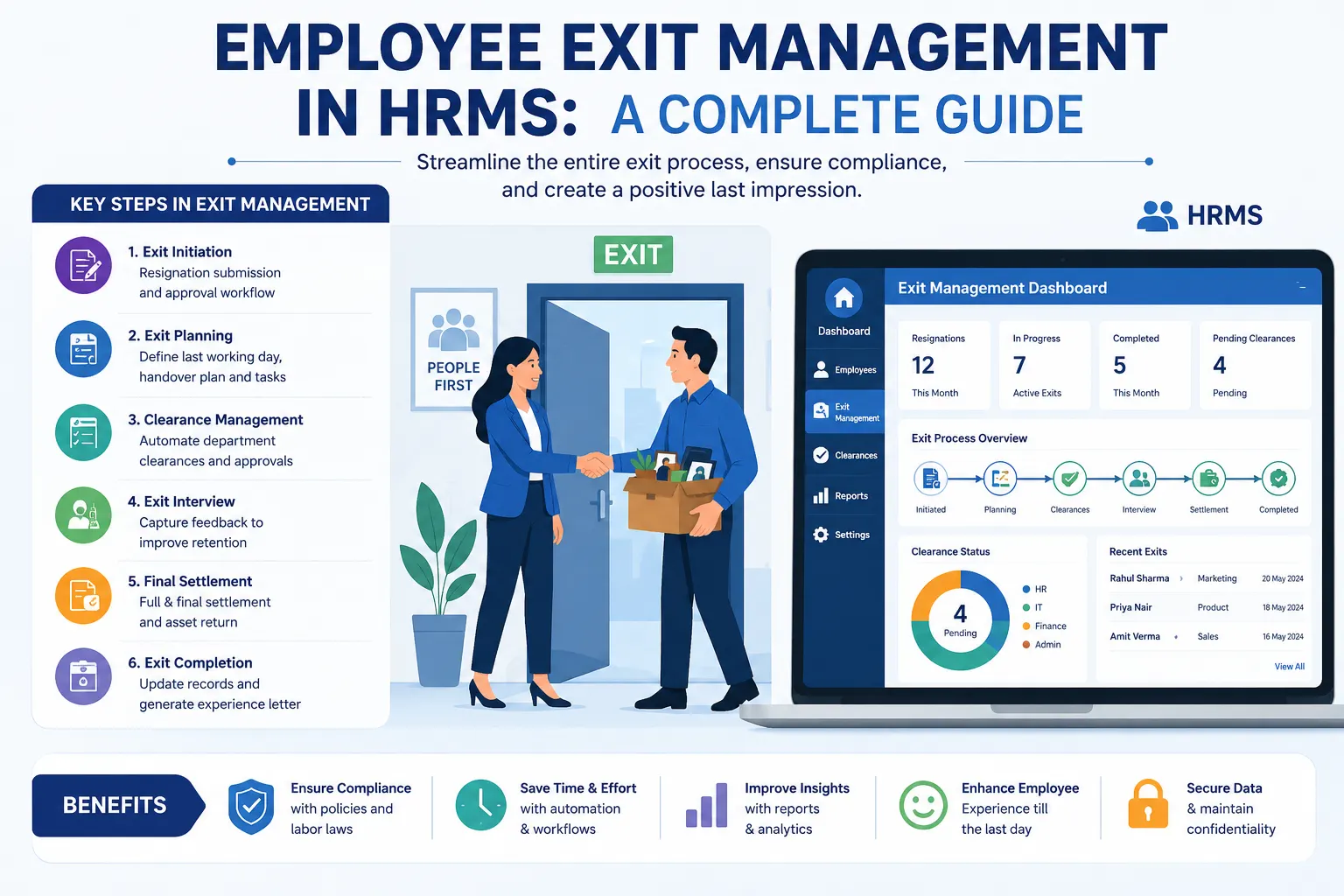
Employee exit management refers to the structured process of handling an employee's departure from an organization. It encompasses everything from the initial resignation or termination notice to the final settlement of dues, retrieval of company assets, and deactivation of system access.
In an HRMS, this is managed through a dedicated Exit Management Module — a centralized workflow that coordinates HR teams, department managers, IT, finance, and payroll to execute a smooth and compliant offboarding.
Types of Employee Exits
An HRMS typically supports multiple exit types, each with its own workflow:
- Voluntary Resignation — The employee initiates departure by submitting a resignation letter.
- Involuntary Termination — Initiated by the employer due to performance issues, misconduct, or redundancy.
- Retirement — Triggered when an employee reaches the defined retirement age or opts for voluntary retirement (VRS).
- End of Contract — For fixed-term employees whose engagement concludes at contract expiry.
- Absconding — When an employee stops reporting without formal notice.
- Death / Medical Exit — Rare but critical scenarios handled with sensitivity and proper documentation.
Key Features of an Exit Management Module in HRMS
1. Resignation Initiation and Approval Workflow
Employees can submit their resignation directly through the HRMS self-service portal. The system routes the request to the reporting manager and HR for acknowledgment. Managers can accept, reject, or negotiate the notice period — all tracked within the system with timestamps.
2. Notice Period Management
The HRMS calculates the applicable notice period based on the employee's grade, contract, or company policy. It tracks serving status, flags early releases, and handles notice period buyouts or waivers — ensuring compliance with employment contracts.
3. Exit Interview Scheduling
Structured exit interviews are crucial for capturing attrition insights. The HRMS can automate scheduling with HR personnel, send questionnaires, and store feedback for workforce analytics. This data helps identify patterns in turnover and improve retention strategies.
4. Full and Final (F&F) Settlement
One of the most critical components, F&F settlement involves calculating:
- Remaining salary and variable pay
- Leave encashment (earned/privilege leave balance)
- Gratuity (as per statutory eligibility)
- Deductions for notice period shortfall or asset recovery
- Reimbursement of pending expenses
The HRMS integrates with the payroll engine to auto-generate the F&F statement, minimizing manual errors and ensuring timely disbursement.
5. Asset Recovery and Checklist Management
A configurable exit checklist ensures systematic collection of company assets such as laptops, ID cards, access badges, and vehicles. Each checklist item is assigned to a responsible person — IT, Admin, Finance — and tracked to completion. The HR team receives a consolidated clearance status before processing final payment.
6. Access Revocation and IT Deprovisioning
Integration with IT systems (Active Directory, email, VPN, SaaS tools) allows the HRMS to trigger automated deactivation of digital access on the employee's last working day. This is critical from a data security standpoint and reduces dependency on manual IT tickets.
7. Document Generation
The HRMS auto-generates all exit-related documents including:
- Acceptance of resignation letter
- Experience / relieving certificate
- Service certificate
- NOC (No Objection Certificate)
- Form 16 and tax documents
These can be digitally signed and shared through the employee self-service portal.
8. Exit Analytics and Reporting
A robust HRMS provides HR leaders with attrition dashboards covering:
- Department-wise and role-wise turnover rates
- Reasons for exit (captured via exit interviews)
- Trends across tenure, age groups, and locations
- Comparison of voluntary vs. involuntary exits over time
Benefits of Managing Employee Exits Through HRMS
Operational Efficiency — Automated workflows eliminate manual follow-ups and paper-based processes, reducing the time-to-complete an exit from weeks to days.
Compliance and Audit Trail — Every action is logged with date, user, and status. This creates a comprehensive audit trail for legal and regulatory compliance.
Data Security — Timely revocation of access reduces the risk of data breaches from departing employees.
Employee Experience — Even in exit, a smooth, transparent, and dignified process leaves a positive impression — contributing to employer brand and alumni relations.
Payroll Accuracy — Deep integration with payroll ensures correct F&F calculations, reducing disputes and legal exposure.
Strategic Insights — Exit data feeds into HR analytics, helping leadership understand attrition drivers and proactively address retention risks.
Common Challenges and How HRMS Addresses Them
| Challenge | HRMS Solution |
|---|---|
| Delayed F&F settlements | Automated payroll integration and approval workflows |
| Incomplete asset recovery | Digital checklists with owner assignments and reminders |
| Security risks from active credentials | IT integration for automated access revocation |
| Inconsistent exit documentation | Template-driven document generation |
| Limited attrition insights | Exit interview analytics and dashboards |
| Manual notice period tracking | Auto-calculation based on policy and grade |
Best Practices for Employee Exit Management
- Start early — Initiate exit workflows as soon as a resignation is received, not on the last day.
- Standardize the checklist — Ensure every exit type has a defined, role-specific checklist.
- Conduct structured exit interviews — Qualitative feedback is as important as the F&F number.
- Communicate timelines clearly — Employees should know exactly when to expect their relieving letter and final payment.
- Train managers — Line managers play a key role in the exit process; equip them with HRMS access and clear responsibilities.
- Keep data confidential — Exit reasons and feedback must be handled with discretion.
Conclusion
Employee The exit scheme is much more than that. A formality— This is the final chapter of the employee lifecycle and a reflection Of organizational maturity. A well organized. HRMS Transforming what was once chaotic, manual process An organized, compliant, and even me humane experience. By automating workflows, ensure timely settlements, And by capturing meaningful output data, organizations not only protect themselves legally, but also create. A reputation Seam an employer Who respects its people— Even the way outside To invest in a robust HRMS exit module It just isn't a HR priority; This is a business imperative.