




VAIRAVAN K
Senior Developer
Updated on
23-02-2026
Invoice Automation and Payment Collection: How the Ledgers API Makes It Effortless
If you’ve ever chased down a client for payment, entered the same invoice information for the hundredth time, or stayed late to reconcile outstanding payments, then you already know the pain. Invoicing is one of those business functions that sounds easy but quietly sucks up hours every week. And for Indian SMBs, where GST compliance is an added complexity, the issue is even more acute.
The silver lining? Invoice automation is no longer the exclusive domain of large corporations. With the right API integrations, any business can automate the entire process of invoicing and payment receipt, from creating a GST-compliant invoice to recording the payment in the books, all without ever having to lay hands on a spreadsheet.
This is exactly what the Ledgers API is designed for.
What Is Invoice Automation, Really?
Invoice automation means using software to handle the repetitive, rule-based parts of invoicing — creating invoices, sending reminders, tracking payment status, and updating your accounts — without human intervention at every step.
It's not about removing people from the process. It's about removing the grunt work so your team can focus on things that actually need human judgment. Think: resolving disputes, nurturing client relationships, or identifying patterns in your cash flow.
Done right, invoice automation can cut invoice processing time by over 70%, reduce errors that come from manual data entry, and significantly improve how quickly you collect payments.
The Real Cost of Manual Invoicing
Before we talk about solutions, it's worth understanding what manual invoicing actually costs you. There's the obvious — time spent creating and sending invoices. But there's also the hidden cost of late payments. When invoices go out late, or follow-up reminders don't happen on schedule, payment cycles stretch out. For a business running on thin margins, a 15-day delay in collections can mean the difference between meeting payroll and scrambling for a short-term loan.
Manual processes also create reconciliation headaches. When a payment comes in, someone has to match it to an invoice, update the ledger, and mark the invoice as paid. If your invoicing tool and your accounting system don't talk to each other, that's double work — and double the chance of errors.
How the Ledgers API Solves This
The Ledgers API is designed to connect your business workflows directly to a robust accounting backend. Instead of your team jumping between tools, the API lets you build automated pipelines that handle the entire invoice-to-payment lifecycle.
Here's how that looks in practice.
Automated Invoice Creation
Using the Ledgers API, you can trigger invoice generation based on events in your own system. A project gets completed, a subscription renews, a delivery is confirmed — your application calls the API, and a GST-compliant invoice is created instantly, with all the right tax codes, line items, and customer details already populated. No manual entry, no formatting errors, no forgotten GSTIN fields.
Seamless Journal Entry Updates
One of the most time-consuming parts of payment collection is making sure your books reflect reality. Every invoice sent, every payment received, every credit note issued — each of these needs a corresponding journal entry. The Ledgers API handles this automatically. When an invoice is created or a payment is logged, the underlying double-entry accounting entries are created in real time. Your Chart of Accounts stays accurate without anyone manually keying in transactions.
Payment Status Tracking
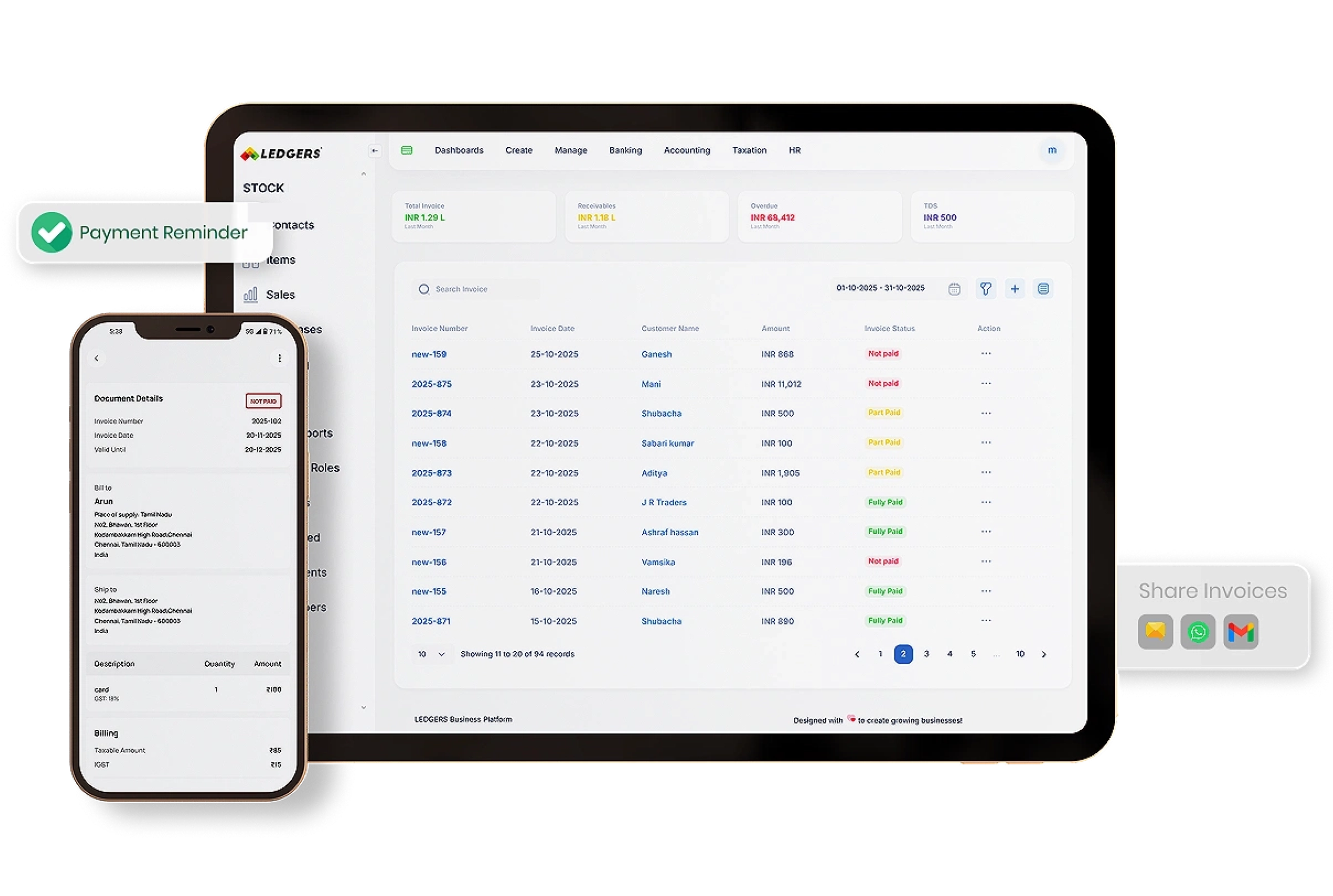
The API gives you programmatic access to invoice status — whether an invoice is pending, partially paid, or fully settled. You can build dashboards that show your collections team exactly where things stand, trigger automated payment reminder emails at defined intervals (say, at 7, 15, and 30 days overdue), and escalate to human follow-up only when the automated nudges haven't worked.
Multi-Channel Collection Workflows
Payment collection isn't one-size-fits-all. Some clients prefer bank transfers, others use UPI, and some still send cheques. The Ledgers API lets you log payments regardless of the channel and reconcile them against the right invoice. You get a clean audit trail, and your accounting stays tidy even when payments come in through different methods.
Real-Time Reporting and Cash Flow Visibility
Because everything — invoice creation, payment logging, and journal entries — flows through a single API, your financial reports are always up to date. You can pull receivables aging reports, outstanding invoice summaries, and collection efficiency metrics programmatically, without waiting for month-end closes or manual data exports.
Who Benefits Most?
The Ledgers API is particularly valuable for businesses that invoice at volume — SaaS companies, logistics providers, service agencies, and e-commerce platforms. If you're issuing more than 50 invoices a month and managing follow-ups manually, you're leaving efficiency on the table.
It's also a strong fit for businesses building internal finance tools or customer portals, where you want invoicing and payment collection to be part of a seamless user experience — not a separate process that requires your team to intervene.
Getting Started
The integration of the Ledgers API into your current infrastructure is easy. The API is RESTful, accepts standard JSON data, and has endpoints for creating invoices, making journal entries, logging payments, and viewing financial statements. It is easy to get started with the API, even for developers who are not accountants.
The larger change, to be honest, is not the technical implementation but the mentality of viewing the invoicing process as an automated financial pipeline as opposed to a manual administrative process.
The Bottom Line
Automating invoices is not a nicety. In a competitive market where cash flow is king, the companies that get paid faster and reconcile easier have a real-world advantage. The Ledgers API provides you with the tools to build such a system – one that hums in the background, keeping your books straight and your money flowing, while your team focuses on growing the business.
If you're still chasing down invoices manually, it's time to let the API do the chasing for you.