




VAIRAVAN K
Updated on
30-07-2026
GST eInvoicing: A Complete Guide for Modern Businesses
In the dynamic world of the digital age, it becomes essential for any business to comply with the rules in a very efficient manner. This is achieved through the GST e-invoice introduced by the Government of India. This is not only about complying with regulations but moving forward to become smart and efficient in doing so.
For any businessman or accountant, it becomes essential to understand the concept of the GST e-invoice.
What is GST eInvoicing?
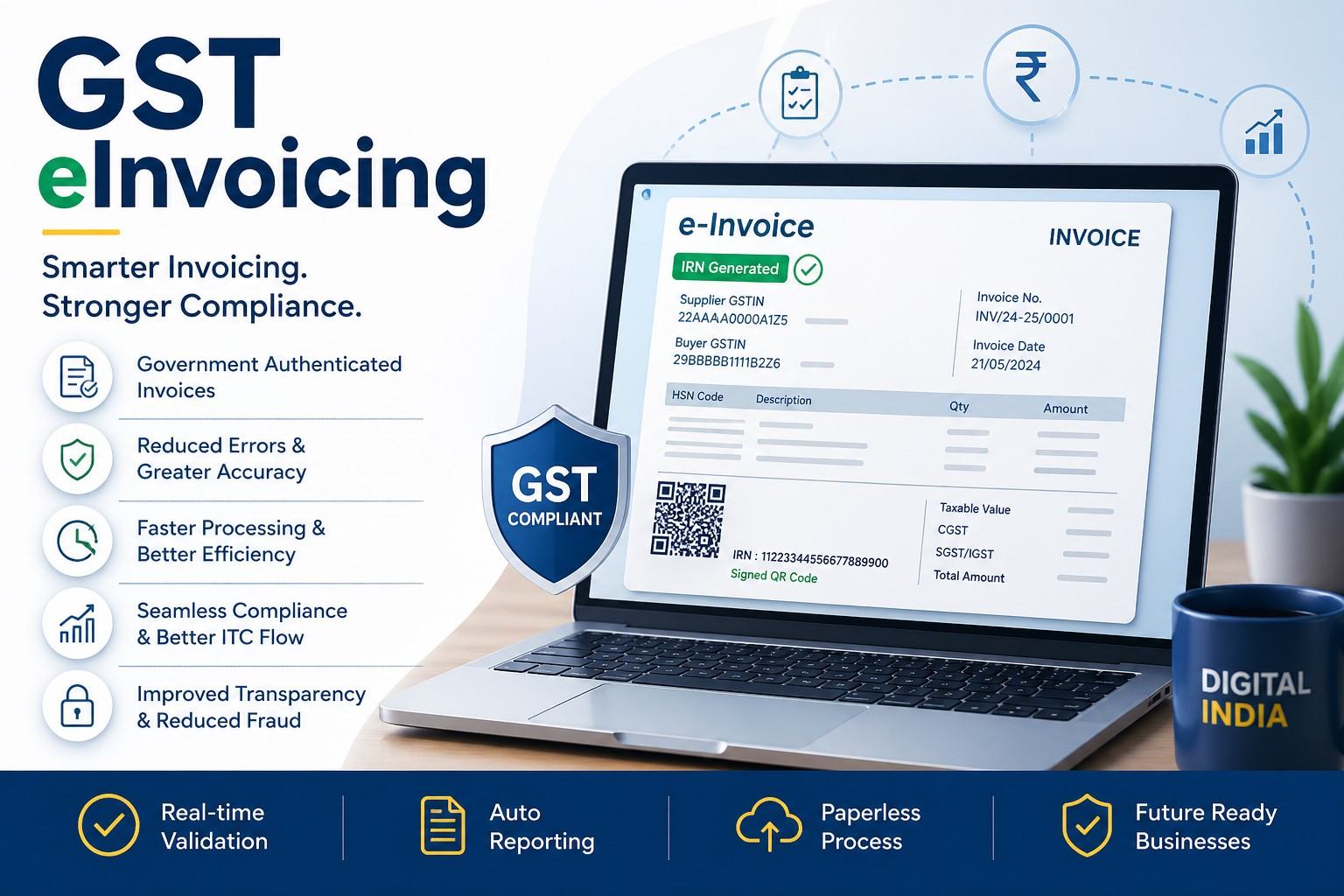
E-invoicing under GST refers to the process of having B2B invoices electronically authorized by the government prior to being sent to the buyers. Rather than manually preparing invoices and submitting them afterwards, businesses simply submit their invoices on a dedicated portal. This portal then verifies the information and assigns a unique number and QR code to each invoice.
This guarantees that all invoices are authentic and accounted for in real-time.
Why was eInvoicing introduced?
Before eInvoicing, businesses faced several challenges like manual errors, duplicate entries, and mismatched data during GST return filing. These issues often led to notices, penalties, and reconciliation problems.
The introduction of eInvoicing addresses these problems by:
- Standardizing invoice formats
- Reducing tax evasion
- Automating return filing processes
- Improving accuracy in Input Tax Credit claims
It brings consistency across industries and simplifies compliance for both buyers and sellers.
Who needs to comply with GST eInvoicing?
GST eInvoicing is mandatory for businesses whose turnover exceeds the threshold set by the government. Over time, this limit has been reduced to include more businesses under the system.
Currently, businesses with a turnover above the prescribed limit must generate eInvoices for all B2B transactions, exports, and certain other transactions. However, B2C invoices are not covered under this system.
It is important to regularly check eligibility because the threshold may change as the system expands.
How does GST eInvoicing work?
The process of eInvoicing is simple once you understand the flow:
- The business generates an invoice using its accounting or billing software
- The invoice data is uploaded to the Invoice Registration Portal
- The portal validates the information
- A unique Invoice Reference Number is generated
- A digitally signed QR code is added to the invoice
- The validated invoice is shared with the buyer
This entire process happens within seconds, making invoicing faster and more reliable.
Key components of an eInvoice
An eInvoice includes all standard invoice details along with a few additional elements:
- Supplier and buyer GSTIN
- Invoice number and date
- Item details with HSN codes
- Taxable value and GST amount
- Invoice Reference Number
- QR code for verification
The QR code allows quick validation of invoice details even without internet access, which adds an extra layer of transparency.
Benefits of GST eInvoicing
1. Reduced errors
Since invoice data is validated before finalization, the chances of mistakes are significantly lower.
2. Faster return filing
Data from eInvoices is automatically reflected in GST returns, reducing manual work.
3. Better Input Tax Credit flow
Buyers can claim Input Tax Credit easily because invoices are already verified.
4. Improved transparency
Every invoice is recorded in a central system, which reduces fraud and duplication.
5. Time-saving automation
Businesses can automate their invoicing and compliance processes, saving valuable time.
Challenges businesses may face
While eInvoicing brings many benefits, there can be a few initial challenges:
- Adapting to new software or systems
- Training staff to handle the new process
- Ensuring real-time invoice generation
- Integrating existing accounting tools with the portal
However, these challenges are temporary and can be easily managed with the right tools.
How to implement GST eInvoicing smoothly
To make the transition easier, businesses should:
- Use reliable accounting software that supports eInvoicing
- Automate invoice generation and submission
- Regularly update systems based on GST changes
- Train the accounting team properly
A smart invoicing platform can handle most of the technical work, allowing businesses to focus on operations.
You can explore a modern invoicing solution here: https://ledgers.cloud/in/invoice
Common mistakes to avoid
Even with automation, certain mistakes can lead to compliance issues:
- Generating invoices without IRN
- Entering incorrect GSTIN or invoice details
- Delayed reporting of invoices
- Not updating software with latest rules
Staying updated and using the right tools can help avoid these errors.
Future of GST eInvoicing
GST eInvoicing is expected to expand further in the coming years. The government aims to include more businesses and integrate systems more deeply with tax reporting.
This means businesses that adopt eInvoicing early will have a competitive advantage. They will be better prepared for future compliance requirements and digital transformations.
Final thoughts
GST eInvoicing is more than just a regulatory requirement. It is a step toward smarter accounting and efficient business operations. By reducing errors, improving transparency, and automating compliance, it helps businesses grow with confidence.
Adopting eInvoicing today ensures that your business stays compliant, efficient, and ready for the future.