




PUGALENTHI
Updated on
30-07-2026
Understanding ITC Eligibility Rules with Real Examples
In the realm of the Goods and Services Tax (GST) in India, the Input Tax Credit (ITC) is one of the cornerstone principles which provides a means for organizations to lessen their overall tax liability. ITC provides businesses with the opportunity to utilize input tax credits incurred in relation to items purchased (as well as services obtained), which are used in the course of their business activities (and/or that are consumable and/or that will form part of the final product), thereby minimizing the number of taxes that may be levied on a product.
Why is ITC Important for Businesses?
The primary advantage of ITC for businesses lies in its ability to reduce the tax payable on output supplies. By offsetting the GST paid on inputs against the GST collected on sales, businesses can significantly enhance their cash flow and profitability. Understanding ITC eligibility is crucial for leveraging this benefit while remaining compliant with the GST law.
Core Eligibility Conditions for Claiming ITC
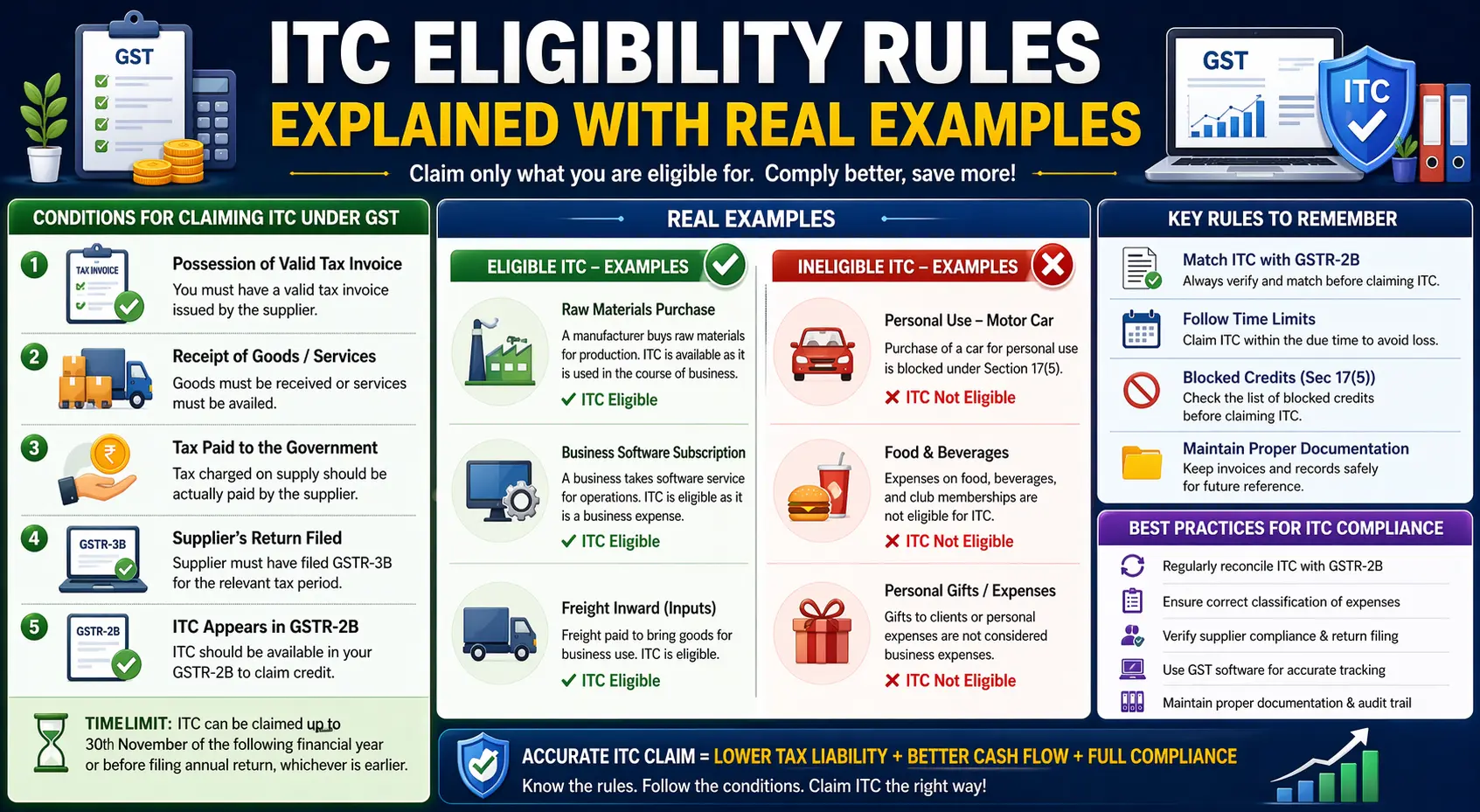
To claim ITC under GST, businesses must meet certain eligibility criteria:
- Possession of a Valid Tax Invoice: ITC can only be claimed if the registered taxpayer has a valid GST-compliant invoice issued by the supplier.
- Receipt of Goods/Services: The taxpayer must have received the goods or services for which the tax invoice is issued.
- Tax Payment by Supplier: The supplier must have paid the tax charged on the invoice to the government.
- Filing of GST Returns: Both the supplier and recipient need to file their respective GST returns to facilitate the ITC claim process.
Key GST Rules for ITC
These rules ensure smooth ITC claims, minimizing disputes and administrative challenges:
Matching with GSTR-2B
The recipient's ITC claims must match with the GSTR-2B, an auto-drafted statement reflecting the eligible ITC for the taxpayer. Any discrepancies could lead to disallowed credits.
Time Limits for Claiming ITC
According to GST law, ITC must be claimed by the earlier of:
- The due date of furnishing the return for September following the end of the financial year.
- The due date of filing the annual return.
Restrictions under Section 17(5)
The ITC rules restrict claims on certain items such as:
- Motor vehicles for personal use.
- Works contract services when supplied for construction.
- Goods or services used for personal consumption.
Real-World Examples
Eligible ITC on Business Purchases
A manufacturing company that purchases raw materials from a supplier pays GST on the invoice. The company can claim ITC on this transaction, as it is directly linked to its output production.
Ineligible ITC on Personal Expenses
If a business owner buys a motor vehicle for personal use, the GST on this purchase cannot be claimed as ITC due to its personal nature.
Partial ITC Scenarios
In cases where goods or services are used partly for business and partly for personal usage, ITC can be claimed proportionally for the business part only.
Common Mistakes and How to Avoid Them
To ensure error-free ITC claims:
- Proper Documentation: Maintain comprehensive records of all GST invoices and receipts.
- Reconciliation: Regularly reconcile your records with your supplier's returns to avoid mismatches.
Best Practices for Accurate ITC Tracking
An efficient ITC management system involves:
- Using accounting or GST software for automated tracking and reconciliation.
- Regularly cross-verifying GSTR statements with your accounting records.
- Staying updated with GST notifications and framework changes.
Conclusion
For businesses to take full advantage of all available ITC benefits, they must understand and comply with eligibility regulations. To optimize your company's ITC claims and tax compliance process, keep accurate records, apply established best practices, and use suitable technologies in your ITC management.
Additionally, properly managing and complying with ITC regulations will benefit your organization financially while helping to improve India's tax ecosystem.
LEDGERS
LEDGERS assists with compliance relating to GST through the integration of reconciliations into your accounting processes to allow the speedy identification of errors in records prior to incurring any penalties or interest. LEDGERS allows you to automate the process of synchronizing your GSTN data and tracking invoices on an invoice-by-invoice basis eliminating the need for manual corrections and the time-consuming process of verifying transactions at the end of a reporting period through the use of automatic validations from the system to facilitate revenue compliance activities.