




MONISHA D
Updated on
30-07-2026
How to Track GST Filing Status Online
It is very important to keep a check on the filing status of your GST returns. It is irrespective of the nature of the business - whether it is an owner’s small business or any big firm. This will help in avoiding any kind of fines.
With digital tools and platforms like Ledgers Accounting Software, businesses can simplify GST filing, monitor return status, and manage compliance more efficiently from one place.
What is GST Filing Status?
GST filing status refers to the current stage of your GST return after submission on the GST portal. It helps you understand whether your return has been:
- Successfully filed
- Submitted but pending verification
- Processed by the GST system
- Rejected due to errors
Tracking this status ensures that your returns are properly recorded and accepted by the GST authorities.
Why Tracking GST Filing Status is Important
Many businesses file GST returns but forget to verify whether the filing was successful. This can lead to compliance issues later.
Key Reasons to Track GST Status:
- Ensure your return is successfully filed
- Avoid late fees and penalties
- Identify errors or rejected returns quickly
- Maintain accurate tax records
- Confirm Input Tax Credit (ITC) eligibility
- Stay audit-ready
Regular monitoring helps businesses stay in control of their tax obligations.
Types of GST Returns You Can Track
Businesses may file different types of GST returns based on their category.
Common GST Returns Include:
- GSTR-1 – Details of outward supplies (sales)
- GSTR-3B – Summary return with tax payment
- GSTR-4 – For composition scheme taxpayers
- GSTR-5 – For non-resident taxable persons
- GSTR-6 – For Input Service Distributors
- GSTR-7 – TDS return
- GSTR-8 – TCS return for e-commerce operators
Each return type can be tracked separately after filing.
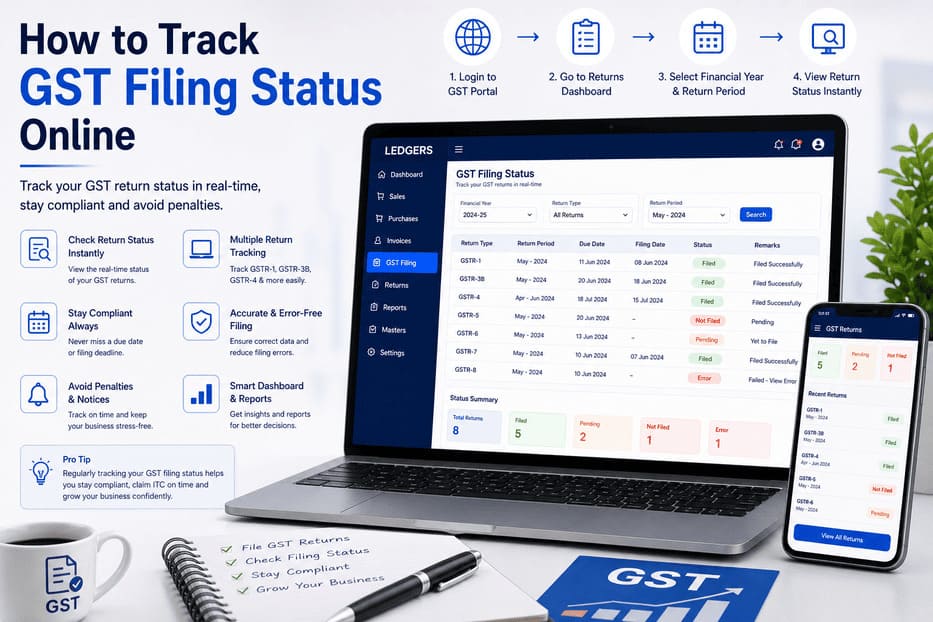
How to Track GST Filing Status Online (Step-by-Step)
You can easily check your GST return status through the official GST portal.
Step 1: Visit the GST Portal
Go to the official GST website.
Step 2: Login to Your Account
Enter your GSTIN, username, and password.
Step 3: Navigate to Returns Dashboard
Go to Services → Returns → Returns Dashboard
Step 4: Select Financial Year and Return Period
Choose the relevant year and month for which you filed the return.
Step 5: View Return Status
You will see the current status of your return such as:
- Filed
- Submitted
- Pending
- Error
- Not Filed
Understanding Different GST Filing Statuses
When you file GST returns, the status shown on the portal reflects the current stage of your submission. Understanding each status correctly helps you take timely action and avoid compliance issues.
1. Filed
This means your GST return has been successfully submitted along with tax payment (if applicable).
What it indicates:
- Return is complete and accepted
- No further action required
- Data is recorded in GST system
Why it matters: Confirms compliance for that period and avoids penalties.
2. Submitted (But Not Filed)
This status appears when the return is submitted but not fully filed.
Possible reasons:
- Final verification not completed
- Tax payment pending
- EVC (Electronic Verification Code) or DSC not applied
What to do: Complete the verification step to finalize filing.
3. Pending
The return is awaiting processing or action either from your side or the GST system.
Common scenarios:
- Awaiting confirmation after submission
- Processing delay from GST portal
- Incomplete filing steps
Action required: Check if any steps (verification/payment) are pending.
4. Error / Rejected
This indicates that your GST return has issues and was not accepted.
Common causes:
- Incorrect GSTIN details
- Mismatch in invoice data
- Wrong tax calculations
- Missing required fields
What to do:
- Review error messages
- Correct data
- Refile the return
5. Not Filed
This status means no return has been submitted for the selected period.
Risks:
- Late fees and penalties
- Interest on tax dues
- Compliance issues
Action required: File your return immediately to avoid penalties.
6. Filed – Awaiting Processing (In Some Cases)
Sometimes after filing, returns may take time to reflect final processing.
What it means:
- Return is submitted
- Backend processing is ongoing
No immediate action required unless delays are unusual.
Why Understanding Status is Important
-
Helps avoid missed filings
-
Ensures tax payments are completed
-
Prevents penalties and notices
-
Confirms ITC eligibility
-
Keeps financial records accurate
Using software like Ledgers helps you track these statuses clearly in one dashboard without confusion.
Common Issues While Tracking GST Status
Sometimes businesses may face issues while checking GST status.
Common Problems Include:
- Incorrect login credentials
- Selecting the wrong return period
- Technical errors on the portal
- Delay in status updates
- Filing incomplete returns
- Payment not completed
To avoid these issues, ensure accurate filing and proper verification.
How Ledgers Simplifies GST Filing & Tracking
Tracking GST manually through the portal can be time-consuming, especially for businesses handling multiple returns.
Ledgers Accounting Software simplifies GST filing and status tracking by providing:
- Centralized GST dashboard
- Real-time return tracking
- Automated GST calculations
- Error-free data preparation
- Easy report generation
- Filing-ready data formats
- Better compliance management
This helps businesses reduce manual effort and improve accuracy.
Benefits of Using Software for GST Tracking
Save Time
Avoid manual tracking and multiple logins.
Reduce Errors
Automated calculations reduce filing mistakes.
Better Visibility
Track all returns in one dashboard.
Stay Compliant
Never miss filing deadlines.
Improved Accuracy
Ensure correct tax reporting every time.
Tips to Ensure Smooth GST Filing & Tracking
Follow these best practices:
- File returns before the due date
- Double-check GSTIN and invoice data
- Ensure tax payment is completed
- Keep records organized
- Regularly review return status
- Use accounting software for automation
Who Should Track GST Filing Status Regularly?
GST tracking is important for:
- Small business owners
- Accountants and tax professionals
- Startups
- Retailers and traders
- Service providers
- Manufacturers
- Multi-branch businesses
Any GST-registered business should monitor return status regularly.
Why Real-Time GST Tracking Matters
Delayed or incorrect GST filing can impact:
- Cash flow
- Tax compliance
- Business reputation
- Vendor relationships
- ITC claims
Real-time tracking helps businesses avoid these risks and stay financially organized.
Conclusion
GST filing status tracking online is one of the easiest ways to stay in compliance and ensure that your returns are accurately filed and without any errors.
Instead of relying on manual tracking, businesses can simplify the entire process with Ledgers Accounting Software. From GST invoicing to return tracking and reporting, Ledgers provides a complete solution to manage GST efficiently.
Stay compliant, avoid penalties, and manage your GST filings smarter with the right tools.