




MONISHA D
Updated on
30-07-2026
How to File GST Returns Online in India (2026 Guide)
GST return filing is one of the most crucial compliance obligations for businesses in India. Each registered tax payer must file their sales, purchases, tax collections, input tax credit, and tax payable on time. Accurate return filing enables companies to avoid penalties, remain compliant, and ensure smooth operations.
A majority of the business owners still find GST return filing complicated due to ever-changing regulations, various types of returns, reconciliations, and deadline reminders. Here come the digital accounting and compliance solutions.
Ledgers Accounting Software helps businesses simplify GST invoicing, tax calculation, accounting, and GST filing workflows through a connected cloud platform. By maintaining organized sales and purchase records, businesses can prepare returns faster and more accurately.
This 2026 guide explains how to file GST returns online in India step by step, who must file, common return types, required documents, mistakes to avoid, and how software can simplify the process.
What is GST Return Filing?
A GST return is an official document submitted to the government containing details of:
- Outward supplies (sales)
- Inward supplies (purchases)
- GST collected from customers
- Input Tax Credit (ITC) claimed
- Tax payable
- Tax paid
- Other adjustments, if applicable
GST returns help tax authorities verify transactions and ensure correct tax payment.
Why GST Return Filing is Important
Filing GST returns on time helps businesses:
- Stay legally compliant
- Avoid late fees and penalties
- Claim eligible Input Tax Credit
- Maintain a clean compliance record
- Reconcile customer and vendor transactions
- Improve business credibility
- Avoid notices and mismatches
Late or incorrect filing can create unnecessary financial and operational stress.
Who Needs to File GST Returns?
GST return filing generally applies to:
- Regular GST registered businesses
- Traders and wholesalers
- Retailers
- Manufacturers
- Service providers
- E-commerce sellers (as applicable)
- Composition taxpayers (separate return formats)
- Businesses with interstate supplies
- Exporters and growing companies
Even businesses with no transactions in some periods may need Nil returns, depending on registration type and compliance status.
Common GST Return Types in India (2026)
Different taxpayers may need different GST returns based on business type.
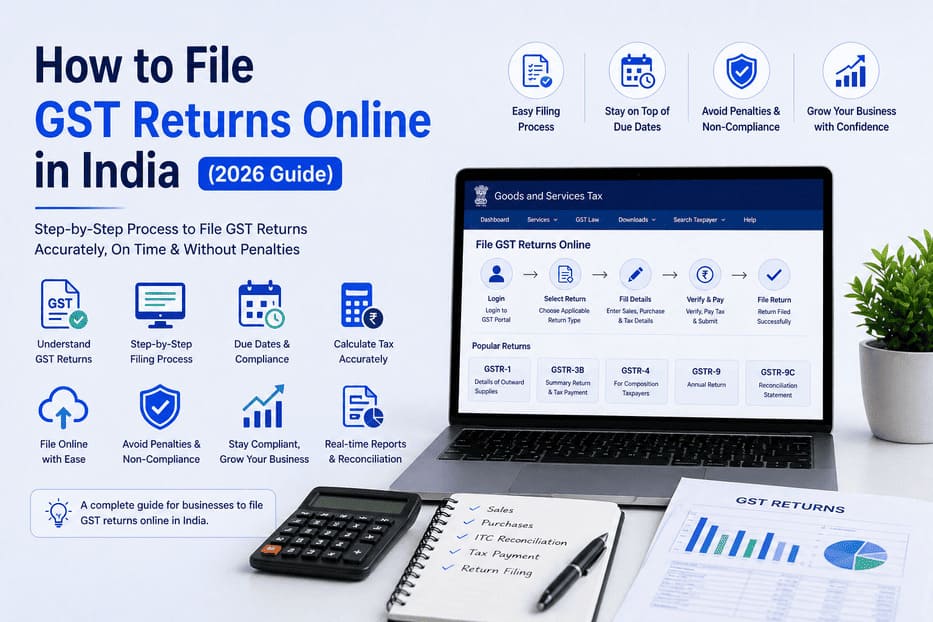
GSTR-1
Used to report outward supplies or sales invoices.
GSTR-3B
Summary return used to declare tax liability and pay tax.
GSTR-9
Annual return for eligible taxpayers.
GSTR-4
Applicable to eligible composition taxpayers.
GSTR-9C
Reconciliation statement where applicable under rules in force.
Always verify the latest applicability and due dates based on your business category.
Documents and Data Required Before Filing
Before filing GST returns online, keep these records ready:
- Sales invoices
- Purchase invoices
- Debit notes and credit notes
- Expense bills
- GSTIN details of vendors/customers
- Tax payment challans
- Input Tax Credit records
- Previous returns, if needed
- Bank payment records
- Reconciliation reports
Using accounting software like Ledgers helps organize all this data in one place.
How to File GST Returns Online in India (Step-by-Step)
Step 1: Keep Sales and Purchase Data Ready
Ensure all invoices are recorded correctly for the filing period.
Check:
- Invoice dates
- GSTIN numbers
- Tax amounts
- HSN / SAC details
- Duplicate entries
- Missing invoices
Accurate books reduce filing errors.
Step 2: Reconcile Input Tax Credit
Match purchase data with supplier-uploaded records wherever applicable.
Review:
- Missing vendor invoices
- Wrong GST amounts
- Ineligible ITC claims
- Duplicate credits
This step helps avoid mismatches and notices.
Step 3: Calculate GST Liability
Determine:
- Output GST collected on sales
- Eligible ITC on purchases
- Net GST payable after adjustment
Ledgers can simplify tax calculations automatically through organized entries.
Step 4: Login to GST Filing Portal
Access the official GST return filing portal using authorized credentials.
Keep ready:
- Username
- Password
- OTP / authentication access
- Filing period details
Step 5: Select the Correct Return Type
Choose the relevant return such as:
- GSTR-1
- GSTR-3B
- GSTR-4
- Annual return, where applicable
Selecting the wrong form may delay compliance.
Step 6: Enter or Upload Data
Input required sales, purchase, tax, and summary details.
Many businesses use software exports to reduce manual entry and save time.
Step 7: Verify Tax Liability and ITC
Before submission, review:
- Total taxable turnover
- GST payable
- ITC claimed
- Late fee if any
- Interest if applicable
Always double-check values before filing.
Step 8: Make Tax Payment if Required
If tax is payable, complete payment using available online payment methods.
Keep challan and payment references for records.
Step 9: Submit and File Return
After verification:
- Submit return
- Complete authentication process
- Download acknowledgement
- Save filing reference number
Keep a copy for future audit or reconciliation purposes.
Step 10: Maintain Proper Records
After filing, securely store:
- Filed return copy
- Payment challans
- Working papers
- Reconciliation reports
- Supporting invoices
Cloud systems help preserve records safely.
How Ledgers Helps Simplify GST Filing
Ledgers Accounting Software helps businesses prepare returns faster by organizing accounting and tax records efficiently.
Key Benefits:
- GST-compliant invoicing
- Auto tax calculations
- Sales and purchase summaries
- Customer/vendor management
- Easy report generation
- Outstanding tracking
- Cloud access from anywhere
- Better reconciliation support
This reduces manual workload and improves filing readiness.
Common GST Filing Mistakes to Avoid
Avoid these common errors:
- Wrong GSTIN entry
- Missing invoices
- Duplicate invoice uploads
- Incorrect tax values
- Claiming ineligible ITC
- Filing wrong return type
- Missing due dates
- Not reconciling books with returns
Small mistakes can lead to notices, penalties, or delayed credits.
Tips to File GST Returns Faster in 2026
Maintain Real-Time Bookkeeping
Do not wait until month-end.
Use GST Billing Software
Generate invoices with correct tax data from day one.
Reconcile Monthly
Check books and tax data regularly.
Track Deadlines
Set reminders for due dates.
Review Before Submission
Always verify totals and credits.
Store Digital Records
Maintain all documents securely.
Benefits of Filing GST Returns on Time
Timely filing offers multiple advantages:
- Better compliance score
- No late fee burden
- Smooth ITC claims
- Easier loan and tender eligibility
- Improved business credibility
- Reduced notice risk
- Better financial discipline
Who Should Use GST Filing Software?
Software-based GST filing support is ideal for:
- Startups
- SMEs
- Retail businesses
- Traders
- Service companies
- Multi-branch businesses
- Accountants
- Growing enterprises
It helps save time while improving accuracy.
Why Businesses Prefer Ledgers
Businesses choose Ledgers because it combines:
- Accounting
- GST invoicing
- Return-ready reports
- Payment tracking
- Business insights
- Cloud convenience
- Scalable operations support
Instead of using multiple disconnected systems, businesses can manage everything in one platform.
Conclusion
GST return filing does not need to be stressful or complicated. With proper records, timely reconciliation, and the right software tools, businesses can file GST returns online in India smoothly and accurately.
If you want to simplify invoicing, bookkeeping, and GST compliance, Ledgers Accounting Software provides a smarter way to stay filing-ready throughout the year.
Stay compliant, avoid penalties, and grow confidently with organized GST management in 2026.