




VAIRAVAN K
Updated on
30-07-2026
RCM Invoice Under GST: Everything Indian Businesses Need to Know
You have ever availed any service from a freelancer, an unregistered vendor, or a foreign vendor, and wondered who pays the GST for the service, well, you have already encountered the Reverse Charge Mechanism (RCM). And, yes, there are RCM invoicing rules too.
The RCM invoicing rules are something that often catches small and mid-sized businesses in India off guard. The reason for the confusion is obvious: in the case of RCM, the buyer needs to pay the GST, rather than the supplier. And that is quite a different ball game from the standard GST invoicing rules.
So, what are RCM invoices, when do you need to raise RCM invoices, what needs to go into RCM invoices, and how you can use the RCM invoicing rules to your advantage using the Ledgers.cloud software are what we are going to look at in detail.
What Is an RCM Invoice?
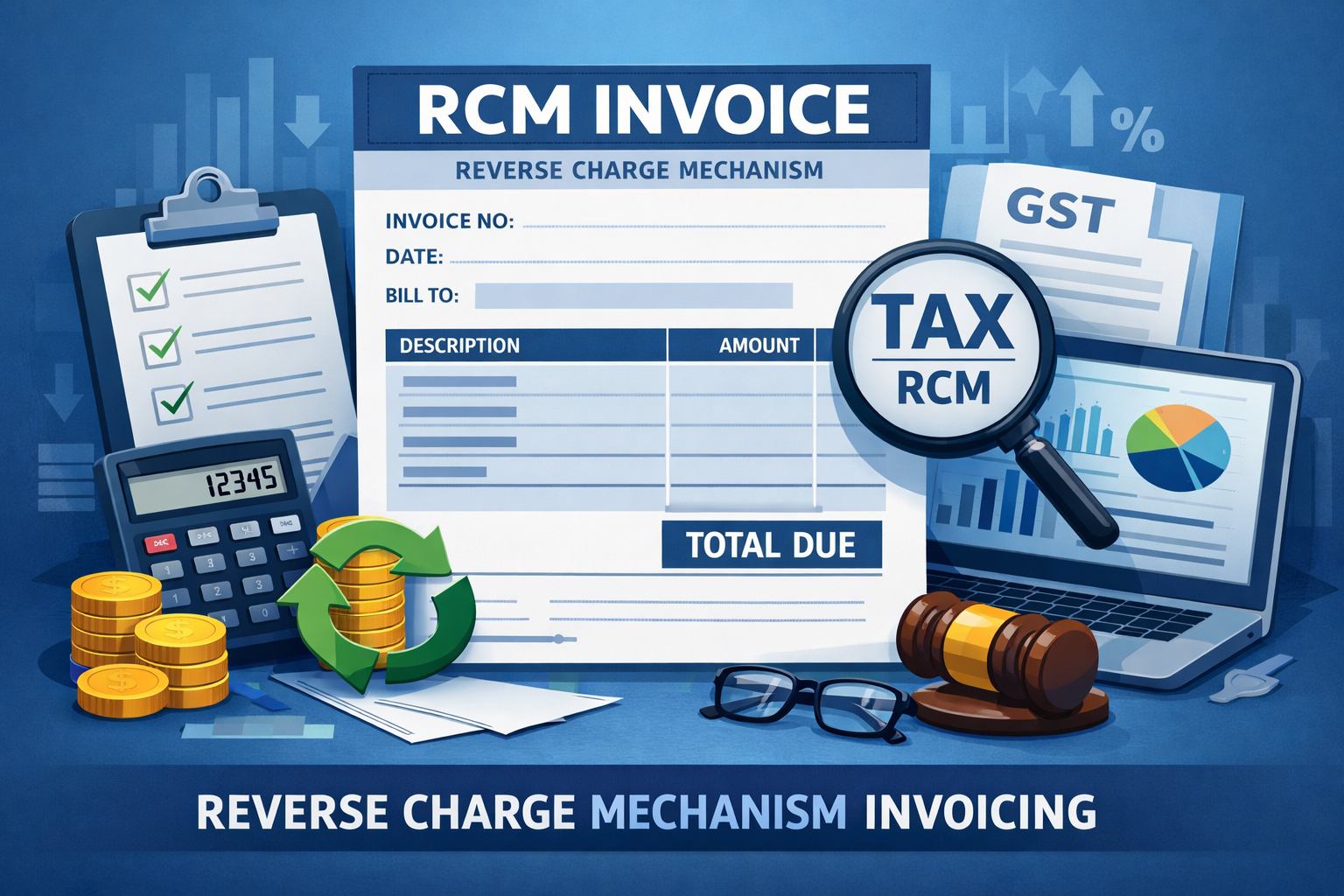
Under normal GST, the supplier raises an invoice, collects GST from the buyer, and deposits it with the government. Under RCM, this flow reverses. The buyer pays the GST directly to the government and to document this liability, they must raise a self-invoice.
This self-invoice (often called an RCM invoice or a reverse charge invoice) serves as the official record of the transaction. Without it, you cannot claim ITC on the amount you've paid, and you'll have trouble reconciling your GST returns.
Think of it as the GST system's way of saying: if the supplier isn't going to collect tax, someone else needs to document and pay it and that someone is you.
When Does RCM Apply?
RCM kicks in across several common business scenarios:
- Purchases from unregistered suppliers for notified goods/services under Section 9(4) of the CGST Act
- Import of services from overseas vendors think SaaS subscriptions, cloud platforms, or freelance work from abroad
- Notified services such as legal fees from advocates, goods transport agency (GTA) services, and security services
- Sponsorship services provided to a body corporate or partnership firm
If your business regularly works with any of these, you're almost certainly already under an RCM obligation — even if you haven't been formalising it with proper invoices.
What Must an RCM Invoice Contain?
The GST law is quite specific. Missing even one field can make your ITC claim vulnerable during audits. Every RCM self-invoice must include:
- The words "Reverse Charge" prominently mentioned
- Date of invoice must be issued on the date of receipt of goods or services
- Supplier's name, address, and GSTIN (or an unregistered identifier if not available)
- Recipient's name, address, and GSTIN
- Description and HSN/SAC code of the goods or services
- Taxable value and GST rate CGST + SGST for intra-state, IGST for inter-state
- A sequential invoice number for your own records
The ITC Connection: Why Getting This Right Matters
Here's the part that directly affects your cash flow: the GST you pay under RCM is eligible for Input Tax Credit but only in the same month you make the payment.
That means if you receive a service in March but don't issue your self-invoice or make the payment until April, your ITC is pushed to April. Across multiple vendors and months, these timing mismatches add up and create reconciliation headaches in GSTR-2B.
The safest approach: issue your RCM self-invoice on the day of receipt, pay the GST liability in that month's return. Consistent, same-month handling keeps your books clean and your ITC claims defensible.
RCM in GSTR Filings: Where Does It Show Up?
RCM transactions flow through your GST returns in a specific way:
- GSTR-1: Not applicable. RCM outward liability is not reported here.
- GSTR-3B (Table 3.1(d)): Report your inward supplies under RCM and the tax payable.
- GSTR-3B (Table 4(A)(3)): Claim ITC on RCM paid in the same period here.
Many businesses miss the Table 3.1(d) entry entirely, or claim ITC in a different month from when they paid the tax. Both situations invite GST notices. A proper RCM invoice workflow where invoices are dated, categorised, and linked to payment — makes these entries almost automatic.
How Ledgers.cloud Simplifies RCM Invoicing
Managing RCM manually is genuinely error-prone. Ledgers.cloud is built for exactly this kind of Indian GST complexity. With the platform, you can:
- Generate RCM self-invoices with all mandatory fields pre-filled
- Automatically flag transactions that attract RCM based on supplier type and service category
- Track GST liability and ITC by month, so you're never claiming credit in the wrong period
- Auto-populate GSTR-3B Tables 3.1(d) and 4(A)(3) from your invoice data
- Maintain a clean audit trail for all reverse charge transactions
Whether you're a startup paying SaaS subscriptions to overseas providers, a trading company using unregistered transporters, or a firm receiving legal consultations from advocates — Ledgers.cloud makes sure your RCM obligations are handled systematically, not haphazardly.
Final Thoughts
RCM invoicing is not optional, and it is not complicated if you have the right process. You simply need to raise the self-invoice on the same day of receipt, settle the GST for the month, claim the ITC for the month, and correctly report it in GSTR-3B.
The most common GST issues faced by businesses under RCM GST are not because of bad intentions but because of bad systems. The vendor was paid at the end of the month, an invoice was forgotten, a GSTR column was forgotten. All of these issues can be solved with the right accounting software.
If you want to stop worrying about RCM compliance and focus on running your business, explore how Ledgers.cloud handles GST invoicing end-to-end including reverse charge, e-invoicing, and GSTR filing support, all in one place.