
VAIRAVAN K
Updated on 30-07-2026
Ever been there as a business owner? You look at your accounting dashboard, and it's just a bunch of numbers. You're left wondering which ones really count. Your revenue might be going up, but man, cash feels tight. Expenses seem under control, yet profits are dropping. It’s not that the data is missing; it's about having the right data.
Picking the right financial metrics is super important. If you go for the wrong ones, they'll just spin you around. But get it right, and you know exactly how your biz is doing, what needs help, and what's kicking ass.
Many small businesses default to tracking what is easy to see: total sales, bank balance, or monthly expenses. These numbers are useful, but they rarely tell the full story.
A retail business obsessing over gross revenue might miss a shrinking profit margin. A service firm focused only on invoices raised might ignore how long clients actually take to pay. The metric you ignore is often the one that surprises you later.
The real question is not "what should all businesses track?" It is "what should your business track, at this stage, to make better decisions?"
Your financial metrics should reflect how your business actually makes money. A SaaS company tracks monthly recurring revenue and churn rate. A manufacturing business watches inventory turnover and cost of goods sold. A consulting firm monitors utilization rate and project margins.
Before picking metrics, ask yourself three honest questions:
Your answers point directly to the metrics worth tracking.
While every business is different, a few categories of metrics apply broadly.
Profitability Metrics tell you whether the business is sustainable. Gross profit margin shows how much revenue remains after direct costs. Net profit margin shows what is left after everything, including overheads, taxes, and interest. If these margins are shrinking quarter over quarter, something fundamental needs attention.
Liquidity Metrics tell you whether you can meet your obligations today and next month. The current ratio compares current assets to current liabilities. A ratio below 1 is a warning sign. More practically, track your cash runway: how many months can you operate at current burn without new revenue? Tools like Ledgers make it easier to monitor cash flow in real time, so surprises are fewer.
Efficiency Metrics tell you how well the business converts inputs into outputs. Accounts receivable turnover shows how quickly customers pay. Inventory turnover shows how fast stock moves. A business that is profitable on paper but slow to collect cash will still face serious cash flow problems.
Growth Metrics tell you whether the business is moving in the right direction. Month on month revenue growth, customer acquisition rate, and average revenue per customer all fall here. Growth metrics matter most when you are making investment decisions or planning for the next 12 months.
A startup in its first year should not obsess over the same metrics as a business doing ten crore rupees in annual revenue. Stage matters.
In the early stage, focus on cash burn rate, gross margin, and customer acquisition cost. You are validating a model, not optimizing one. In the growth stage, shift attention to revenue growth rate, churn (if applicable), and operating leverage. In the mature stage, profitability ratios and return on equity become central because efficiency and sustainability matter more than growth at any cost.
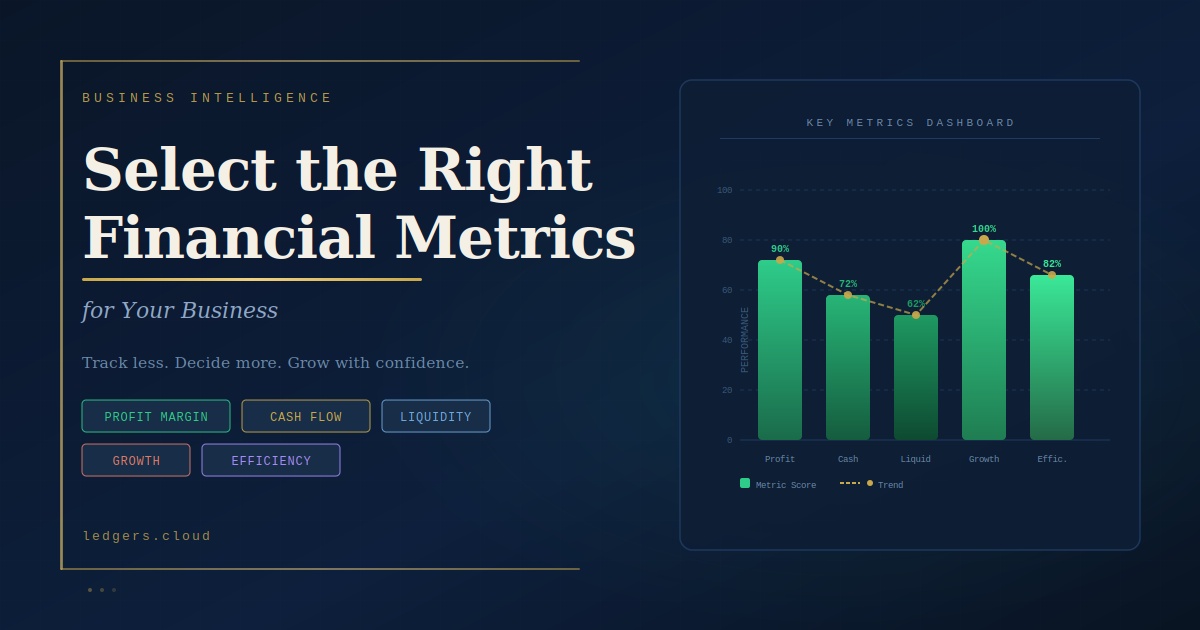
Metric overload is real – when everything is top priority, nothing really is. Businesses usually do better limiting their dashboards to five to eight key metrics. These should be checked weekly or monthly, with a more in-depth review quarterly.
Keep it simple by tracking one metric from each of the four main areas, plus one or two specific to your biz. This balanced approach stops you from getting lost in spreadsheets.
Here is where many businesses fall short. They collect the metrics, review them, and then do nothing different. Metrics are not reports for their own sake. They are triggers for decisions.
Set thresholds. If your gross margin drops below a certain percentage, review pricing. If your accounts receivable days outstanding crosses a limit, tighten credit terms or follow up more aggressively. If cash runway drops below three months, activate a contingency plan.
Using accounting software like Ledgers can help automate this tracking, generate reports, and give you the clarity you need to act quickly rather than react slowly.
Your business will evolve, so should your metrics. Review them yearly because what's key in year one might be useless by year three. Maybe you launch a new product line or expand into a fresh market, introducing aspects to track that no one saw coming.Always aim for clarity numbers leading to improved choices, not just more data. Focus on those that result in better decisions.
