
KARTHICKKUMAR R
Updated on 16-09-2026
In today’s global economy, businesses frequently work with clients, vendors, and partners across different countries. This means dealing with multiple currencies, fluctuating exchange rates, and complex financial reporting. Managing these transactions manually can lead to errors, delays, and inconsistent financial records.
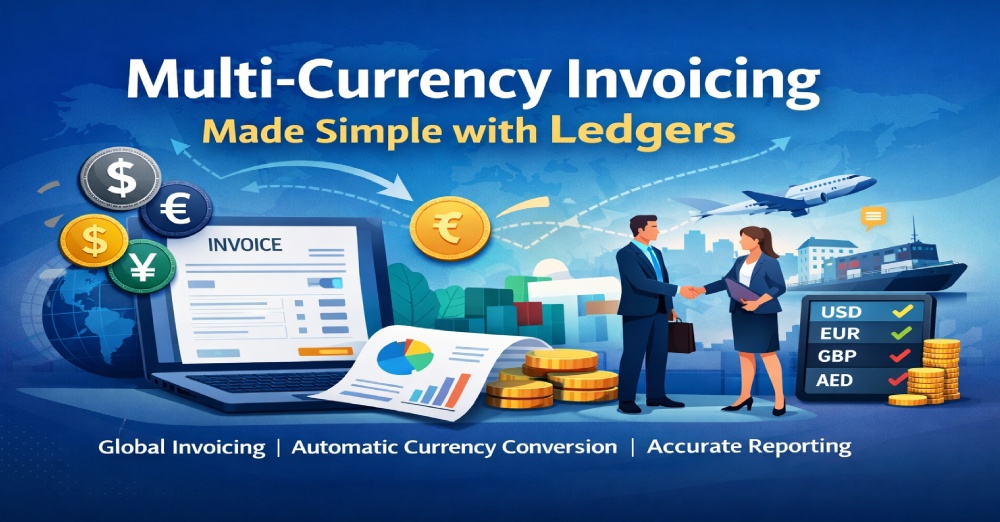
LEDGERS multi-currency invoicing support simplifies international transactions by allowing businesses to create invoices, estimates, and proposals in their customer’s preferred currency while maintaining accurate accounting records in the base currency. With automated exchange rate conversion and flexible reporting, Ledgers makes global billing effortless and reliable.
Multi-currency invoicing refers to the capability of a business to issue invoices in various currencies. It allows companies to better accommodate local customers by billing them in their own currency, thus eliminating the complexity and potential friction caused by currency conversion at the customer's end.
Businesses that operate internationally or serve clients abroad must handle payments in different currencies. Without a proper system, companies may face challenges such as:
A robust multi-currency accounting system eliminates these challenges by automatically managing exchange rates and maintaining accurate records.
Ledgers allows businesses to generate invoices, quotations, and estimates in more than 100+ international currencies including USD, EUR, GBP, AED, and more. This enables businesses to bill customers in their local currency, making transactions more convenient and professional.
Exchange rates change constantly, making manual conversion unreliable. Ledgers automatically applies the correct exchange rate based on the invoice date, ensuring accurate financial calculations.
This automation ensures businesses always use reliable conversion rates without manually checking financial markets.
Even when transactions are made in foreign currencies, Ledgers automatically converts them into the business’s base currency (such as INR) for consistent accounting and reporting.
Businesses can continue operating globally while maintaining standardized financial records.
In some situations, companies may negotiate special exchange rates with international clients or partners. Ledgers allows users to override the system exchange rate and apply a custom rate when needed.
This flexibility gives businesses full control over their financial transactions.
Ledgers provides detailed reports that consolidate transactions across different currencies. Businesses can analyze performance, revenue, and outstanding payments from global clients in a single dashboard.
This helps business owners understand their global financial performance clearly.
Dealing with multiple currencies comes with its own set of challenges:
Ledgers addresses these challenges by offering a sophisticated yet user-friendly multi-currency invoicing system that integrates seamlessly into existing financial workflows.
Ledgers not only simplifies billing through multi-currency invoicing but also minimizes the errors typically associated with manual currency conversions and ledger adjustments.
To maximize efficiency and accuracy when dealing with multi-currency invoicing through Ledgers, consider these best practices:
Multi-currency invoicing doesn’t have to be a complex, cumbersome task. With Ledgers, businesses can seamlessly handle multi-currency transactions, eliminate the traditional challenges associated with global trading, and focus on what truly matters growth and client satisfaction.
Adopting Ledgers for your multi-currency invoicing needs not only streamlines your financial operations but also positions your business as a competitive player in the global market. Stay ahead of the curve with simplified, efficient, and professional invoicing solutions.
