
MONISHA D
Updated on 30-07-2026
Tax Deducted at Source (TDS) compliance is an essential responsibility for businesses, employers, professionals, and organizations operating in India. Timely deduction, accurate return filing, and proper reporting of TDS transactions are critical to avoiding penalties, notices, and compliance issues under the Income Tax Act.
Manual TDS filing processes often become difficult due to frequent rule changes, multiple return forms, challan matching, PAN validation, and complex reporting requirements. Businesses handling large transaction volumes may struggle with calculation errors, delayed filings, and reconciliation issues.
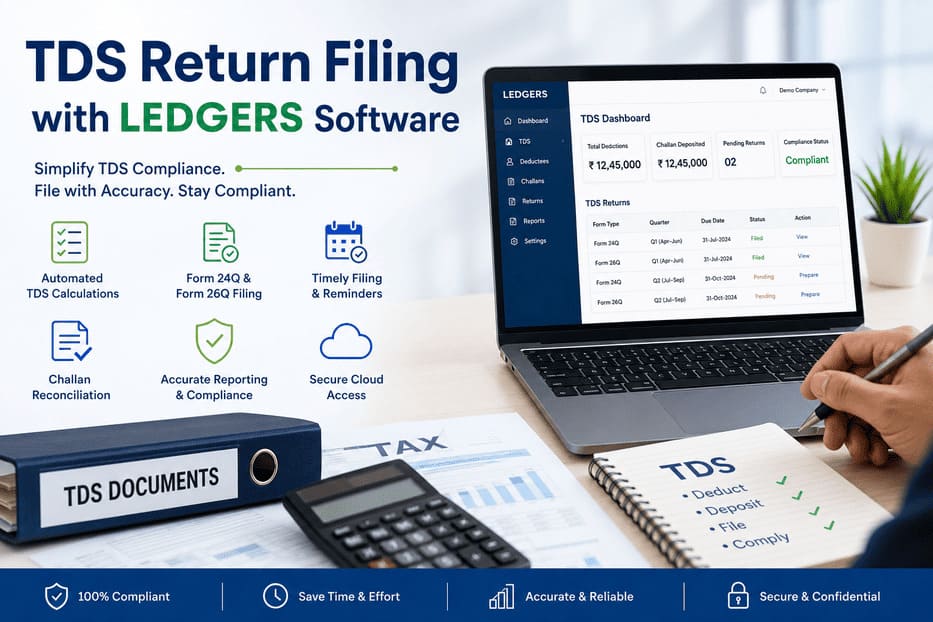
Modern cloud-based platforms such as LEDGERS simplify TDS management through automation, centralized reporting, and integrated compliance tools. Businesses can manage deductions, generate returns, reconcile challans, and file TDS statements efficiently from a single platform.
This article explains everything businesses need to know about TDS return filing using LEDGERS software, including filing procedures, TDS forms, benefits, compliance requirements, and best practices.
TDS return filing is the process of submitting details of tax deducted at source to the Income Tax Department.
Businesses and deductors who deduct TDS while making specified payments must regularly report:
These details are submitted through quarterly TDS returns.
TDS returns help the government track:
Failure to file accurate TDS returns may lead to penalties, notices, and legal complications.
TDS compliance directly impacts financial accuracy, tax reporting, and vendor relationships.
Proper TDS filing helps businesses:
Automated TDS platforms reduce manual effort and improve filing accuracy significantly.
Different TDS return forms are used based on the type of payment being reported.
Form 24Q is used for TDS deducted on salary payments.
It includes:
Employers must file Form 24Q quarterly.
Form 26Q is used for TDS deducted on non-salary payments.
This includes:
Businesses making such payments must file Form 26Q regularly.
Many businesses face operational difficulties while handling TDS manually.
Different TDS sections apply different deduction rates and thresholds.
Incorrect PAN details can lead to higher TDS deductions and return rejection.
Mismatch between deducted tax and deposited challans creates compliance issues.
Manual preparation often causes missed deadlines.
Businesses may struggle to reconcile:
Tax rules and compliance formats are updated regularly.
LEDGERS TDS Software helps businesses automate and manage the complete TDS workflow.
The platform simplifies:
This reduces manual workload and improves filing accuracy.
The software automatically applies correct TDS rates based on payment category and applicable tax provisions.
This reduces manual calculation errors.
Businesses can track all TDS deductions from a single dashboard.
This improves visibility into:
The software validates PAN details before filing to reduce rejection risks.
LEDGERS automatically prepares TDS return files in the required format for submission.
This significantly reduces manual effort.
The platform helps reconcile:
This minimizes mismatch errors.
Businesses receive notifications for:
Organizations can provide role-based access to finance and accounting teams.
Businesses can file TDS returns efficiently using a structured workflow.
Add business details such as:
Accurate setup ensures smooth filing.
Enter or import payment transactions including:
The system automatically calculates applicable TDS.
Review:
This helps identify errors before filing.
Create and track challans for TDS payment.
Ensure taxes are deposited within due dates.
Match challan payments with deduction records.
This prevents filing mismatches.
Generate applicable forms such as:
The software prepares returns in compliance-ready format.
Upload generated TDS return files to the government filing portal.
LEDGERS simplifies the preparation and validation process.
After filing, businesses can generate:
These certificates can be shared with employees and vendors.
Businesses using automated TDS software gain several operational advantages.
Automation reduces manual data entry and speeds up return preparation.
Built-in validation minimizes filing mistakes.
Businesses can track deadlines and avoid late filing penalties.
Centralized records improve reporting consistency.
Businesses can reconcile challans and deductions more efficiently.
Teams can access TDS data securely from anywhere.
Businesses must file quarterly TDS returns within prescribed due dates.
Timely filing is critical to avoid:
Automated reminders help businesses stay compliant throughout the year.
Businesses should avoid frequent compliance errors.
Invalid PAN information may cause return rejection.
Different payment types require different TDS sections.
Incorrect challan details create reconciliation problems.
Late tax payment results in interest penalties.
Incomplete transaction recording affects return accuracy.
Automation improves overall compliance quality by reducing dependency on manual spreadsheets and repetitive calculations.
LEDGERS helps businesses:
This creates a more efficient tax compliance environment.
Businesses can improve TDS operations by following structured compliance practices.
Ensure PAN and payment details are updated regularly.
Frequent reconciliation prevents year-end filing issues.
Create a compliance calendar for payments and returns.
Reduce manual errors through software automation.
Review deduction reports before filing returns.
India’s taxation system is becoming increasingly digital and automated.
Businesses adopting cloud-based compliance solutions gain advantages such as:
Digital tax management is becoming essential for modern businesses.
TDS compliance systems are expected to become more automated in the coming years.
Future developments may include:
Businesses using automated software today will be better prepared for future regulatory changes.
TDS return filing is a critical compliance activity for businesses across India. Managing deductions, challans, return forms, and filing deadlines manually can be complex and time-consuming.
Modern solutions like LEDGERS help businesses simplify TDS management through automation, centralized reporting, and compliance tracking.
With features such as automated calculations, Form 24Q and Form 26Q preparation, challan reconciliation, and filing support, LEDGERS enables businesses to improve efficiency while reducing compliance risks.
By adopting automated TDS software, businesses can avoid penalties, improve financial accuracy, and maintain seamless tax compliance in an increasingly digital tax environment.
