




PUGALENTHI
Updated on
30-07-2026
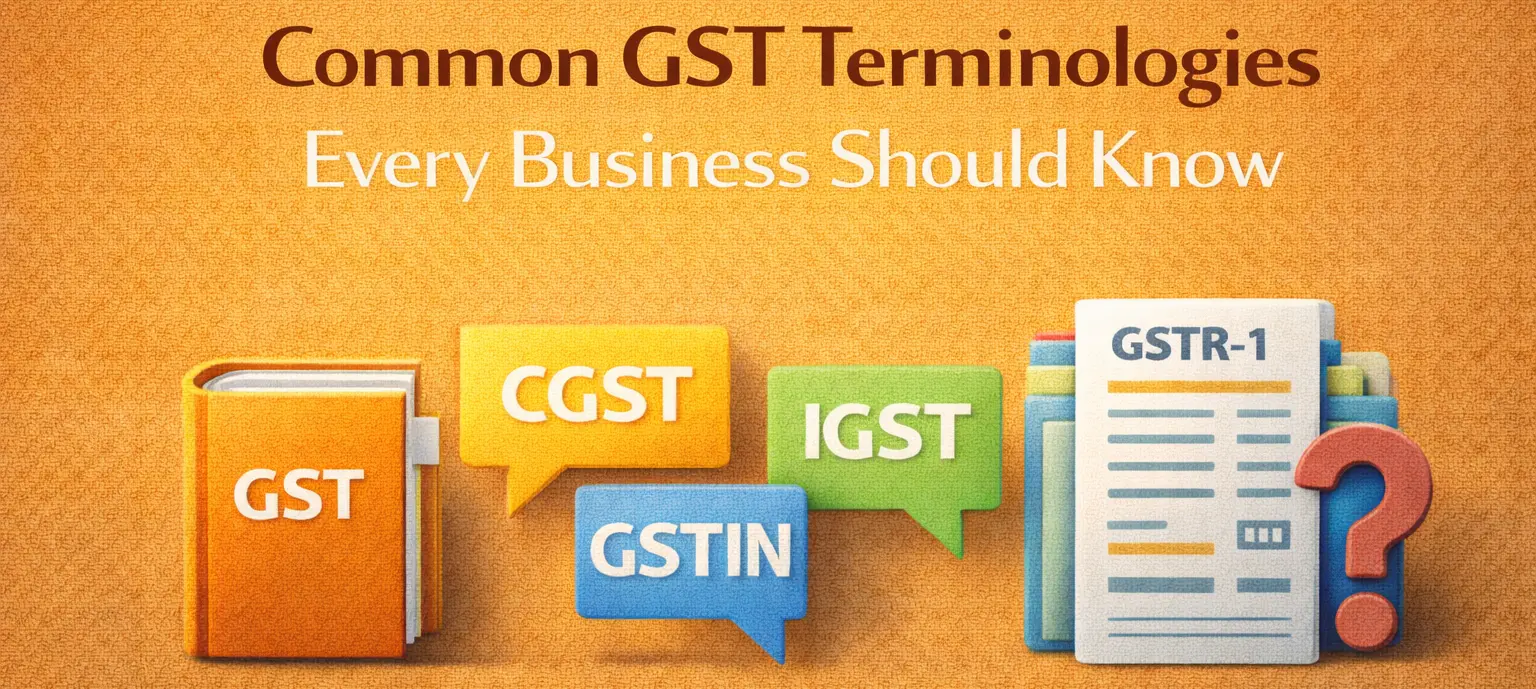
The implementation of Goods and Services Tax (GST) has had a profound effect on the taxation regime for a number of countries' businesses, including India. It is imperative that business owners have an understanding of GST if they want to effectively manage their finances and comply with regulations, however, many business owners find the terminology surrounding GST difficult to understand. Therefore, the intent of this straightforward and user-friendly guide named "Common GST Terminology Every Business Needs to Understand" is to elucidate commonly used GST terminology by providing definitions as well as examples. Let's go!
Understanding GST: A Guide for Business Owners
Being a GST compliant business owner means you can confidently understand GST Related Terms when it comes to all aspects of being in compliance with the GST Requirements. The following are the Key GST Terms laid out in a structured manner, along with definitions and examples for your ease of reference
GSTIN
GSTIN stands for Goods and Services Tax Identification Number. It is a unique 15-digit code assigned to every business registered under GST.
- The first two digits represent the state code.
- The next ten digits are the taxpayer's PAN number.
- One digit is the entity code, followed by a checksum character.
Example: A business registered in Karnataka might have a GSTIN like 29AADCS1234M1Z5.
CGST, SGST, IGST: Understanding the Types of GST
CGST (Central Goods and Services Tax)
CGST is levied by the Central Government on intrastate supplies of goods and services. It is one part of the tax that contributes to the overall GST rate.
Example: If the GST rate on a product is 18%, the CGST component might be 9% for sales within a state.
SGST (State Goods and Services Tax)
SGST is collected by the respective state government on the same intrastate supply on which CGST is levied. Like CGST, it forms another part of the total GST rate.
Example: If CGST for a product is 9%, SGST would also be 9% for intrastate transactions.
IGST (Integrated Goods and Services Tax)
IGST applies to interstate transactions and is collected by the Central Government. It is applicable when goods or services are shipped between states.
Example: A 18% IGST is levied on goods shipped from Maharashtra to Gujarat.
ITC (Input Tax Credit)
Input Tax Credit allows businesses to deduct the tax they have paid on inputs while calculating their tax liability. ITC is a major advantage of GST, ensuring that the tax paid on the input side can be used to offset tax payable on sales.
Example: If you purchase raw materials worth â¹1,00,000 and pay â¹18,000 as GST, that amount can be deducted from your GST liabilities when you sell the final products.
GSTR-1, GSTR-3B, GSTR-2B: GST Returns Simplified
GSTR-1
GSTR-1 is a monthly or quarterly return that contains details of all sales and outward supplies. This form is crucial for the reconciliation and confirmation of sales transactions.
Deadline: 11th of the following month for monthly filers and the 13th of the month following the quarter for quarterly filers.
GSTR-3B
GSTR-3B is a monthly self-declaration of summarized GST liabilities. It's a simplified summary return that must be filed by all GST registrants.
Deadline: 20th of the following month.
GSTR-2B
GSTR-2B is a system-generated statement containing details of input tax credit. It is based on the information filed by suppliers in their GSTR-1.
Usage: It helps businesses reconcile and validate the input tax credits before filing GSTR-3B.
Reverse Charge
By using the reverse charge system, GST will be liable to be paid by the person who receives goods and/or services rather than the supplier. The reverse charge system most frequently relates to specific services and unregistered suppliers.
Example: A business must pay GST for legal services under the reverse charge mechanism because they are procuring the service.
Input and Output Tax
Input Tax
This is the GST that a business pays on purchases and expenses, like raw materials and services.
Output Tax
This is the GST collected by a business on sales of goods and services.
The business pays the government the difference between output tax and eligible input tax credit, lowering the overall tax burden.
Taxable Supply
A taxable supply refers to the supply of goods and services that are subject to GST under the law. It determines the taxability of a transaction.
Example: Most consumer goods like electronics and textiles are considered taxable supplies.
Compliance
Compliance refers to the process of adhering to all GST rules and regulations, including timely registration, accurate tax filing, and maintaining proper records of transactions. It is critical for avoiding penalties and ensuring smooth business operations.
As a business owner, staying compliant requires understanding these key GST terms and diligently managing your financial records to reflect them accurately.
Conclusion
Understanding GST terminologies is indispensable for every business owner. This guide, titled "Common GST Terminologies Every Business Should Know," equips you with essential knowledge to navigate the GST landscape effectively. From comprehending GSTIN and the nuances of CGST, SGST, and IGST to mastering the filing process with forms like GSTR-1 and GSTR-3B, you are now better prepared to handle GST compliance with confidence. Remember, efficient tax management begins with understanding the language of GST, ensuring your business's prosperity in a tax-compliant environment.
LEDGERS
LEDGERS simplifies GST compliance by embedding reconciliation directly into the accounting workflow, helping businesses identify mismatches early and address them before they lead to interest or penalties. With automated GSTN data synchronization, invoice-level tracking, and system-driven validations, LEDGERS enables seamless, reliable compliance without last-minute corrections or manual follow-ups.