




ATCHAYA M
Updated on
30-07-2026
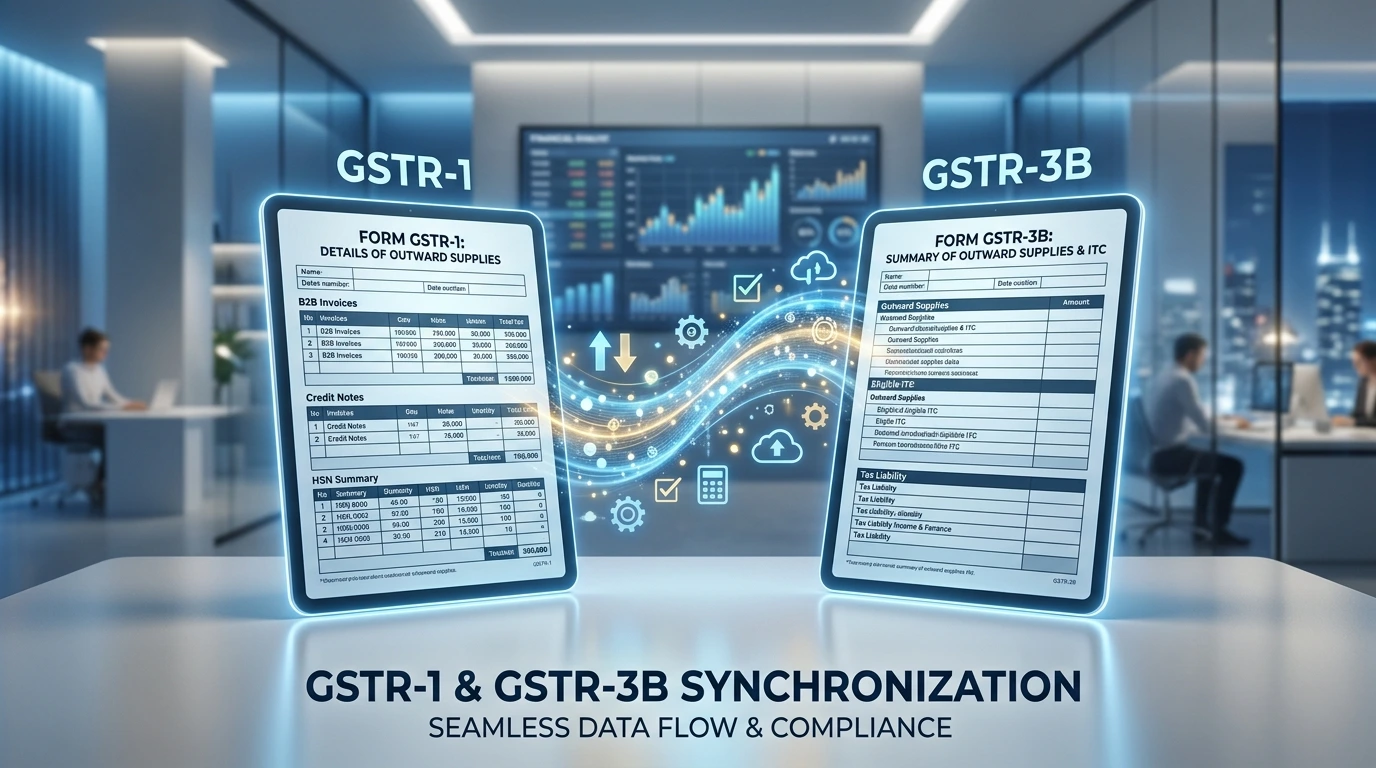
Understanding the Connection Between GSTR-1 and GSTR-3B
The most important online returns that businesses file on a regular basis under the GST Act are GSTR-1 and GSTR-3B. While they are very different in nature, they are connected to one another, and this is why many businesses will complete each return without really understanding how they are related. This can result in the businesses experiencing issues related to discrepancies, reconciliation and compliance.
Consequently, it is imperative that businesses understand how GSTR-1 and GSTR-3B function together in order to maintain accurate GST records. When the data reported in both returns match, the businesses can file those returns with confidence and reduce the chances of receiving notices, needing to make any corrections or having to spend unnecessary time following up with the department; however, when there are discrepancies between the two returns, businesses will experience complications, which will take both time and effort to resolve.
By having a complete understanding of the connection between both returns, businesses are able to increase their compliance accuracy and make their GST reporting process as efficient as possible.
What Is GSTR-1?
The GSTR-1 return contains information about goods and services that were supplied one time only by a registered supplier during an earlier period. This return gives information regarding:
- Invoices issued to other registered businesses (B2B)
- Sales invoices issued to unregistered businesses (B2C)
- Credit notes issued
- Debit notes issued
- Export transactions
- Amendments made to previously submitted invoices.
GSTR-1 is a return in which the registered supplier reports the actual sales transaction based on the invoice level to the department for the purpose of allowing their customers to claim the input tax credit (“ITC”) in their GSTR-3B return through the use of digital technology. Consequently, the data reported in GSTR-1 is available to the registered supplier in real-time on the GST system, and therefore, their customers can view that data for the purpose of making a claim for ITC before filing their GSTR-3B return.
What Is GSTR-3B?
GSTR-3B is a summary return that reports:
- Taxable outward supplies
- Input Tax Credit claimed
- GST liability
- Tax payments made
Unlike GSTR-1, GSTR-3B does not require detailed invoice-level reporting. Instead, it provides summarized information about business transactions for a particular period.
Since tax liability is reported through GSTR-3B, accuracy in this return is extremely important.
Why Are GSTR-1 and GSTR-3B Connected?
Although the two returns are filed separately, both represent the same business transactions.
In simple terms:
- GSTR-1 reports the invoice details.
- GSTR-3B reports the tax impact of those invoices.
Because they originate from the same sales activity, the values reported should generally align.
For example:
If a business reports taxable sales worth ₹10 lakh in GSTR-1, the corresponding tax liability should normally be reflected in GSTR-3B as well.
When this relationship is maintained properly, GST compliance becomes much smoother.
Common Reasons for Mismatches
Many businesses experience differences between GSTR-1 and GSTR-3B due to operational issues rather than tax complexities.
Some common causes include:
- Missing invoices in one return
- Incorrect taxable value reporting
- Delayed invoice entry
- Duplicate transactions
- Manual data entry mistakes
- Credit note adjustments not considered properly
These differences often become visible during reconciliation exercises.
Why Mismatches Create Problems
When GSTR-1 and GSTR-3B figures do not align, it can raise questions regarding reporting accuracy.
Potential consequences include:
- Additional reconciliation work
- Compliance notices
- Clarification requests from authorities
- Increased audit scrutiny
Even when mismatches are genuine timing differences, businesses may still need to explain them properly.
Why Month-End Rush Creates Errors
Many businesses prepare both returns close to filing deadlines. Under time pressure, teams may focus on completing the filing process quickly rather than validating data thoroughly.
This often leads to:
- Incomplete reviews
- Missed invoices
- Reporting inconsistencies
Maintaining records throughout the month helps reduce filing-period pressure and improves return quality.
Structured Systems Offer Assistance
When corporations expand, it becomes increasingly harder to maintain the same level of consistency between returns without having to manually manage all the information associated with those returns.
Structured GST systems help with those types of issues by:
- Centralizing all invoice data
- Eliminating duplicated data entries
- Providing better visibility into tax liabilities
- Assisting with the reconciliation processes.
When structured systems are used for maintaining the accuracy of both GSTR-1s and GSTR-3Bs, an organization can be confident that data captured at the same time for multiple returns will be consistent and reliable.
Conclusion
GSTR-1 and GSTR-3B are two separate GST returns; nevertheless, each return is linked to one another through the same transaction(s). GSTR-1 captures the transactions at the invoice level and GSTR-3B captures the liability associated with those transactions. Therefore, both returns must contain no discrepancy between them.
Organized recordkeeping, regular reviews of the data, and impeccable reconciliation prior to filing help businesses eliminate mismatches while simultaneously improving compliance accuracy. Understanding the linkages between the GSTR-1 & GSTR-3B returns is an important step toward building a stronger and more reliable system for GST compliance.