




MONISHA D
Developer
Updated on
09-06-2026
E-Invoice Rules Every Business Must Know
E-invoicing has become one of the most important compliance requirements under the Goods and Services Tax (GST) system in India. As the government continues to digitize taxation and improve invoice transparency, businesses must understand and follow e-invoice regulations carefully to avoid penalties, filing issues, and tax mismatches.
For many businesses, especially manufacturers, wholesalers, exporters, and large enterprises, e-invoicing is no longer optional. It has become a mandatory part of GST compliance and invoice management.
Modern accounting and compliance platforms such as LEDGERS help businesses automate e-invoice generation, GST reporting, tax calculations, and compliance management through integrated digital workflows.
This article explains the most important e-invoice rules every business should know, including applicability, invoice requirements, IRN generation, GST compliance rules, penalties, benefits, and best practices.
What Is E-Invoicing Under GST?
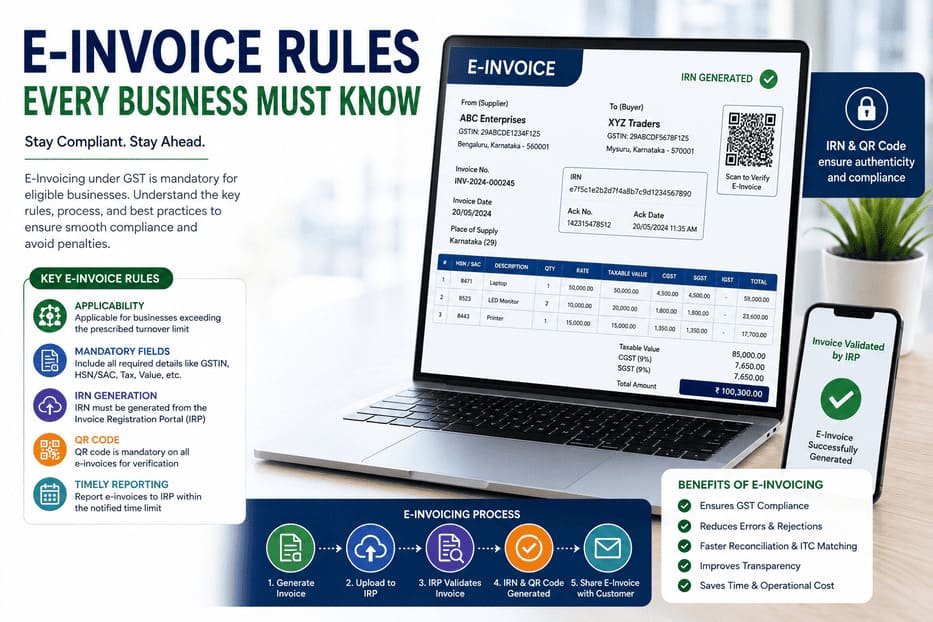
E-invoicing, also called electronic invoicing, is a system where GST invoices are electronically authenticated by the Invoice Registration Portal (IRP) before they are issued to customers.
Under this system:
- Businesses generate invoices using their own accounting or billing software
- Invoice data is uploaded to the IRP
- The portal validates invoice details
- A unique Invoice Reference Number (IRN) is generated
- A digitally signed QR code is added to the invoice
Once validated, the invoice becomes a legally recognized GST invoice.
The authenticated invoice data is automatically shared with the GST system, helping simplify GST return filing and tax reporting.
Businesses can automate this process using solutions like LEDGERS E-Invoice Software.
Why E-Invoicing Is Important
E-invoicing improves tax transparency, reduces invoice fraud, and simplifies GST compliance.
Key Benefits of E-Invoicing
- Reduces manual invoice errors
- Improves GST return accuracy
- Simplifies reconciliation
- Prevents duplicate invoices
- Enhances Input Tax Credit matching
- Reduces tax evasion
- Speeds up invoice validation
- Improves business automation
E-invoicing also helps businesses maintain standardized invoice formats across operations.
Businesses Required to Follow E-Invoice Rules
The government has prescribed turnover-based thresholds for e-invoicing applicability.
Businesses exceeding the notified turnover limit must generate e-invoices for eligible transactions.
E-invoicing commonly applies to:
- Manufacturers
- Traders
- Exporters
- Wholesalers
- Service providers
- Large enterprises
The applicability threshold may change periodically based on government notifications.
Businesses should monitor current GST updates regularly.
Transactions Covered Under E-Invoicing
E-invoicing generally applies to:
- B2B invoices
- Export invoices
- Debit notes
- Credit notes
However, certain transactions and business categories may be exempt under GST rules.
Businesses should review official notifications carefully to confirm applicability.
Mandatory Details Required in an E-Invoice
An e-invoice must contain all mandatory GST invoice details.
Seller Information
Include:
- Business name
- Address
- GSTIN
- Contact details
Buyer Information
Include:
- Customer name
- GSTIN
- Billing address
- Place of supply
Invoice Information
The invoice must contain:
- Invoice number
- Invoice date
- Invoice type
Product or Service Details
Include:
- Item description
- HSN/SAC code
- Quantity
- Unit price
- Taxable value
Tax Information
Mention:
- CGST
- SGST
- IGST
- Tax percentages
IRN and QR Code
The Invoice Reference Number and QR code generated by the IRP are mandatory for e-invoices.
Missing mandatory details may result in invoice rejection.
Understanding Invoice Reference Number (IRN)
The Invoice Reference Number is a unique identifier generated by the Invoice Registration Portal.
The IRN is generated using:
- Supplier GSTIN
- Invoice number
- Financial year
The IRN helps:
- Prevent invoice duplication
- Enable invoice tracking
- Improve GST reporting accuracy
Without IRN validation, the invoice is not considered a valid e-invoice.
Role of QR Code in E-Invoicing
The IRP generates a digitally signed QR code after invoice validation.
The QR code contains:
- Supplier GSTIN
- Invoice number
- Invoice date
- Invoice value
- IRN
The QR code enables easy invoice verification and compliance validation.
Step-by-Step E-Invoice Process
Businesses should understand the standard e-invoicing workflow.
Step 1: Generate Invoice
Create the invoice using accounting or billing software.
Step 2: Upload Invoice Data to IRP
Send invoice details electronically to the Invoice Registration Portal.
Step 3: Invoice Validation
The IRP validates:
- GSTIN
- Invoice number
- Invoice format
- Mandatory fields
Step 4: IRN Generation
The portal generates a unique Invoice Reference Number.
Step 5: QR Code Authentication
A digitally signed QR code is generated.
Step 6: Invoice Sharing
The authenticated invoice can now be shared with customers.
The invoice data also flows into GST return systems automatically.
Common E-Invoice Mistakes Businesses Must Avoid
Many businesses still face compliance issues due to invoice errors.
Incorrect GSTIN Details
Wrong GSTIN entries can invalidate invoices.
Duplicate Invoice Numbers
Duplicate invoice numbers may lead to rejection by the IRP.
Wrong HSN/SAC Codes
Incorrect classification impacts GST calculation accuracy.
Incorrect Tax Calculation
Manual tax errors create filing mismatches.
Delayed Invoice Reporting
Late invoice generation may affect compliance timelines.
Missing Mandatory Fields
Incomplete invoices may fail validation.
Penalties for Non-Compliance with E-Invoice Rules
Businesses failing to follow e-invoice regulations may face:
- Monetary penalties
- GST notices
- Invoice rejection
- ITC mismatch issues
- Compliance scrutiny
Non-compliant invoices may also impact customer Input Tax Credit claims.
Maintaining accurate invoice processes is critical for avoiding compliance risks.
How E-Invoicing Helps GST Filing
E-invoicing simplifies GST return filing significantly.
Authenticated invoice data automatically integrates with GST systems, helping businesses:
- Reduce manual data entry
- Improve GSTR-1 preparation
- Minimize filing errors
- Improve ITC reconciliation
- Speed up compliance processes
Automation improves overall tax reporting efficiency.
Benefits of Using E-Invoice Software
Automated e-invoicing software provides several advantages.
Faster Invoice Generation
Invoices can be generated instantly.
Real-Time Validation
Invoice errors can be detected before submission.
Improved Compliance
Software ensures GST-compliant invoice formatting.
Automatic Tax Calculations
GST calculations are handled automatically.
Better Record Management
Cloud systems securely store invoice records.
Simplified Reconciliation
Invoice and tax reconciliation become easier.
How LEDGERS Simplifies E-Invoicing
LEDGERS E-Invoice Management Software helps businesses automate invoice generation and GST compliance processes.
Key features include:
- Automated IRN generation
- QR code integration
- GST-compliant invoice templates
- Tax calculations
- Invoice tracking
- Return integration
- Cloud-based access
- Real-time reporting
These features help businesses reduce compliance workload and improve operational efficiency.
Best Practices for E-Invoice Compliance
Businesses can improve compliance by following structured practices.
Maintain Accurate Customer Data
Ensure GSTIN and address details are updated regularly.
Use Automated Billing Systems
Automation reduces manual invoicing errors.
Validate Invoice Data Before Submission
Check invoice details carefully before IRP upload.
Reconcile Invoices Regularly
Frequent reconciliation helps identify mismatches early.
Train Finance Teams
Employees should understand GST and e-invoice rules properly.
E-Invoicing Challenges Businesses Face
Despite automation, businesses may still face operational challenges.
ERP Integration Issues
Older accounting systems may not support e-invoice integration.
High Transaction Volumes
Large businesses require scalable invoice automation systems.
Frequent Rule Changes
Businesses must stay updated with evolving GST requirements.
Staff Training Requirements
Finance teams require proper understanding of digital compliance workflows.
Future of E-Invoicing in India
India’s GST ecosystem is becoming increasingly digital and automated.
Future developments may include:
- Expanded e-invoice applicability
- AI-based invoice validation
- Real-time compliance monitoring
- Advanced analytics
- Automated reconciliation
- Deeper ERP integration
Businesses adopting automation early will be better prepared for future compliance changes.
Conclusion
E-invoicing has become a critical component of GST compliance for businesses across India. Understanding e-invoice rules, IRN generation, QR code requirements, and invoice validation processes is essential for maintaining compliance and avoiding penalties.
Manual invoicing systems often lead to calculation errors, reconciliation issues, and compliance risks. Automated solutions help businesses streamline invoice generation, improve GST filing accuracy, and reduce operational complexity.
Platforms like LEDGERS provide businesses with powerful e-invoice automation tools that simplify GST compliance, improve invoice management, and support seamless tax reporting.
By adopting proper invoicing practices and modern automation systems, businesses can maintain error-free e-invoice compliance while improving efficiency, transparency, and long-term financial management.