




HARI KRISHNAN S
Updated on
30-07-2026
From Spreadsheets to Software: The Evolution of Payroll Systems
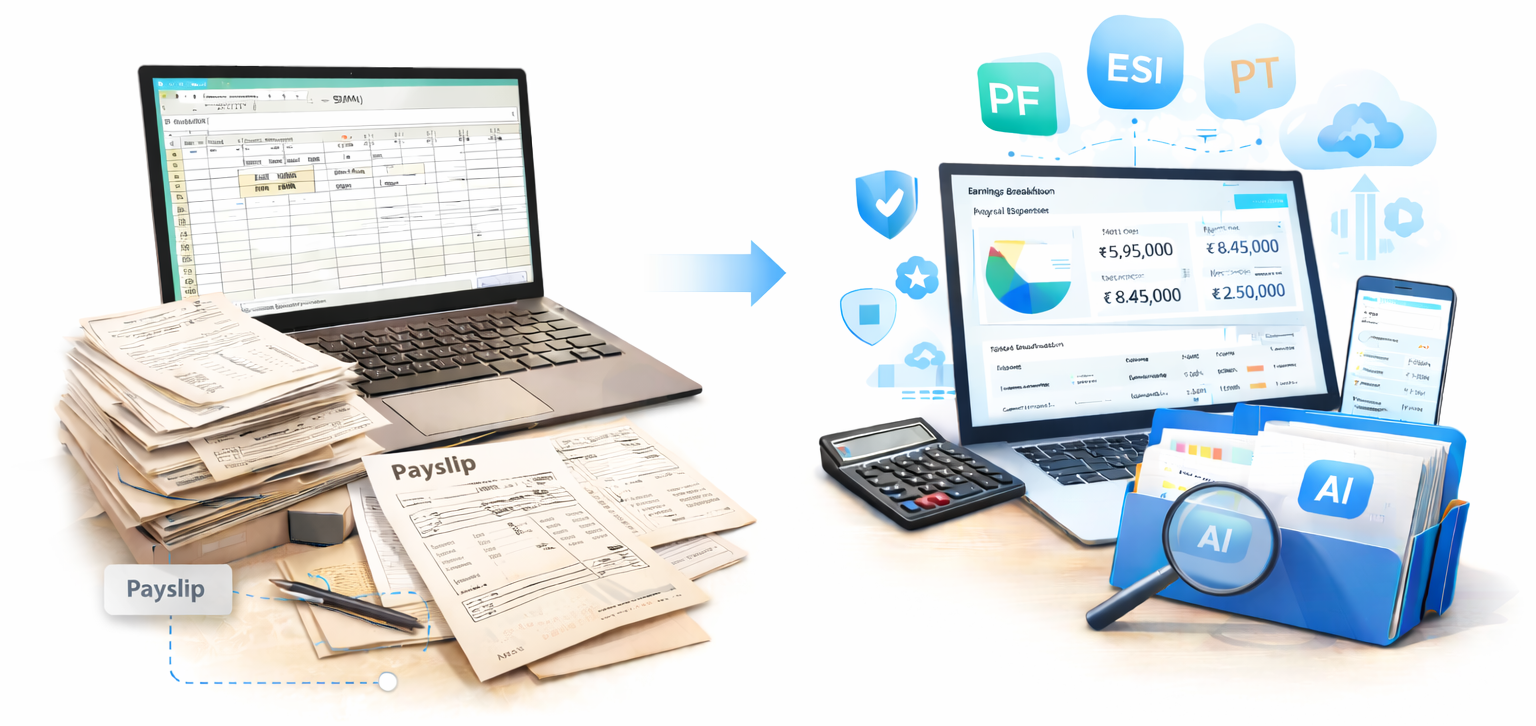
The journey of payroll management Mirror the broader digital transformation of business operations. What started ledger books And manual calculations Developed for the latest cloud- based systems artificial intelligence. This development reflects not only no technological advancement, But a fundamental shift How organizations approach one Most of them critical functions: payment their people Accurate and on period.
The Era of Manual Calculations
Before computers became commonplace in offices, payroll was an entirely manual process. Accountants hunched over desks with ledgers, calculators, and tax tables, meticulously computing wages, deductions, and net pay for each employee. The process was time-consuming and error-prone. A single miscalculation could cascade through an entire pay period, requiring hours of detective work to identify and correct.
For small businesses with a handful of employees, this system was manageable, if tedious. For larger organizations, payroll departments swelled with clerks whose sole responsibility was ensuring everyone got paid correctly. The arrival of each pay period meant days of intensive work, double-checking figures, and hoping no mistakes slipped through.
The Spreadsheet Revolution
The introduction of spreadsheet software in the late 1970s and early 1980s represented the first major leap forward. Programs like VisiCalc, and later Lotus 1-2-3 and Microsoft Excel, transformed payroll processing. Suddenly, calculations that once required careful manual arithmetic happened instantaneously. Formulas could be replicated across hundreds of rows. Changes to tax rates or benefit deductions could be implemented once and applied universally.
Spreadsheets brought significant advantages. They were flexible, allowing businesses to customize their payroll processes to their specific needs. They were accessible, running on the personal computers that were becoming standard office equipment. And they were relatively affordable compared to mainframe-based systems.
However, spreadsheets also had limitations that became more apparent as businesses grew and regulations became more complex. They were still fundamentally manual systems requiring significant human input and oversight. Data had to be entered carefully, formulas could be accidentally overwritten, and version control became a nightmare when multiple people needed access. Security was minimal—anyone with access to the file could view sensitive salary information or, worse, make unauthorized changes.
Perhaps most critically, spreadsheets existed in isolation. Payroll data lived in one file, employee records in another, time tracking in a third. This fragmentation made it difficult to maintain accuracy and compliance, especially as employment laws and tax codes grew increasingly complicated.
The Rise of Dedicated Payroll Software
The 1990s saw the emergence of dedicated payroll software designed specifically to address the limitations of spreadsheets. These early systems, often installed on-premises, automated many aspects of payroll processing. They could calculate taxes based on current rates, track year-to-date earnings, generate checks or direct deposit files, and produce reports for tax filing.
This generation of software introduced important concepts that remain central to payroll systems today. Data integration allowed payroll to connect with timekeeping systems, reducing manual data entry. Automated tax calculations ensured compliance with constantly changing regulations. Employee self-service portals began emerging, allowing workers to view their pay stubs and update personal information without involving HR staff.
The software also introduced better controls and audit trails. Who made what changes and when became trackable. Access could be restricted based on roles. Backup and recovery processes protected against data loss.
Still, these systems had their own challenges. They required significant upfront investment in software licenses and server infrastructure. Updates and patches had to be manually installed, often requiring IT expertise. Scaling up as a business grew meant purchasing additional licenses and potentially more hardware. And for companies with operations in multiple locations or countries, managing different instances of the software became complex.
The Cloud Computing Transformation
The shift to cloud-based payroll systems, accelerating in the 2010s, fundamentally changed the landscape. Instead of software installed on local servers, payroll moved to systems accessed through web browsers and hosted by vendors on their infrastructure.
This model offered compelling advantages. Implementation became faster and less expensive, with no servers to purchase or maintain. Updates happened automatically and simultaneously for all users, ensuring everyone always had the latest features and tax tables. Scaling became as simple as adjusting subscription levels rather than buying new hardware. And access became truly mobile—managers could approve timecards from their phones, employees could view pay stubs from anywhere, and payroll could be run from home if needed.
Cloud systems also enabled a level of integration previously difficult to achieve. Payroll could connect seamlessly with accounting software, human resources management systems, benefits administration platforms, and time tracking tools. This created ecosystems where data flowed between applications, reducing redundancy and the errors that come from manual data transfer.
Security, once a concern about cloud computing, became a strength. Major payroll vendors invested heavily in cybersecurity measures far beyond what most individual companies could implement on their own, including encryption, multi-factor authentication, and continuous monitoring for threats.
The Modern Era: Intelligence and Automation
Today's most advanced payroll systems represent another evolutionary leap, incorporating artificial intelligence, machine learning, and advanced automation. These systems don't just process payroll—they actively help prevent errors, ensure compliance, and provide insights.
Machine learning algorithms can identify anomalies that might indicate errors or fraud, such as unusual overtime patterns or duplicate payments. Predictive analytics help businesses forecast labor costs and model the impact of compensation decisions. Natural language processing enables employees to ask questions and get answers about their pay through chatbots rather than waiting for HR assistance.
Compliance has become increasingly automated. Modern systems monitor regulatory changes across jurisdictions and automatically update calculations accordingly. They can handle the complexity of employees working remotely across state or country lines, each with different tax obligations. They flag potential compliance issues before they become problems.
Integration has reached new levels of sophistication. Payroll systems now connect not just with accounting and HR software, but with retirement plan administrators, health insurance providers, workers' compensation carriers, and government agencies. W-2s can be filed electronically, garnishments can be managed automatically, and new hire reporting happens seamlessly.
The employee experience has transformed as well. Self-service portals evolved into comprehensive platforms where workers can view their entire compensation picture, adjust tax withholdings, enroll in benefits, track paid time off, and access financial wellness tools. Some systems even offer on-demand pay, allowing employees to access earned wages before the regular pay cycle.
The Impact on Organizations
This evolution has had profound effects on how businesses operate. The time required to process payroll has decreased dramatically. What once took days now takes hours or even minutes. This efficiency has allowed payroll and HR teams to shift from transactional work to strategic initiatives, focusing on talent development, employee engagement, and workforce planning rather than just processing checks.
Accuracy has improved significantly. While no system is perfect, the combination of automation, validation rules, and integration has reduced error rates substantially compared to manual or spreadsheet-based processes. This means fewer corrections, less frustration for employees, and reduced compliance risk.
Perhaps most importantly, access to payroll has democratized. Sophisticated payroll capabilities that were once available only to large corporations with substantial IT budgets are now accessible to small businesses through affordable cloud subscriptions. A startup with five employees can access the same caliber of payroll technology as a multinational corporation.
Looking Forward
The evolution In progress. Emerging technologies Promises more change. Blockchain Can enable more secure and transparent payroll records. Advanced AI Can predict and prevent compliance issues before they occur. Integration with global financial systems could make international payroll It's that simple domestic processing. The fundamental challenge of payroll Not changed: ensuring people On time and correctly paid in accordance applicable laws. What has changed? our ability To assemble this challenge effectively. From manual ledgers AI- powered platforms, each evolution What is the construction? previous innovations while addressing limitations and expanding opportunities. Assessing organizations their payroll The process today, the lesson from this evolution is apparent: the right system is one It doesn't just encounter current needs But can adapt to future changes in technology, rules and regulations and business requirements.
The spreadsheet that worked a small business ok me its early days can be a liability As it grows. Local systems such as required significant investment Can go further flexible cloud alternatives. The evolution From the spreadsheet sophisticated software It just isn't a story K technological progress. This is a story of businesses to recognize that payroll, Far from being a simple administrative task, is a critical function Deserves the best tools available. Seam these tools Continue to evolve, freeing organizations to be less focused the mechanics of payroll And more the people It serves.