




ATCHAYA M
Developer
Updated on
13-02-2026
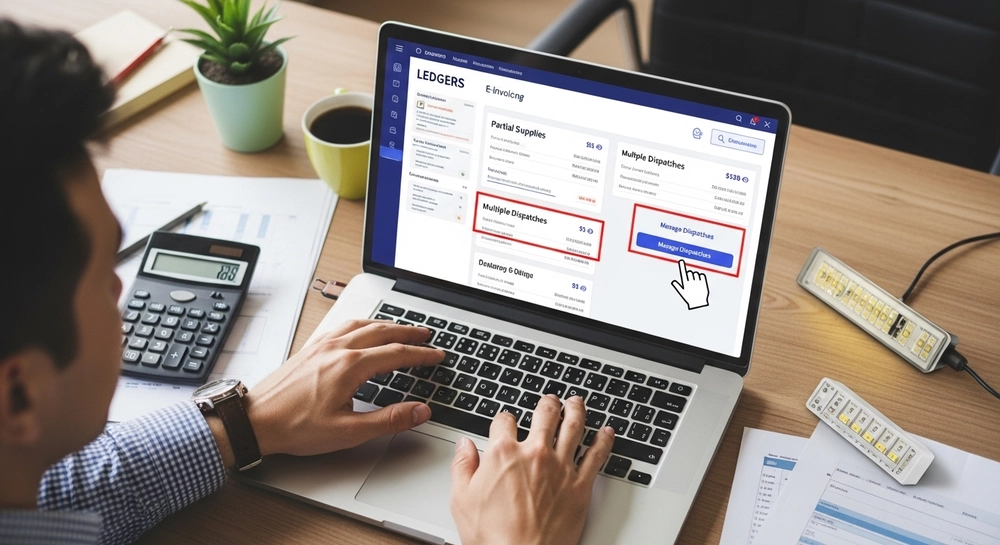
Handling Partial Supplies and Multiple Dispatches in e-Invoicing
For many businesses involved in selling a product, multiple transactions occur during the fulfillment process rather than just one complete transaction. Fulfillment of an entire order will often occur in multiple transactions due to a variety of factors, including: the supply is not available all at once; larger orders are typically shipped in phases; the logistics process has limitations, requiring multiple trips to deliver an order; customers may request to receive the order in parts.
While partial fulfillment of an order is common from a business and operational perspective, e-invoicing and compliance with GST regulations can create complexity. When an order has been fulfilled partially or shipped in multiple shipments, businesses must be cautious about issuing the invoice correctly and generating the IRN correctly. If businesses do not take care, they risk generating the IRN incorrectly, creating e-way bill problems, or creating discrepancies in their GST returns.
Why Partial Supplies Create Compliance Challenges
Partial supply situations usually arise when:
- Goods are not fully available at once
- Large orders are delivered in phases
- Logistics constraints require multiple trips
- Customers accept delivery in parts
From a GST perspective, the challenge is deciding when to issue and how to represent the supply correctly without overstating or understating tax liability.
Issuing a single invoice for the full order value before dispatching all goods may create problems if only part of the supply actually moves. On the other hand, raising multiple invoices without clear linkage can complicate tracking and reconciliation.
Understanding the Relationship Between Order, Invoice, and Dispatch
It is important to remember that GST and e-Invoicing work at the invoice level, not the order level. An order is a commercial document, but compliance obligations arise only when an invoice is issued.
In partial supply scenarios, businesses generally follow one of these approaches:
- Issue separate invoices for each dispatch
- Issue invoices only for quantities actually supplied
- Maintain clear linkage between dispatches and invoices
Each approach must ensure that the invoice accurately reflects what is being supplied at that moment.
Issuing Separate Invoices for Partial Supplies
The most common and safest approach is to issue separate invoices for each partial dispatch. Each invoice:
- Covers only the quantity being supplied
- Is eligible for IRN generation
- Reflects the correct taxable value
- Can be linked to its own e-Waybill
This approach keeps compliance clean because every movement of goods is supported by a valid invoice and IRN. It also simplifies return filing, since each invoice represents a completed supply.
Avoiding Common Mistakes in Partial Dispatch Cases
Businesses often run into issues when they:
- Generate IRN for full quantity but dispatch only part
- Use the same invoice for multiple dispatches
- Modify invoice quantities after IRN generation
- Generate e-Waybills without matching invoice values
Once an IRN is generated, the invoice details become fixed. Any mismatch between the invoice and actual movement of goods can attract scrutiny during inspections or audits.
Handling Multiple Dispatches Against a Single Order
When a single customer order is fulfilled through multiple dispatches, it is important to maintain clarity in internal records. While customers may see it as one order, GST treats each invoiced supply independently.
Best practices include:
- Referencing the same order number across invoices
- Clearly indicating partial supply quantities
- Maintaining consistency in tax rates and HSN details
- Tracking cumulative quantities internally
This ensures transparency for both the business and the customer without affecting compliance.
Impact on e-Waybill Generation
Partial dispatches often require separate e-Waybills for each movement of goods. Since e-Waybills rely on invoice data, mismatches can occur if invoice values do not align with dispatched quantities.
To avoid issues:
- Generate e-Waybills only for invoiced quantities
- Avoid reusing invoice numbers for multiple trips
- Ensure transport details match each dispatch
Clean linkage between invoice, IRN, and e-Waybill helps during roadside checks and audits.
Return Filing and Reconciliation Considerations
From a GST return perspective, partial supplies should not create problems if invoicing is handled correctly. Each invoice appears independently in GSTR-1, and tax liability is reported based on actual supplies.
Problems arise only when:
- Invoices are raised ahead of dispatch
- Quantities are adjusted later without proper documentation
- Credit notes are used unnecessarily to correct mistakes
A disciplined invoicing approach reduces reconciliation effort later.
Why a Structured System Matters
Managing partial supplies manually or through spreadsheets increases the risk of inconsistency. A structured invoicing system helps businesses:
- Issue invoices only for actual supplies
- Maintain traceability across dispatches
- Avoid post-IRN corrections
- Stay audit-ready
This becomes especially important for businesses handling high-value or high-volume goods.
Conclusion
Partial supplies and multiple dispatches are a reality for many businesses, but under e-Invoicing, they require careful handling. The key is to ensure that invoices always represent what is actually supplied, not what was originally ordered or planned.
By issuing clear, dispatch-aligned invoices and maintaining proper documentation for each movement of goods, businesses can handle partial supplies confidently while staying compliant with e-Invoicing and GST requirements. A disciplined approach at the invoicing stage prevents downstream issues and keeps compliance simple, even in complex logistics scenarios.