




VAIRAVAN K
Senior Developer
Updated on
18-06-2026
GST Invoicing Software in India: A Complete Guide for Businesses
Running a business in India today means living with GST, whether you like it or not. Every invoice you raise has to follow a set format, every tax line has to be calculated correctly, and every return you file has to match what is sitting in your books. Get any one of these wrong and you are looking at mismatched returns, blocked input credit, or a notice from the department. This is the exact gap that GST invoicing software is built to close, and it is why more Indian businesses are moving away from spreadsheets and generic billing tools every year.
What GST Invoicing Software Actually Does
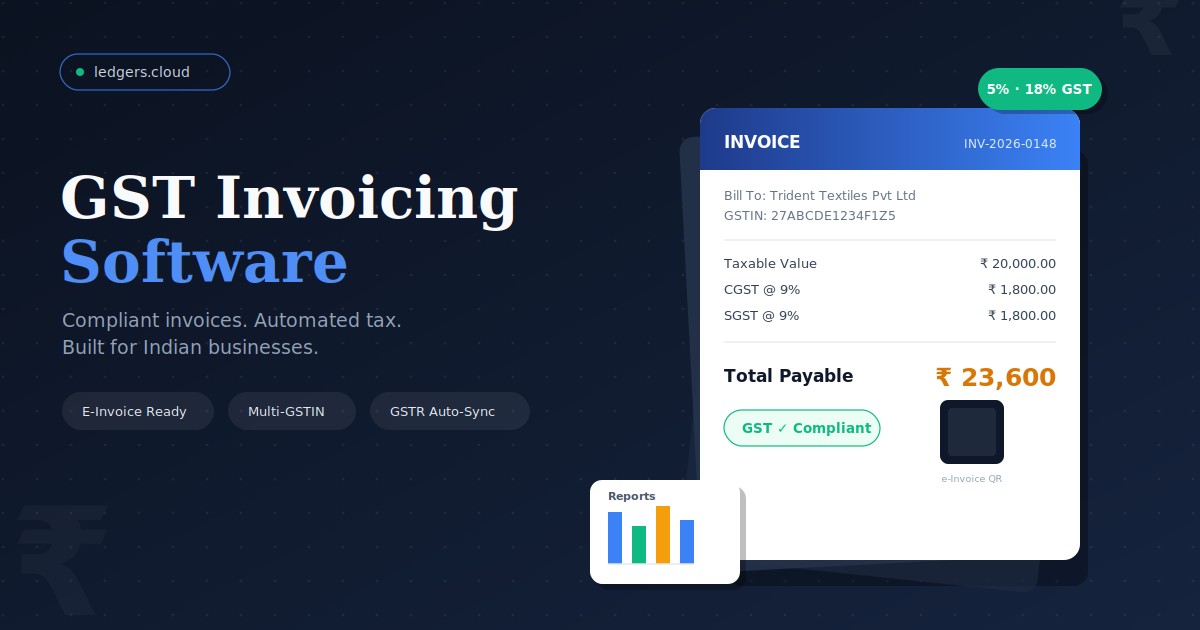
At its core, GST invoicing software creates invoices that are already compliant with GST law the moment you hit generate. Instead of you working out the tax manually, the software picks up the rate linked to the product or service and applies it for you, showing a clean breakup of CGST, SGST, or IGST depending on where the buyer is located. It also keeps a running log of every invoice you raise, which becomes invaluable when it is time to file GSTR-1 or GSTR-3B.
For businesses that cross the e-invoicing turnover threshold of five crore rupees, the software also generates the Invoice Reference Number and QR code that the law requires before an invoice is considered valid. If your turnover is above ten crore, you also have to report that e-invoice to the government portal within thirty days, so software that handles this automatically saves you from a compliance headache you really do not want.
Why Manual Invoicing Starts to Break Down
Most small businesses begin with Excel or a basic billing app, and honestly, that works fine in the early days. The trouble starts once the business grows a little. Tax rates differ across products, invoice numbers get duplicated by accident, and the figures in your books slowly drift away from what you have actually filed in your returns. Reconciling all of this every month eats up hours that could be spent on something more useful, like talking to customers or chasing payments.
There is also the audit side of things to consider. If a GST officer asks for invoice level detail during scrutiny, having everything scattered across spreadsheets and old email attachments is not where you want to be standing. A proper invoicing system keeps records organised and ready to pull up the moment they are needed, which counts for a lot when you are trying to prove your numbers are clean.
GST itself has also gotten a fresh shake up recently. With the GST 2.0 reforms that came into effect in September 2025, most goods and services now fall under the five percent or eighteen percent slabs, with a forty percent rate reserved for luxury and sin goods. Software that updates its tax tables on its own saves you from manually rechecking rates on every single product line every time the rules shift.
Features Worth Looking For
Not every invoicing tool offers the same depth, so it helps to know what actually matters before you commit to one. A few things worth checking are listed below.
- Multi GSTIN and multi branch support, useful if you operate from more than one state
- Automatic GST rate mapping linked to HSN and SAC codes
- E-invoice and IRN generation for businesses above the applicable turnover limit
- E-way bill generation linked directly to your invoices
- GSTR-1 and GSTR-3B ready reports that cut down the work your accountant has to do
- Recurring invoices and reminders for clients who pay you every month
- Bank reconciliation so you always know which invoices are actually paid
Who Actually Needs This
GST invoicing software is not reserved for large companies with finance teams. A freelance designer raising a handful of invoices a month benefits just as much as a trader handling hundreds of transactions a day. Retailers get faster billing at the counter, service providers get cleaner records for advance tax workings, exporters get the paperwork needed for LUT filing and refund claims, and manufacturers get HSN level tracking across multiple product lines without losing their mind over spreadsheets.
If your business raises even one GST invoice a month, the time saved and the errors avoided usually make the switch worth it within the first few months.
Choosing the Right Software for Your Business
Not all GST invoicing tools are built the same way, so a bit of comparison goes a long way. Look for software that updates automatically whenever GST rates or filing rules change, rather than one that needs you to patch things manually every time the GST Council meets. Cloud based platforms tend to work better for most businesses since your data stays accessible from anywhere and backups happen on their own, without you having to think about it.
It also helps to check whether the software connects to your bank for reconciliation, supports multiple users with different access levels, and produces reports that are genuinely ready for return filing rather than raw data you still have to clean up yourself. Pricing matters too, of course, but the real cost of poor software tends to show up later, in penalties and wasted hours, rather than in the subscription fee itself.
This is exactly the gap that Ledgers is built to fill. It brings GST compliant invoicing, GSTR filing, e-invoicing, bank reconciliation, and payroll together in one place, so you are not juggling four or five different tools just to keep your books straight. The platform is built around how Indian businesses actually file and reconcile, which means less guesswork and fewer surprises at filing time. If you want invoicing software that takes the compliance load off your plate while you get on with running the business, it is worth giving ledgers.cloud a try.