




MONISHA D
Updated on
30-07-2026
Understanding GST Invoice Rules Every Business Owner Must Know
GST invoicing is one of the most important parts of running a compliant business in India. Every registered business must issue invoices correctly, maintain accurate records, and ensure proper tax reporting under the Goods and Services Tax (GST) system. Errors in invoicing can lead to penalties, delayed payments, tax mismatches, and compliance issues.
Whether you are a startup, retailer, wholesaler, service provider, manufacturer, freelancer, or growing enterprise, understanding GST invoice rules is essential for smooth business operations.
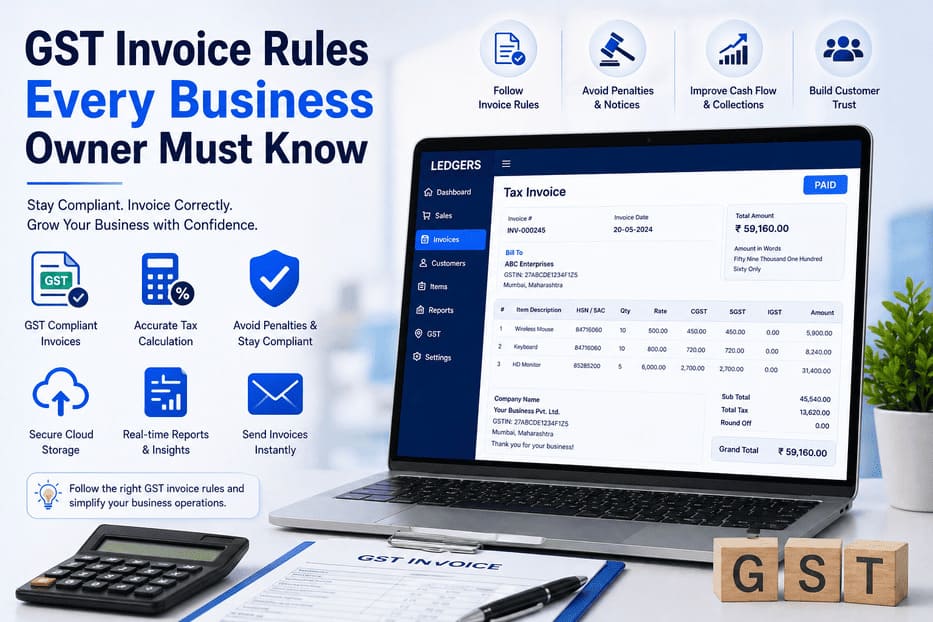
Ledgers Accounting Software helps businesses simplify GST invoicing with automated tax calculations, professional invoice formats, customer management, payment tracking, and cloud-based access. It helps generate invoices accurately while reducing manual mistakes.
What is a GST Invoice?
A GST invoice is a legal tax document issued when goods or services are sold. It records transaction details such as seller information, buyer information, taxable value, GST amount, and total payable amount.
A proper GST invoice is required for:
- Collecting GST from customers
- Claiming Input Tax Credit (ITC) by buyers
- Filing GST returns
- Maintaining business records
- Tracking sales and receivables
Without a correct invoice, businesses may face difficulties during tax filing and audits.
Why GST Invoice Rules Matter
GST invoices are not just bills—they are official tax records. Incorrect invoices may result in:
- Tax mismatches in returns
- Customer disputes
- ITC rejection for buyers
- Penalties from authorities
- Accounting confusion
- Delayed collections
Using invoicing software like Ledgers helps reduce these risks through automation and proper formatting.
1. Every GST Invoice Must Have a Unique Invoice Number
Each invoice issued by a business must carry a unique serial invoice number for a financial year.
Important Points:
- Invoice numbers should be sequential
- Duplicate invoice numbers should be avoided
- Can include alphabets, numbers, hyphens, or slashes
- Maintain consistency throughout the year
A unique numbering system helps in tracking invoices and filing returns properly.
2. Mention Seller Details Clearly
Every GST invoice must contain complete business details of the seller.
Include:
- Legal business name
- Business address
- GSTIN
- Contact details (optional but recommended)
This confirms who issued the invoice.
3. Buyer Details Must Be Correct
Customer information should be clearly mentioned, especially for B2B invoices.
Include:
- Customer name
- Billing address
- Shipping address (if different)
- GSTIN of buyer (for registered customers)
- State code where applicable
Incorrect customer data may create GST return mismatches.
4. Invoice Date is Mandatory
Every invoice must carry the correct issue date.
The invoice date determines:
- Tax period
- Return filing month
- Payment due date
- Credit period tracking
Always issue invoices promptly and with accurate dates.
5. Describe Goods or Services Properly
Invoices should clearly mention what is being sold.
Include:
- Product / service name
- Quantity
- Unit
- Rate
- Discount if any
- Total taxable value
Vague descriptions should be avoided.
6. Use Correct HSN or SAC Codes
GST invoices often require classification codes.
HSN Code:
Used for goods.
SAC Code:
Used for services.
Correct coding helps in:
- GST reporting
- Tax classification
- Return filing
- Audit compliance
Ledgers helps maintain product and service masters with proper tax data for faster invoicing.
7. Apply Correct GST Tax Type
Depending on the transaction type, correct GST should be charged.
Intra-State Supply:
- CGST
- SGST
Inter-State Supply:
- IGST
Incorrect tax type may lead to payment errors and notices.
Ledgers automates CGST, SGST, and IGST calculations based on invoice rules.
8. Show Tax Amount Separately
Invoices must clearly display:
- Taxable amount
- CGST amount
- SGST amount
- IGST amount
- Total invoice value
Transparent breakup builds trust and ensures accurate accounting.
9. Place of Supply Must Be Mentioned
For inter-state transactions and many B2B invoices, place of supply is important.
This helps determine whether CGST/SGST or IGST applies.
Especially relevant for:
- Inter-state sales
- Export supplies
- Service transactions
10. Signature or Authorization Helps Authenticity
Invoices may include:
- Authorized signatory name
- Digital signature
- Company seal (if used internally)
Digital invoicing platforms simplify this process.
11. Maintain Invoice Copies Properly
Businesses should securely maintain invoice records for future use.
Keep copies for:
- GST return filing
- Customer disputes
- Payment follow-up
- Tax notices
- Audit checks
Cloud software like Ledgers stores invoices securely for anytime access.
12. Issue Different Invoice Types Correctly
Businesses may need multiple invoice types.
Common Types:
- Tax Invoice
- Proforma Invoice
- Credit Note
- Debit Note
- Export Invoice
- B2B Invoice
- B2C Invoice
Ledgers supports GST invoicing workflows and related invoice management features.
13. Payment Tracking is Equally Important
Creating invoices alone is not enough. Businesses must track whether payments are received.
Track:
- Paid invoices
- Partial payments
- Overdue invoices
- Outstanding balances
Ledgers offers real-time receivables tracking and invoice status management.
14. Use Professional Invoice Templates
A clean invoice improves brand image and customer confidence.
Professional invoices should include:
- Logo
- Clean formatting
- Proper tax breakup
- Payment terms
- Contact details
Ledgers enables PDF-ready professional invoices for print or email delivery.
15. Automate GST Invoicing to Reduce Errors
Manual invoicing using spreadsheets often creates:
- Wrong calculations
- Missing tax fields
- Duplicate invoice numbers
- Incorrect totals
Automation helps save time and maintain accuracy.
How Ledgers Helps Businesses Stay GST Compliant
Ledgers Accounting Software simplifies invoicing through:
- GST-compliant invoice creation
- Auto tax calculation
- Invoice sharing by email or WhatsApp
- Real-time tracking
- Multi-currency invoicing
- Customer payment reminders
- Secure cloud access
- Accounting integration
Common GST Invoice Mistakes to Avoid
Avoid these common errors:
- Wrong GSTIN entered
- Incorrect tax type selected
- Missing HSN/SAC code
- Duplicate invoice number
- Wrong customer details
- Incorrect totals
- Delayed invoice issue
- No record backup
Using Ledgers helps reduce such mistakes through a guided workflow.
Who Should Follow These Rules?
These GST invoice rules are important for:
- Retailers
- Traders
- Wholesalers
- Manufacturers
- Service providers
- Consultants
- Freelancers
- Startups
- Multi-branch businesses
Any GST-registered business should issue invoices correctly.
Why Smart Businesses Use GST Invoicing Software
Modern businesses prefer software because it helps:
- Create invoices faster
- Stay GST compliant
- Reduce manual work
- Improve collections
- Maintain accurate records
- Scale billing operations smoothly
Conclusion
Understanding GST invoice rules is essential for every business owner in India. Proper invoices improve tax compliance, cash flow, customer trust, and operational efficiency.
Instead of depending on manual billing methods, businesses can simplify invoicing with Ledgers Accounting Software. It helps generate accurate GST invoices, automate calculations, track payments, and keep records organized in one smart platform.