




ALISHA FATHIMA A A
Updated on
30-07-2026
Streamline Payroll with Attendance Integration Using Ledgers Software
Attendance integration with payroll has become a critical requirement for modern businesses striving to improve operational efficiency, accuracy, and compliance. As organizations grow in size and complexity, managing employee attendance and payroll using separate systems often leads to fragmented processes, data inconsistencies, and increased administrative burden. Integrating attendance and payroll through ledgers software enables businesses to automate salary calculations, minimize errors, and maintain regulatory compliance while improving employee confidence in payroll processes.
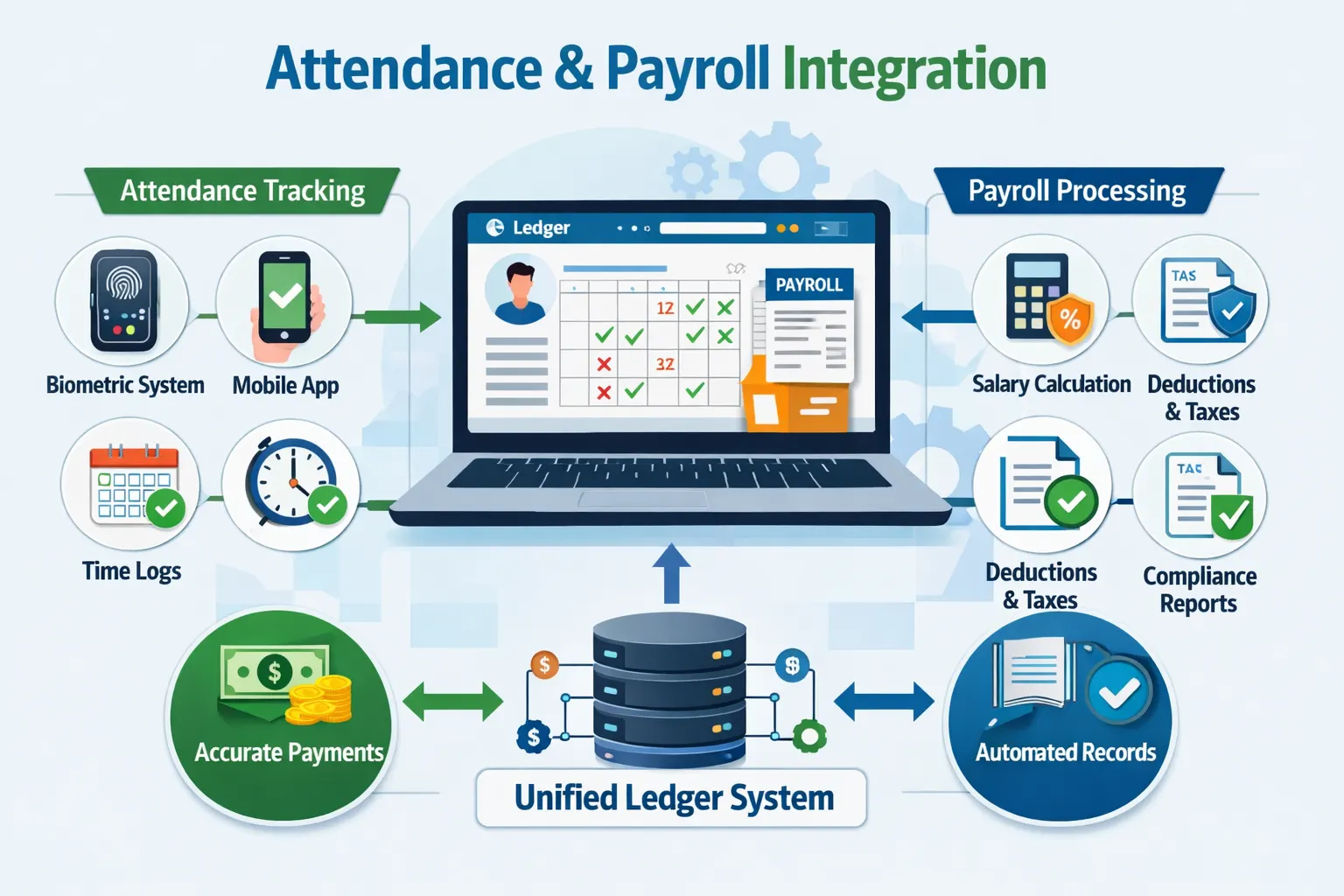
In many organizations, attendance is tracked using biometric devices, mobile applications, or manual registers, while payroll is processed using separate payroll or accounting tools. When these systems do not communicate seamlessly, HR and finance teams are forced to manually reconcile data every payroll cycle. This not only consumes valuable time but also increases the likelihood of payroll discrepancies, delayed salary payments, and compliance risks. Ledgers software bridges this gap by centralizing attendance and payroll data into a unified, structured system that ensures accuracy, transparency, and scalability.
Challenges of Managing Attendance and Payroll Separately
Managing attendance and payroll as separate functions introduces several challenges that grow more complex as organizations expand. These challenges impact efficiency, employee satisfaction, and compliance with labor regulations.
Data Inconsistency and Payroll Errors
One of the most common challenges is data inconsistency. Attendance data captured from biometric machines, mobile apps, or manual inputs does not always align with payroll rules. Differences in cut-off dates, rounding logic, shift policies, overtime calculations, and leave treatment often result in payable day discrepancies and salary disputes.
For example, attendance systems may calculate working days differently from payroll systems, or leave balances may not be updated in real time. These inconsistencies require manual correction, increasing the risk of errors and employee dissatisfaction.
Manual Processes and Operational Inefficiency
Many organizations rely on spreadsheets or partial integrations to transfer attendance data into payroll systems. This manual approach increases dependency on human intervention, making payroll processing time-consuming and error-prone. HR and finance teams spend significant time validating data, correcting mistakes, and responding to employee payroll queries.
Manual data entry also slows down monthly payroll closures and audits. As the workforce grows, these inefficiencies multiply, making it difficult for organizations to scale payroll operations effectively.
Compliance and Regulatory Risks
Compliance is a major concern in attendance and payroll management. Payroll calculations must adhere to labor laws, statutory deductions, tax regulations, and company policies. When attendance and payroll systems operate independently, discrepancies in attendance data can lead to incorrect statutory contributions, tax miscalculations, and non-compliance with wage and hour regulations.
Failure to reconcile attendance records with payroll output can result in penalties, audit observations, and reputational damage. For organizations operating across multiple locations or jurisdictions, these compliance risks become even more significant.
Lack of Transparency and Employee Trust
When payroll discrepancies occur, employees expect clear explanations. However, disconnected attendance and payroll systems make it difficult to trace salary calculations back to attendance records. This lack of transparency erodes employee trust and increases the volume of payroll-related queries, placing additional strain on HR teams.
Understanding Attendance Integration with Payroll
Attendance integration enables payroll to directly receive attendance information (e.g., working days, hours of overtime, days off, holidays, and absence days) into the calculations done by the payroll department without requiring any additional action from a person. Automation of attendance integration into payroll processing means that employees or HR personnel are no longer required to manually enter attendance data into the payroll system. This provides opportunities for reducing errors, saving time, and achieving reliable consistency among attendance and payroll records as well as financial records.
Additionally, integrated systems provide organizations with access to real-time information on attendance and payroll activities, which facilitates the ability to identify and correct mismatches in real-time prior to payroll processing. This degree of automation and control has become critical to the accuracy and efficiency of payroll processing today
Key Benefits of Attendance and Payroll Integration
Integrating Attendance data with payroll processes reap multiple benefits for Human Resources (HR), Financial Management and improved experience for employees.
1. More Accurate Payroll - Because manual calculations are eliminated by automated data transfer; therefore, automating your attendance process will improve accuracy when calculating payable workdays/overtime and the employees' remaining leave balances. The result of implementing automated attendance processes and integrating payroll with attendance will be that all payrolls processed each pay cycle, will utilize accurate attendance data.
2. Payroll Procedures Done Faster - With an integrated attendance and payroll process, payroll processing times have decreased substantially. HR and Finance Departments have been able to complete payroll processing at much faster rates, particularly during peak periods
3. Reduced Administrative Expenses - The ability to reduce the manual input of attendance data and redo entries, has significantly decreased Administrative Cost for Organizations, and Organizations also Save Money on Payment Errors that require them to incur Additional Costs to Correct Errors, resulting in Penalties or Disputes Created Between the Organization and the Employee.
4. Increased Compliance with Labor Laws and Regulations - The use of integrated attendance and payroll processes results in Compliance with Labor Laws, Statutory Deductions, and Federal/State Income Tax Regulations. Accurate attendance data will create Accurate Contributions and Significantly Reduce the Risk of Non-Compliance by the Organization.
5. Employee Trust and Satisfaction Increased - When Employees are paid promptly and accurately it builds trust and increases satisfaction with the Organization. The Transparent Calculations of Payroll through Automated Attendance Processes, significantly reduces the number of Payroll Disputes and creates an Improved Experience Overall for Employees.
Why Ledgers Software Is the Right Choice
Incorporating participation into payroll records and automating participant payments were made possible through the use of ledgers software. By creating a centralized and structured repository for recording, authenticating, and tracking payroll transactions, Ledgers software provides a connection between participation data and payroll/financial records that exceeds that achieved with traditional stand-alone attendance tracking or payroll tools.
Centralizing and Integration of Processes: Ledgers Software consolidates attendance records, payroll records, and financial data into one integrated system, thereby eliminating the separate operating systems and providing the ability for companies to have the same payroll processes used for every department.
Automated Creation of Ledger Entries: With Ledgers software, all payroll transactions that are based on attendance records automatically result in the creation of ledger entries. Salary information, deduction information, tax information, and employee contributions are all created for payroll and recorded in a systematic manner; therefore, there is no longer a need for a company to reconcile manually ledger and payroll transactions.
Enhanced Transparency and Audit Readiness: The payroll entries recorded in Ledgers software are backed by verifiable attendance records, providing visibility into the audit process, increasing the level of visibility regarding payroll transactions, and allowing organizations to respond to compliance audits quickly.
Robust Compliance Framework: Ledgers software is designed to support businesses in satisfying legal and regulatory obligations through the accurate recording of payroll taxes, deductions, and employer contributions. Automated controls and reporting structures enable organizations to meet legal requirements while minimizing compliance risks .
Scalability and Uniformity of Processing: As companies grow, Ledgers software provides for the continued uniformity of payroll processing across geographic areas, departments, or employment categories. Whether hiring new employees, opening new offices, or changing payroll structures, Ledgers software ensures that uniform payroll processing continues throughout these changes.
The Role of Ledgers Software in Long-Term Payroll Management
Beyond automation, Ledgers software provides long-term value by supporting strategic payroll management. Centralized data enables better reporting, forecasting, and decision-making. Finance teams gain clearer insights into payroll costs, while HR teams can analyze attendance trends and workforce productivity .
Ledgers software also integrates seamlessly with broader financial systems, ensuring payroll data aligns with accounting and financial reporting. This alignment strengthens financial governance and supports informed business decisions
Conclusion
Attendance integration with payroll using Ledgers software is a strategic necessity for organizations seeking efficiency, accuracy, and compliance. Managing attendance and payroll separately leads to inefficiencies, data inconsistencies, and increased compliance risks-challenges that intensify as businesses grow.
By centralizing attendance and payroll data into a single integrated system, Ledgers software eliminates manual reconciliation, improves transparency, and ensures regulatory compliance. This unified approach streamlines payroll operations, reduces errors, and builds employee confidence in payroll management.
Adopting Ledgers software for attendance and payroll integration empowers organizations to scale efficiently, maintain compliance, and deliver a reliable payroll experience-making it a cornerstone of modern workforce and financial management.
Say goodbye to manual payroll. Ledgers Software links attendance directly to payroll for smooth, accurate salary calculations .