




SHANJU A
Updated on
30-07-2026
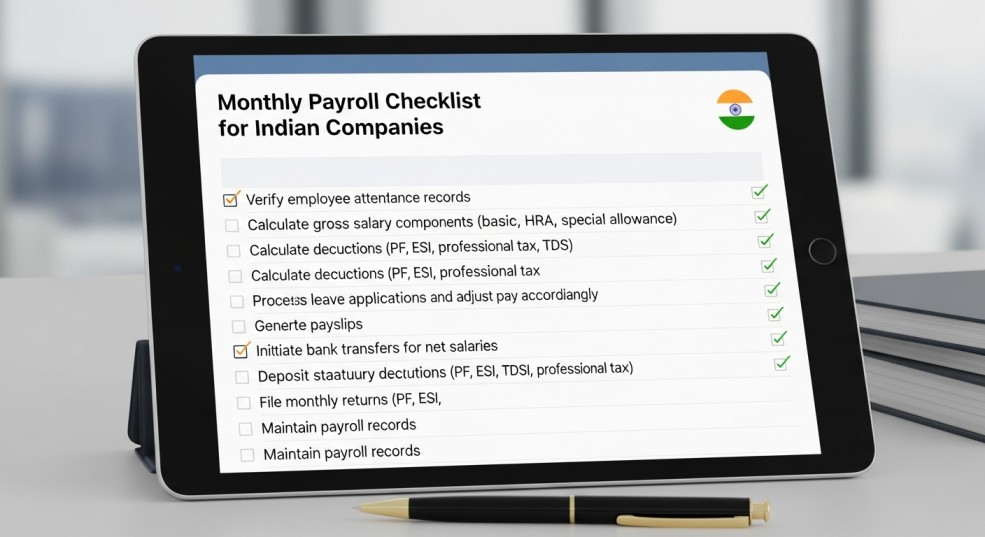
Monthly Payroll Checklist for Indian Companies
Running payroll every month can feel overwhelming when you are juggling multiple tasks and deadlines. Between calculating salaries, processing statutory deductions, filing returns, and ensuring compliance, it is easy to miss something important. A single mistake can lead to unhappy employees, penalties from authorities, or both.
Having a payroll checklist is really important for Indian companies. It helps them stay organized. Makes sure they do not forget anything. This guide will tell companies what they need to do every month to run their payroll correctly and follow all the rules. Indian companies need to follow these steps to run their payroll smoothly and stay compliant, with the regulations that apply to companies.
Before Processing Payroll
The groundwork you do before actually processing payroll determines how smoothly everything runs. Taking care of these tasks first saves you from headaches later.
Collect Attendance Data
We need to get the attendance records for all employees for the month. This means we have to look at the days they came to work the extra hours they worked the times they were late the times they left early and any days they only worked half a day. A lot of companies use machines that scan fingers or faces, attendance apps, on phones or just a book where people sign in to keep track of attendance records for all employees.
You need to make sure the data is correct and has all the information. If you find any mistakes or things that do not look right you should check with the managers. The employees who work from home should also send in their attendance using the system that your company has. This is important for the company to keep track of the employees attendance.
Check the attendance for the few days of the month. The attendance for the days of the month can get uploaded really late or it might not get uploaded at all. If your company is open on Saturdays or Sundays then you should check if the attendance, for weekend working is correct. You should also make sure that public holidays were marked correctly in the attendance system. Check the attendance system again to confirm that holidays and attendance for the last days of the month are correct.
Update Leave Records
We need to write down all the leaves that people take in a month. This means we have to record leave sick leave, earned leave, loss of pay maternity leave, paternity leave and all the other types of leave that our company gives to employees. We have to keep track of every type of leave including maternity leave and paternity leave and also loss of pay and earned leave and casual leave and sick leave.
We need to check the leave balances for each employee. Some employees may have taken time off than they were supposed to which will affect how much salary they get. We have to make sure our leave management system or spreadsheet has the information from this month. This way we can verify the leave balances, for each employee. Make sure everything is correct.
We need to check if any employees took a day off and make sure that it is calculated correctly.
We have to look at the periods of leave to confirm that they were approved by the managers.
Now we have to update the leave balances for the month so the employees know how much leave they have available for the employees.
The employees need to know how much leave they have. We need to make sure the leave balances, for the employees are correct.
Process New Joiners
For employees who joined during the month we need to collect all the documents from the employees. The employees who joined during the month have to give us a lot of documents. This includes the appointment letters that the employees who joined during the month have filled. The employees who joined during the month also have to give us their KYC documents. The KYC documents include things, like Aadhaar and PAN card. The employees who joined during the month have to give us their bank account details. We also need to know about the employer of the employees who joined during the month.. The employees who joined during the month have to fill Form 11 for PF registration.
Calculate their salary on a pro-rata basis based on their joining date. Register them for PF and ESI if applicable. Generate their UAN and ESIC number. Add them to your payroll system with all correct details.
To make sure everything goes smoothly you should verify the bank account details of the employees by doing a test transfer if you can. If the bank details are wrong it can cause problems when you try to transfer their salary.
You should also collect information about their employer and their Form 16 especially if they started working with you in the middle of the year. This information is really important because it helps you calculate the Tax Deducted at Source or TDS for the whole financial year. Having the correct TDS calculation for the financial year is crucial, for the employees so you should make sure to get their previous employer details and Form 16.
Handle Employee Exits
When employees leave during the month we need to figure out their settlement. The final settlement for employees includes the salary for the days they actually worked. We also need to add the money they get for not using their leave. Employees might also get a bonus or incentive that they have earned. If employees do not give notice we have to deduct the notice period shortfall from their final settlement, for employees.
We need to process the employees provident fund withdrawal or transfer requests. Then we have to update the employees status in the portal and the ESIC portal. We must make sure we have the employees resignation letter and the feedback, from the employees exit interview and that these things are documented properly for the employee.
To figure out the notice period recovery we need to see if the employee served the notice period before they left. The company also needs to get its property, like laptops and ID cards from the employee. The company should also get back any advance amounts it paid to the employee.
We have to go through all the reimbursement claims the employee submitted and clear them.
The employee will get a relieving letter and an experience certificate when they leave.
If the employee is leaving in the middle of the year the company will give them Form 16.
Record Salary Changes
You need to update any salary changes that happened during the month. This includes things like raises, promotions or other salary adjustments. The new salary structure has to be put into your payroll system. You have to make sure everything is entered right so that salaries are paid correctly. Update the salary revisions for things, like increments and promotions.
Document any changes to allowances, bonuses, or other salary components. Get written confirmation of these changes from management and keep them on file.
If you have to pay some money because the changes were made to the past you need to figure out the amount of money that you owe. You have to pay tax on the money that you owe. You can get some help with this tax under Section 89 if the amount of money is really big. You should also update the salary details, in your system so that for the months that are coming up the new amounts are used automatically.
Collect Investment Declarations
At the start of the year or when you have to make declarations you should get investment declarations, from every employee. The employees have to tell you about the investments they plan to make under Section 80C, Section 80D HRA and the other sections that help save tax.
These declarations are really helpful to figure out the Tax Deducted at Source throughout the year. You should remind your employees about the deadline, for submitting these declarations. Then follow up with the employees who have not submitted their Tax Deducted at Source declarations yet.
Also collect actual investment proofs if it is near the year-end. Employees need to submit proof of actual investments made during the year. Reconcile declarations with proofs and adjust TDS for the remaining months accordingly. Some employees might need to pay additional tax while others might get refunds.
Update Loan and Advance Records
We need to see if any employees have taken loans that we need to get this month. We also have to check if any employees have taken advances that we need to recover this month. For these employees we will update the amounts that are still owed to us. Then we will calculate how money we need to take out of their salary every month and we will do this based on what we agreed to with the employees who took the loans or advances.
Some employees might have finished paying back their loan. We need to check this and stop taking money out of their paychecks. We should write down all the details so there is no confusion, about the loan repayment. This way we can keep track of everything related to the loan repayment. Make sure it is accurate.
We need to check if any new loan or advance requests were approved this month. If they were we have to add these loan or advance requests to the recovery schedule. The new loan or advance requests should be added to the recovery schedule starting from this month or the next month depending on what we agreed on.
We also have to make sure that the amount we deduct for the loan or advance requests does not go over the maximum amount that labor laws say we can deduct. This is important, for the loan or advance requests.
Verify Variable Pay Components
Check if there are any performance bonuses, incentives, or commissions to be paid this month. Collect approved data from sales or operations teams regarding targets achieved and payments due.
We need to check the hours people worked and figure out how much extra money they should get. This is based on what our company says and what the labor law says. We have to make sure we are using the overtime rate, which is usually twice the normal hourly rate, for the overtime hours worked. The overtime hours worked should be paid according to our company policy and the labor law requirements.
We need to see if there are any payments that were missed in the months that we still have to pay. This can be money that we did not pay as bonus or salary that we did not pay or mistakes that we made before that we have to fix. We have to figure out how much this is and add it to the payroll for this month. We have to make sure that we include these salary arrears and bonus arrears in the payroll, for this month so that everything is paid.
During Payroll Processing
When you have all the information you need you can begin calculating the salary and taking care of the rest of the process. The salary calculation is an important step because you really need to get it right. Salary calculation requires a lot of attention to detail so you have to be careful, with the salary calculation to make sure everything is correct.
Calculate Gross Salary
To figure out the salary you start with the basic salary. Then you add all the money that the company gives you. This extra money is called allowances. There are kinds of allowances. For example there is house rent allowance, which helps you pay for a place to live. There is also allowance, which is like a bonus to help with expensive things. You might get conveyance allowance to help pay for your commute to work. Some people even get medical allowance to help with doctor visits.. Sometimes there are special allowances for special situations. The thing is, each employee at a company might have a salary structure. This means that the allowances and the basic salary can be different, for each person.
When you are figuring out someones pay you need to add any extra money they get like overtime pay, shift allowances or performance bonuses. You have to use the rates and multipliers when you do the calculations, for overtime pay shift allowances and performance bonuses. This way you can make sure everything is correct for the overtime pay, shift allowances and performance bonuses.
Include any one-time payments like referral bonuses, retention bonuses, or special allowances. Add reimbursements that are part of salary like fixed conveyance or fixed mobile allowances. Ensure pro-rata calculations are done correctly for new joiners and employees who left mid-month.
Process Reimbursements
We need to make sure we include any money that we have to pay to the employees. This includes money for travel, mobile phone bills, internet charges or any other business expenses that the employees have paid for. We have to pay back the employees for things like business expense claims. The employees get money back for things, like travel reimbursements.
You need to check that employees have sent in the bills and that their managers have approved them. The thing is some reimbursements do not have to be included in taxes up to an amount but others are taxed completely. So you have to make sure you put the reimbursements in the categories for the employees. This is important for the employees and, for the company because reimbursements are a deal and you have to get them right.
For travel reimbursements, check if they are within company policy limits. Medical reimbursements are tax-free up to 15,000 rupees per year under the old tax regime. Conveyance allowance is tax-free up to 1,600 rupees per month. Categorize each reimbursement properly for correct tax treatment.
Calculate Statutory Deductions
To calculate the employee provident fund contribution we need to deduct 12 percent of the salary and the dearness allowance.
The employee provident fund contribution is 12 percent of the salary plus the dearness allowance.
We have to keep in mind that there is a wage ceiling of 15,000 rupees, for the employee provident fund contribution.
This wage ceiling of 15,000 rupees applies unless the employee is already a member of the employee provident fund and is contributing an amount of employee provident fund contribution.
Deduct ESI contribution at 0.75 percent of gross salary if the employee earns up to 21,000 rupees per month. ESI applies only in notified areas and to eligible employees.
Calculate TDS based on the employee's projected annual income, tax regime choice, and eligible deductions. Consider their investment declarations and standard deduction while computing tax.
When we are talking about employees who joined our company in the middle of the year or left before the year ended we need to calculate their income correctly so that we can figure out the right amount of Tax Deducted at Source. We should also add the income they earned and the Tax Deducted at Source from their job if they give us that information.
We have to use the tax rates for each employee based on how old they are. The tax rates for citizens are different from the tax rates for other people. So we have to make sure we use the tax rates, for senior citizens when we are calculating the Tax Deducted at Source for them.
Deduct Professional Tax
If your state has tax you need to deduct the amount that applies to the employees gross salary. The thing is different states have rules and rates, for professional tax. Some states have low rates while others have higher ones. Then there are states that do not have tax at all so you do not have to deduct anything for professional tax in those cases.
Maharashtra, Karnataka, West Bengal, Gujarat, Andhra Pradesh and some other states charge tax.
The professional tax in these states is not very high.
The most you will have to pay as tax in any state is 2,500 rupees per year.
This professional tax amount of 2,500 rupees per year is the maximum in any of the states, like Maharashtra, Karnataka, West Bengal. So on.
In some states the professional tax amount is taken out at a rate in months like February or March. For example in Maharashtra the professional tax is more in February so that it reaches the limit for the year. You should plan for this so that employees are not surprised when they see the difference, in the tax amount. This way employees will know what to expect from the tax.
Process Other Deductions
Deduct any loan or advance repayments as per the schedule. Recover any salary advances given to employees.
If your company provides things, like a canteen or transport or a hostel you need to deduct the costs of these things.
If you have gotten a court order to take money out of someones wages you have to do that. You have to process these orders when you get them because the court has told you to do something with the employees wages.
You should subtract the money that employees put into schemes like the National Pension System. Some companies also take out money for insurance, union fees or other things that employees have chosen to pay for. This is because employees have opted for these things and the company is just helping them pay for it by taking the money out of their salary.
We need to check if we paid much money to someone in the past months. If we made a mistake and paid someone money than we should have we should get that extra money back a little at a time. We do not want to take all of the money from the employee at once because that would be very hard for them. This way the employee will not have a lot of trouble because of our mistake, with payments made in previous months.
Calculate Employer Contributions
You have to calculate the money that your company has to pay for your employees. This is not part of what you pay your employees. Your company has to pay this money. This includes the employer Provident Fund contribution which's twelve percent of the employee salary. Out of this twelve percent eight point three three percent goes to the pension fund. Three point six seven percent goes to the Provident Fund.
To figure out how much you need to pay for employer ESI contribution you have to calculate 3.25 percent of the wages for the employees who are eligible. You have to pay these amounts along with the money that the employees contribute. The good thing is that the employer ESI contribution is considered a business expense for your company. So when you are paying the employer ESI contribution you are basically taking care of an expense for your business. The employer ESI contribution is something that you have to pay. It is 3.25 percent of the gross wages, for eligible employees.
For people who get a lot of money and are not part of the pension scheme the whole 12 percent that the employer pays goes to the Provident Fund. You need to calculate this so you do not have problems when the Provident Fund is audited. You also need to add some charges, which are 0.5 percent for administration and 0.5 percent, for the Employees Deposit Linked Insurance and these charges are based on the wages that go to the Provident Fund.
Arrive at Net Salary
To find the salary we need to subtract all the deductions, from the gross salary. The net salary is the amount of money that the employee will actually get in their bank account. We take the salary and subtract all the deductions to get the net salary. This is the amount that goes into the employees bank account.
You should really check your calculations again. Even tiny mistakes can cause a lot of trouble with how happy the employeesre if the company is following the rules. A lot of companies use payroll software to make sure they do not make mistakes when they calculate things. This is a way to avoid problems with employee satisfaction and compliance, with the rules.
We need to round off the salary to the nearest rupee. The company must make sure that no employee gets a net salary because of too many deductions. So we have to check the deductions. If the deductions are more, than the salary we will spread the deductions over many months. This way the net salary of the employee will not be negative. We have to do this for every employee and their net salary.
Generate Payslips
We need to make payslips for each employee. These payslips should show the salary of each employee. They should also show all the allowances that each employee gets.
The payslips should have a list of all the deductions for each employee. This includes things like PF and ESI and TDS. We need to break down each of these deductions so it is clear what each employee is paying.
The payslip should also show the salary of each employee. This is the salary that each employee actually takes home. The net salary is what is left after all the deductions have been taken out of the salary.
We should make sure the payslips, for each employee are easy to understand. Each employee should be able to see their salary and their net salary. They should also be able to see all the allowances they get and all the deductions that are taken out of their salary. This includes PF and ESI and TDS and any other deductions.
When you get your payslip it should have some details on it. This includes the number of days you actually worked. It should also show the leave you took and how much leave you have left. Some companies like to be really open with their employees so they will put the money they contribute to things like your pension, on the payslip too. This is so you can see everything clearly. The payslip will have the number of days worked, the leave you took and your leave balance.
Payslips can be on paper. They can be digital. These days most companies send payslips to people by email. Some companies also make payslips available, through employee self-service portals. This way people can look at their payslips whenever they want to. Payslips are really important for people to keep track of how money they are getting from their job.
To make things easy to understand we need to break down each part of the information. We have to show the number of days the employee was present the number of days the employee was absent and the number of days the employee was on leave. We also need to include the salary, Provident Fund, Employees State Insurance and Tax Deducted at Source for the whole year so far. This way employees can easily see how much they have earned in a year and how much tax has been deducted from their salary. The year-to-date figures, for salary, Provident Fund, Employees State Insurance and Tax Deducted at Source are important for employees to track their earnings and tax deductions.
Making Payments
So when you are done figuring out how money each employee should get you have to actually give them the money. You also have to pay some money to the government, which's, like a rule that everyone has to follow. This is something that the government requires from every company so you have to do it for your employees. You have to pay the employees their salaries and also pay the government the dues that are required by law.
Transfer Salaries
To pay our employees we need to make a file that has all the employee bank account details and the salary they will get after taxes.
We have to make sure this file is in a format that the banks can read, like an Excel file or a simple text file.
Most of the time banks want these files to be, in a format so they can process them easily.
We will put all the employee bank account details and their net salary amounts in this file.
The file will have everything the bank needs to transfer the salary to each employee bank account.
You need to upload the file to your companys banking portal. You should check all the details before you say it is okay to make the payment. Then you should schedule the transfer so that the money reaches the employee accounts by the salary date that your company has chosen for the employees.
Keep proof of payment for your records. Download the bank statement showing successful transfers. This helps if any employee claims they did not receive salary.
You need to check if there are any failed transfers because of account numbers or IFSC codes. If you find any failed transfers you should immediately tell the employees who are affected and get the details from them.
You have to process the failed payments and do it as soon as you can.
After that you should reconcile the amount that was transferred with your salary calculation sheet to make sure everything is correct. You have to check the amount transferred and the salary calculation sheet for the employees to ensure that the failed transfers due, to incorrect account numbers or IFSC codes are taken care of.
Pay PF Contributions
Calculate total PF due including both employee and employer contributions. Log in to the EPFO portal and upload the ECR file with details of all employees and their contributions.
Generate the challan and make payment through net banking before the 15th of the following month. Keep the challan copy and payment confirmation for your records.
You should check that the payment shows up in the portal and the employee UAN accounts. The payment may not show up away or it might not be correct so we need to fix these problems when they happen. We have to make sure the payment is correct, in the portal and the employee UAN accounts.
We need to see if any employees have gone over the PF wage limit this year because of the pay they get. If they have we need to change the amount of money we put into the PF account for them.
We also have to make sure the UANs for all the employees are correct and that they are linked up properly.
Then we have to look at the PF contributions from the few months to see if there are any mistakes and fix them if we find any. We have to check the PF contributions, for all employees to make sure everything is okay.
Pay ESI Contributions
Calculate total ESI due including both employee and employer shares. File the monthly contribution details on the ESIC portal.
You need to generate the challan and make the payment before the 15th of the following month. The ESI payments and the PF payments usually have the deadline. So you can do the ESI payments and the PF payments together. This way you can finish the ESI payments and the PF payments, at the time.
Keep documentation of ESI payment. Verify that contributions reflect correctly in employee ESIC accounts.
We need to make sure all the employees who are eligible for ESI are actually registered and have their ESIC numbers.
We should check if any of these employees are now earning than 21,000 rupees.
If an employee is earning more than this amount they are not eligible for ESI anymore.
In this case we need to stop taking ESI contributions from them starting from the month.
The ESI contributions, for these employees should be stopped from the following month.
Deposit TDS
Tax Deducted at Source on salaries is deposited every three months, not every month. You should still keep track of the Tax Deducted at Source that is deducted every month so you know how Tax Deducted at Source you have to pay in total.
When the quarter ends you need to pay the Total Deducted Source for the quarter by the 7th of the next month. So for the Total Deducted Source you have to do this every quarter.. For the last quarter that ends in March the Total Deducted Source deadline is April 30.
Use challan 281 for depositing TDS. Make payment through net banking using the NSDL portal. Keep the challan counterfoil safely.
You need to keep track of the TDS deducted every month. Do this by adding up all the TDS deductions for each month. Then compare this total with what you have written down in your calculation sheets. For the months when you actually pay the TDS make sure the amount you paid matches what you calculated for that month.
When you pay the TDS you also need to check the TDS challan. The TDS challan should have the TAN, the correct PAN and the correct assessment year, for the TDS.
Pay Professional Tax
If applicable in your state, deposit professional tax deducted from employees. Different states have different payment frequencies and deadlines.
Some states want you to pay every month. Other states are okay with you paying every few months. You need to find out what the rules are, for your state and pay that way. It is an idea to keep the payment slips like the challan copies so you have proof that you paid.
You need to register for tax in the state where you live if you have not done it yet. The process of registration is different in states. For example if you are doing business in Maharashtra you have to register for tax within thirty days of starting your business. On the hand Karnataka has its own portal for registration and the process is also different there. Professional tax registration is very important so you should register for tax in your state as soon, as possible. Professional tax rules and regulations can be different. It is a good idea to check the professional tax registration process in your state.
Filing Returns and Compliance
You have to do more than just pay money. You need to fill out a lot of forms and keep track of paperwork to make sure you are following the rules, with tax compliance. Tax compliance is a deal and you have to do it right.
File PF Return
You need to upload the Employee Contribution Report on the Employees Provident Fund Organisation portal. The monthly Employee Contribution Report has all the details of the Employees Provident Fund Organisation, like what each employee earns and how much they pay into the Employees Provident Fund Organisation.
You have to file the ECR even if you do not have the money to pay for it now. This can cause some problems. The best thing to do is file the ECR and make the payment for the ECR at the time. This way you can avoid issues, with the ECR.
We need to make sure all the details of the employees are correct. This includes the UAN, the name of the employee the bank account and the amounts that the employees contribute. If any of these details do not match the employees will have problems when they try to withdraw their Provident Fund or transfer it. We have to get the employee details right like the UAN and the name and also the bank account and contribution amounts.
You need to make sure that new employees are added correctly with the start dates. Check the list to see that people who have left the company have their last day marked. The money details should be the same, as what you calculated for payroll. It is an idea to save a copy of the ECR that you sent in so you have it for your files.
Maintain Statutory Registers
Update all required registers including attendance register, wage register, leave register, overtime register, and deduction register.
Labor laws say that you have to keep these records and show them when people come to check. These records can be on paper or on the computer. You have to make sure they are current and correct. You really need to stay on top of your labor laws and keep these records up to date because labor laws are very specific, about this.
The wage register should show gross wages, deductions, net wages, and signatures. Maintain separate registers or sections for different employee categories if needed.
You need to update Form T when employees work overtime. It is also an idea to keep a list of fines if you give any fines to the employees. You should keep track of the money you lend to employees. When you get it back. The labor officers should be able to look at all these lists when they want to.
Update Employee Records
You need to update the master employee database with the salary for this month. You also have to include the deductions and payments that were made. This is important because it helps when you are generating reports and you have to track what the company is spending on employees. The master employee database should have the months salary and all the deductions and payments, for each employee.
We need to make sure all the papers, for the people who just started working with us and the ones who left are kept in the right place. We also have to update the information of our employees if they asked us to make any changes during the month.
You need to keep a filing system it can be paper based or on the computer. This way you can easily find an employees payroll information from any month in the past. You should be able to get this information when you need it. For more details ledgers.cloud