




ATCHAYA M
Updated on
30-07-2026
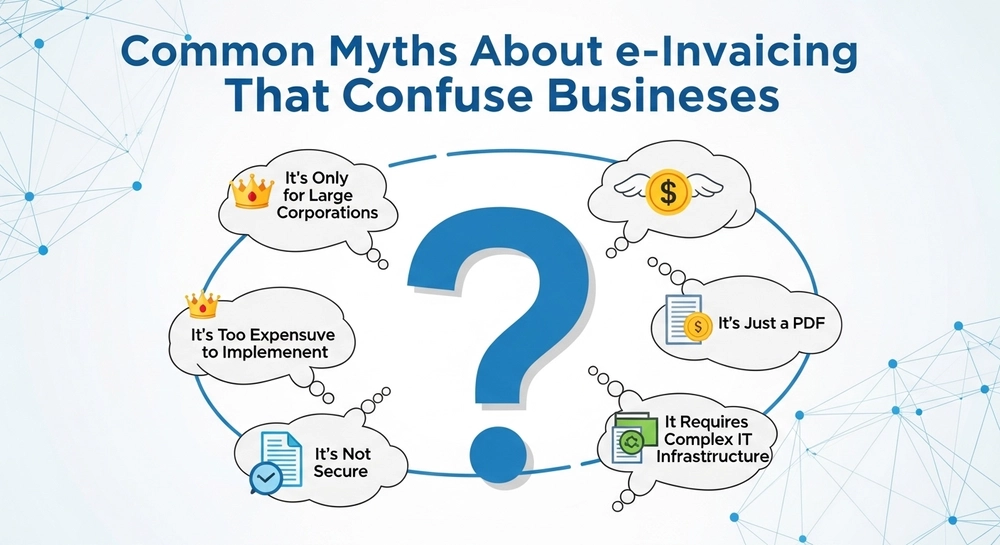
Common Myths About e-Invoicing That Confuse Businesses
Since its arrival on the scene of Goods and Services Tax (GST), many companies have been using e-invoicing successfully; however, there have also been a number of legitimate concerns and misunderstandings surrounding the process of e-invoicing. Unfortunately, these misconceptions are the reason for many of these companies' reluctance to adopt e-invoicing because they do not understand how to comply with its requirements and therefore implement erroneous practices.
There are several reasons why businesses do not completely understand the requirements for e-invoicing; therefore, understanding e-invoicing will improve a company's ability to comply with the program.
Myth 1: e-Invoicing means creating invoices on a Government Portal.
Many people have a major misconception about e-invoicing, which is that businesses must log into the government portal and manually create every invoice. However, creating invoices using the current business' accounting or billing systems will still occur; the only requirement of the business is to register the invoice with the Invoice Registration Portal (IRP) to obtain the invoice registration number (IRN). The IRP will validate the invoice through e-invoicing; but does not replace the business' current invoice generation system.
Myth 2: e-Invoicing is applicable to all invoices.
Another misconception by some business owners is that all invoices issued by a company to its customers are e-invoices. Rather, e-invoicing is normally applicable for business-to-business (B2B) transactions; there are some exceptions for certain types of transactions; these exceptions include certain other legal documents, e-invoices should not be created for sales receipts to the final customers.
Invoices issued to end consumers (B2C transactions) do not require IRN generation. Understanding this distinction helps businesses focus compliance efforts where they are actually required.
Myth 3: Once an IRN Is Generated, the Invoice Cannot Be Corrected
Many businesses assume that any mistake in an e-Invoice cannot be fixed. While it is true that an e-Invoice cannot be edited directly after IRN generation, corrections can still be made through proper adjustment documents such as credit notes or debit notes.
This ensures that compliance records remain accurate while preserving the integrity of the original invoice.
Myth 4: e-Invoicing Is Only for Large Corporations
When e-Invoicing was first introduced, it applied only to large enterprises. This led many smaller businesses to assume that it would never affect them. However, over time, the applicability threshold has been reduced, and more businesses are now covered.
Businesses should monitor their turnover and stay informed, so they are prepared when e-Invoicing becomes applicable to them.
Myth 5: e-Invoicing Automatically Files GST Returns
Another common misunderstanding is that generating e-Invoices automatically completes GST return filing. While e-Invoicing helps structure invoice data, businesses still need to review and file their GST returns separately.
e-Invoicing supports return accuracy but does not replace the filing process itself.
Myth 6: e-Invoicing Makes the Billing Process Slower
Some businesses worry that e-Invoicing adds extra steps and delays billing. In reality, once proper systems and workflows are in place, e-Invoicing becomes part of the normal invoicing process.
In many cases, businesses experience improved accuracy and fewer corrections, which saves time in the long run.
Myth 7: Small Mistakes Will Always Lead to Penalties
Businesses sometimes fear that any minor mistake will result in penalties. In practice, compliance systems are designed to validate invoice data and help prevent errors. When mistakes do occur, they can usually be corrected through proper procedures.
Maintaining accurate records and following structured invoicing practices helps minimize compliance risk.
Myth 8: e-Invoicing Is Only a Compliance Burden
While e-Invoicing does introduce new compliance requirements, it also brings operational benefits. Structured invoicing improves accuracy, reduces reconciliation effort, and strengthens documentation quality.
Over time, businesses often find that digital invoicing improves efficiency rather than creating additional burden.
Why Clearing These Misconceptions Matters
Misunderstandings about e-Invoicing can cause businesses to delay adoption, rely on incorrect processes, or worry unnecessarily about compliance.
By understanding the actual requirements, businesses can approach e-Invoicing confidently and integrate it smoothly into their existing workflows.
Conclusion
e-Invoicing is an important part of modern GST compliance, but many myths surrounding it create confusion for businesses. In reality, e-Invoicing does not replace billing systems, does not apply to all transactions, and does not make invoicing more difficult when handled properly.
By separating facts from misconceptions and adopting structured invoicing practices, businesses can manage e-Invoicing efficiently while maintaining compliance accuracy and operational confidence.