




ATCHAYA M
Updated on
30-07-2026
What Finance Teams Actually Struggle With in e-Invoicing
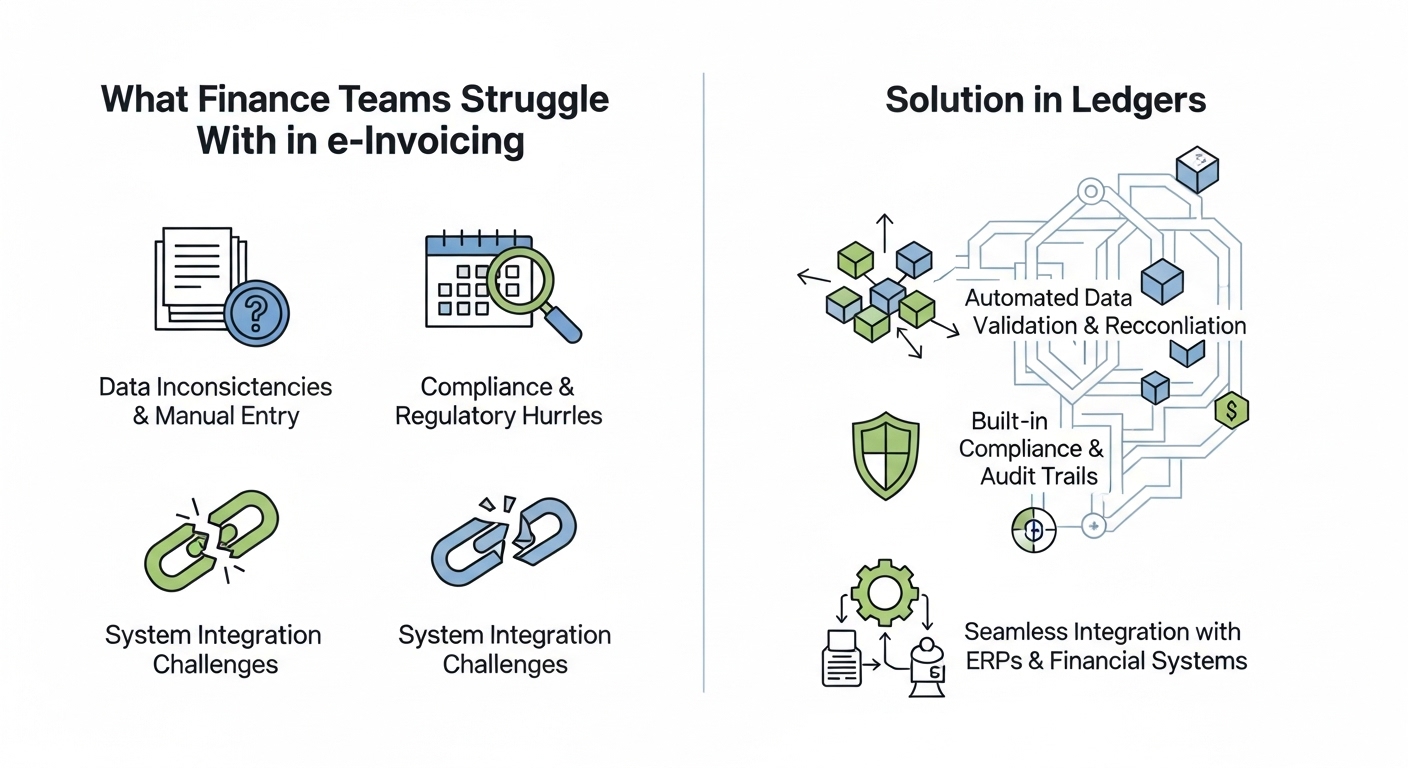
When e-invoicing was first introduced most discussions focused on compliance rules, IRN generation and system integration but there are also very important elements which deal with day-to-day operations of organizations as well. The greatest impact to an organization derived from e-invoicing is experienced mainly by finance teams (the people who deal with invoicing, corrections, reconciliations and GST reporting on a daily basis).
Finance teams have changed and followed the path of e-invoicing as it has evolved but it hasn't been all smooth sailing; Many of the challenges are probably less about technology more about pragmatism, like coordinating work with other departments, completing work by certain times, and being accurate under pressures while doing multiple tasks.
The Pressure of the Last Minute
One of the most difficult times for finance people is during the end of month account preparation. Even in a disciplined environment, invoice volumes generally increase as the reporting date approaches.
Financing teams continuously work hard trying to work through:
- Pending invoices provided by the sales team
- Requested urgent billings
- Corrections needed on any previously prepared invoices
In these situations, balancing speed and accuracy can be extremely challenging. A small delay in preparing the GST return could create additional pressure for finance teams.
Managing Incomplete or Incorrect Data
In many organizations, finance teams depend on data provided by other departments such as sales or operations. Sometimes, the information required for invoicing is incomplete or incorrect.
Common issues include:
- Missing GSTIN or wrong customer details
- Incorrect pricing or quantities
- Unclear transaction classification
Finance teams are then forced to go back and forth with other departments to clarify details, which slows down the invoicing process.
Dealing with Invoice Rejections
IRP rejections are another area that finance teams handle regularly. While the system provides error messages, identifying and fixing the exact issue can still take time.
In busy periods, repeated rejections can disrupt the workflow and create confusion, especially when multiple invoices are involved.
Finance teams need to quickly:
- Understand the error
- Correct the data
- Re-submit the invoice
This process becomes more challenging when deadlines are close.
Maintaining Consistency Across Multiple Transactions
As businesses grow, the number of invoices increases significantly. Finance teams must ensure that all invoices follow consistent formats, numbering patterns, and tax structures.
Even a small inconsistency can create issues during:
- GST return filing
- Reconciliation
- Audit reviews
Maintaining this level of consistency across hundreds or thousands of invoices is not easy and requires constant attention.
Coordinating Between Teams
e-Invoicing is not handled by finance teams alone. It involves coordination with sales, operations, and sometimes logistics teams.
Finance teams often have to:
- Follow up for missing information
- Confirm transaction details
- Clarify customer requirements
Lack of proper communication can delay invoicing and increase the chances of errors.
Managing Corrections and Adjustments
Even after careful invoicing, changes may be required due to customer requests or business adjustments. Since e-Invoices cannot be edited after IRN generation, corrections must be handled through credit notes or debit notes.
Tracking these adjustments and ensuring they are properly recorded adds another layer of complexity to the finance team’s work.
Keeping Up with Compliance Requirements
GST rules and compliance practices continue to evolve. Finance teams must stay updated with changes in:
- Tax rules
- Invoice requirements
- Reporting formats
At the same time, they must continue handling day-to-day operations. Balancing compliance updates with routine work can be challenging.
Working Under Continuous Deadlines
Unlike earlier systems where compliance was handled periodically, e-Invoicing requires continuous attention. Finance teams cannot postpone invoicing tasks, as delays can affect both operations and compliance.
This creates a situation where teams are always working against timelines, making it important to stay organized and efficient.
How These Challenges Get Easier Over Time
Despite these struggles, most finance teams become more comfortable with e-Invoicing over time. As processes improve and teams gain experience:
- Errors reduce
- Coordination becomes smoother
- Workflows become more structured
- Confidence increases
What initially feels difficult gradually becomes part of routine operations.
Conclusion
e-Invoicing has changed the way finance teams work, bringing both structure and new challenges. From managing high volumes to handling data accuracy and coordination, finance teams play a crucial role in maintaining smooth compliance.
While the initial phase can feel demanding, experience and better processes make the journey easier over time. By understanding these practical challenges and addressing them systematically, businesses can support their finance teams and build more efficient and reliable invoicing workflows.