




DHIBAGARAN
Updated on
30-07-2026
Understanding GST e-Invoice Creation in India
In the rapidly changing backdrop of Indian taxation laws, the implementation of Goods and Services Tax (GST) is a landmark that has eased the complexities in the landscape of indirect taxes in India. In pursuing its path to perfection, GST e-Invoice preparation in India is a milestone that will increase transparency and ease the methodological approach to invoice preparation in India. But what does an e-invoice entail, and how will it affect businesses in India? In order to provide a comprehensive understanding to your businesses regarding GST e-Invoice preparation in India, we will address all aspects below:
What is an E-Invoice under GST?
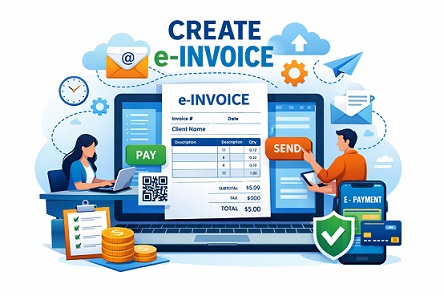
At its core, an e-invoice is an electronic billing document. Under the GST framework, an e-invoice is generated through a designated government portal, ensuring a uniform and systematic way of reporting B2B invoices. The objective is to automate multi-fold tasks, reduce human errors, and create a unified platform where invoices are standardized and authenticated in real-time.
The Importance of GST E-Invoice Creation
GST e-Invoice creation isn't just a procedural change; it brings a plethora of benefits that pave the way for enhanced business scalability and compliance:
- Reduction in Compliance Costs: Automating the invoicing process leads to cost-cutting by minimizing paperwork and discrepancies.
- Enhanced Accuracy: A standard format decreases the likelihood of manual errors.
- Improved GST Return Matching: Simplifies the process of matching invoices with returns since data is already validated.
- Lower Tax Evasion: By ensuring that all invoices are pre-verified through government portals, evasion becomes easy to detect and difficult to execute.
Steps to Create a GST E-Invoice
Here's a step-by-step guide to smoothly navigate the GST e-Invoice creation process:
1. Understand the Legal Framework
Before creating an e-invoice, familiarize yourself with the legal stipulations under the GST Act that mandate e-invoice generation for businesses with an aggregate turnover exceeding a specified threshold. Stay updated with amendments that may adjust this threshold or introduce new compliance requirements.
2. Register on the Invoice Registration Portal (IRP)
To create an e-invoice, registration on the IRP is mandatory. Visit the official e-invoice portal and complete the registration process by filling out the requisite details.
3. Generate the Unique Invoice Reference Number (IRN)
Once youâve created an invoice, upload it on the IRP to generate the IRN. The portal uses your uploaded data and algorithms to assign a unique number, ensuring each invoice is trackable.
4. Validate Invoice with QR Code
After the IRN is generated, the IRP issues a digitally signed QR code. This QR code acts as a quick reference, containing all essential details of the e-invoice and can be accessed even offline.
5. Transmission to GST and E-Way Bill Systems
Once the invoice is validated and assigned a QR code, it's automatically uploaded to the GST and e-way bill systems, integration that aids in seamless verification.
Key Challenges and Solutions in E-Invoice Implementation
While e-invoice implementation streamlines operations, businesses may encounter certain challenges:
- System Adaptation: Transitioning to electronic systems can be daunting. Solution: Deploy robust accounting software that integrates seamlessly with GST portals.
- Data Security Concerns: Managing sensitive data requires stringent security protocols. Solution: Regular audits and advanced encryption methods.
- Training and Awareness: Employees must be well-versed in new processes. Solution: Conduct workshops and comprehensive training sessions.
Future Prospects of GST E-Invoice Creation in India
As technology advances, the infrastructure supporting GST e-invoice creation in India is likely to evolve further. There is a growing focus on AI and machine learning integration into the GST system, potentially facilitating predictive analytics and further automation.
The expanded scope of e-invoicing, to include smaller enterprises, could also level the playing field and promote a competitive, compliant business environment.
Summary and Final Takeaways
Conclusion The introduction of e-invoicing in the GST regime in India marks the beginning of the acceptance of the digital revolution in the financial sector. Right from minimizing errors and costs to marking the beginning of a new era in compliance, the e-invoicing system reflects the government’s idea of a transparent and integrated market. Awareness of this process, from regulations to integrating systems, will help businesses capitalize on the advantages that accrue in this way. Enterprises are ready to move ahead in the digital era.