




MONISHA D
Updated on
30-07-2026
The Complete Guide to GST Compliance and Filing
Goods and Services Tax (GST) compliance has become one of the most important financial and regulatory responsibilities for businesses in India. Whether a business is a small startup, trader, manufacturer, service provider, or large enterprise, maintaining proper GST compliance is essential for smooth business operations, tax transparency, and avoiding penalties.
GST compliance involves multiple activities such as GST registration, invoice management, tax calculation, Input Tax Credit (ITC) reconciliation, return filing, tax payment, and annual reporting. Managing all these processes manually can become complex and time-consuming, especially for businesses handling large transaction volumes.
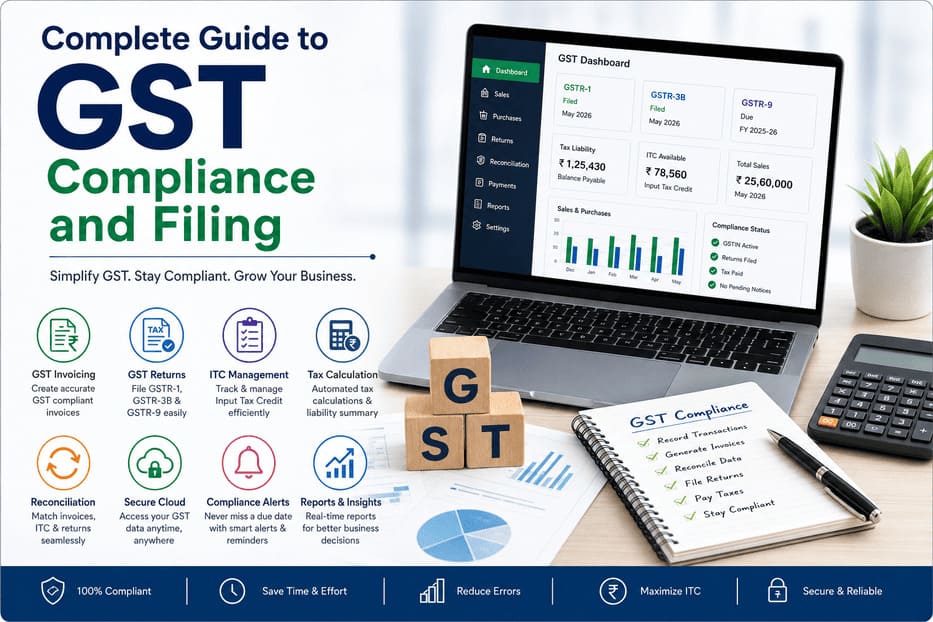
Modern accounting and tax platforms like LEDGERS help businesses automate GST invoicing, return filing, tax calculations, and compliance tracking from a centralized cloud-based system.
This complete guide explains GST compliance and filing in detail, including GST returns, filing processes, compliance requirements, penalties, reconciliation, and how automation simplifies GST management.
What Is GST Compliance?
GST compliance refers to following all rules and regulations prescribed under the Goods and Services Tax system in India.
Businesses registered under GST are responsible for:
- Maintaining GST-compliant invoices
- Collecting GST from customers
- Filing GST returns
- Paying taxes on time
- Claiming eligible Input Tax Credit
- Maintaining accounting records
- Reconciling invoices and tax data
Failure to comply with GST regulations can lead to:
- Penalties
- Interest charges
- Notices
- ITC reversal
- Business disruptions
Proper GST compliance ensures transparency, financial accuracy, and smoother business operations.
Why GST Compliance Is Important
GST compliance impacts both financial management and legal compliance.
Avoids Penalties and Notices
Late filing or incorrect reporting can attract penalties and notices from tax authorities.
Improves Input Tax Credit Claims
Proper invoice reconciliation helps businesses claim eligible ITC accurately.
Enhances Financial Transparency
GST-compliant accounting improves business reporting and audit readiness.
Builds Business Credibility
Timely GST compliance improves trust among vendors, customers, and financial institutions.
Simplifies Tax Audits
Maintaining accurate GST records makes audits easier and less stressful.
Types of GST Returns Businesses Must File
Different GST returns apply depending on business category and transaction type.
GSTR-1
GSTR-1 is used for reporting outward supplies or sales transactions.
It includes:
- Sales invoices
- Debit notes
- Credit notes
- Taxable supplies
- Export invoices
Businesses must file GSTR-1 monthly or quarterly depending on turnover and filing scheme.
GSTR-3B
GSTR-3B is a summary GST return used for reporting:
- Sales turnover
- Tax liability
- Input Tax Credit
- Tax payable
Businesses use GSTR-3B for monthly tax payment and compliance.
GSTR-9
GSTR-9 is the annual GST return that consolidates yearly GST information.
It includes:
- Annual sales data
- Tax paid
- ITC claimed
- Amendments
- Audit-related details
Businesses eligible for annual filing must submit GSTR-9 within prescribed timelines.
GST Registration and Compliance Requirements
Businesses crossing the prescribed turnover threshold must register under GST.
GST registration becomes mandatory for:
- Manufacturers
- Traders
- Service providers
- E-commerce sellers
- Interstate suppliers
- Exporters
After registration, businesses receive a GSTIN used for all GST-related transactions.
Businesses must also:
- Issue GST-compliant invoices
- Display GSTIN properly
- Maintain transaction records
- File returns regularly
GST Invoice Requirements
GST invoices must contain mandatory information such as:
- Seller name and GSTIN
- Buyer details
- Invoice number
- Invoice date
- HSN/SAC codes
- Taxable value
- GST rates
- CGST, SGST, IGST amounts
- Place of supply
Incorrect invoice details may lead to compliance issues and ITC rejection.
Businesses using automated invoicing systems can reduce invoice-related errors significantly.
Understanding Input Tax Credit (ITC)
Input Tax Credit allows businesses to reduce tax liability by claiming credit for GST paid on purchases.
Proper ITC management is crucial for reducing overall tax burden.
Businesses can claim ITC on:
- Raw materials
- Business purchases
- Input services
- Capital goods
However, ITC claims require:
- Valid GST invoices
- Supplier compliance
- Accurate reconciliation
- Proper documentation
Incorrect ITC claims may result in penalties or reversals.
GST Reconciliation Process
GST reconciliation involves comparing:
- Sales records
- Purchase records
- GST returns
- Supplier invoices
- ITC records
Reconciliation helps identify:
- Missing invoices
- Duplicate entries
- Tax mismatches
- Incorrect GST calculations
Regular reconciliation improves compliance accuracy and prevents filing errors.
Common GST Compliance Challenges
Many businesses struggle with GST management due to operational complexity.
Frequent Rule Changes
GST rules and filing procedures are updated regularly.
Invoice Mismatches
Mismatch between supplier and buyer records affects ITC claims.
Manual Calculation Errors
Manual accounting increases risk of tax calculation mistakes.
High Transaction Volumes
Businesses handling large invoice volumes face reconciliation difficulties.
Filing Deadline Management
Missing due dates can result in penalties and interest charges.
How LEDGERS Simplifies GST Compliance
LEDGERS GST Filing Software helps businesses automate and manage GST compliance efficiently.
The platform simplifies:
- GST invoicing
- Tax calculations
- Return preparation
- ITC tracking
- Reconciliation
- Compliance monitoring
- Filing workflows
Automation significantly reduces manual effort and compliance risk.
Key Features of LEDGERS GST Software
Automated GST Calculations
The system automatically calculates:
- CGST
- SGST
- IGST
- Reverse charge taxes
This minimizes manual errors.
GST Return Preparation
Businesses can prepare GST returns quickly using automated transaction mapping.
Invoice Management
The software helps generate GST-compliant invoices with proper tax structure.
Input Tax Credit Tracking
Businesses can monitor eligible and pending ITC claims more effectively.
Reconciliation Support
The system helps reconcile invoices, tax payments, and supplier records.
Cloud-Based Access
Businesses can securely access GST data from anywhere.
Step-by-Step GST Filing Process
Businesses should follow a structured GST filing workflow.
Step 1: Record Transactions
Enter all sales and purchase transactions accurately.
Ensure GST rates and invoice details are correct.
Step 2: Generate GST Invoices
Create GST-compliant invoices for all taxable supplies.
Step 3: Reconcile Purchase and Sales Data
Compare accounting records with GST portal data.
Verify ITC eligibility before filing.
Step 4: Prepare GST Returns
Generate applicable returns such as:
- GSTR-1
- GSTR-3B
- GSTR-9
Step 5: Verify Tax Liability
Ensure tax payable calculations are accurate.
Step 6: Pay GST Liability
Pay outstanding GST before filing final returns.
Step 7: File Returns
Submit GST returns within prescribed due dates.
Penalties for GST Non-Compliance
Failure to comply with GST regulations can result in:
- Late filing penalties
- Interest charges
- ITC reversal
- Compliance notices
- Audit scrutiny
Consistent non-compliance may also affect business reputation and financial stability.
Best Practices for GST Compliance
Businesses can improve GST management by following structured practices.
Maintain Accurate Accounting Records
Ensure all transactions are recorded properly.
Reconcile Data Regularly
Monthly reconciliation reduces year-end issues.
File Returns Before Due Dates
Avoid last-minute filing delays.
Validate Supplier Compliance
Monitor supplier invoice uploads for ITC eligibility.
Use Automated GST Software
Automation improves compliance accuracy and efficiency.
Benefits of Automated GST Filing
Modern GST software provides several operational advantages.
Faster Filing Process
Automation reduces manual work.
Improved Accuracy
Built-in validations reduce filing errors.
Better ITC Management
Businesses can track credits more effectively.
Real-Time Reporting
Dashboards provide visibility into tax liabilities and return status.
Reduced Compliance Risks
Automated alerts help businesses avoid missed deadlines.
GST Compliance for Small Businesses
Small businesses often face resource limitations while managing GST.
Cloud-based GST software helps small businesses by:
- Simplifying invoice creation
- Automating tax calculations
- Reducing paperwork
- Improving filing efficiency
- Managing compliance affordably
Digital compliance tools reduce dependency on manual spreadsheets and complex accounting processes.
Future of GST Compliance in India
India’s GST ecosystem is becoming increasingly digital and automated.
Future developments may include:
- AI-based reconciliation
- Real-time invoice matching
- Automated compliance monitoring
- Faster refund processing
- Enhanced analytics
- Integrated financial reporting
Businesses adopting digital GST systems early will be better prepared for future compliance requirements.
Conclusion
GST compliance and filing are essential for every registered business in India. Managing invoices, tax calculations, Input Tax Credit, reconciliations, and return filing manually can become complex and error-prone.
Modern solutions like LEDGERS help businesses automate GST operations, simplify return filing, and maintain accurate compliance records.
With features such as automated GST calculations, GSTR-1 filing, GSTR-3B preparation, annual return management, and reconciliation support, LEDGERS enables businesses to improve efficiency while reducing compliance risks.
By adopting structured GST processes and automated software solutions, businesses can maintain smooth tax compliance, avoid penalties, and improve long-term financial management.