
ATCHAYA M
Updated on 30-07-2026
One of the greatest obstacles that business organizations encounter after they move to e-Invoicing is to keep data between the invoices submitted to the Invoice Registration Portal (IRP) and the information in the GST returns consistent. Although IRN (Invoice Registration Number) generation serves as proof of the authenticity of the invoice, all compliance-related matters do not end with registering the IRN. All of the registered e-Invoices must eventually flow into the GSTR-1, match the accounting records, and have documented information to support audits and reconciliations.
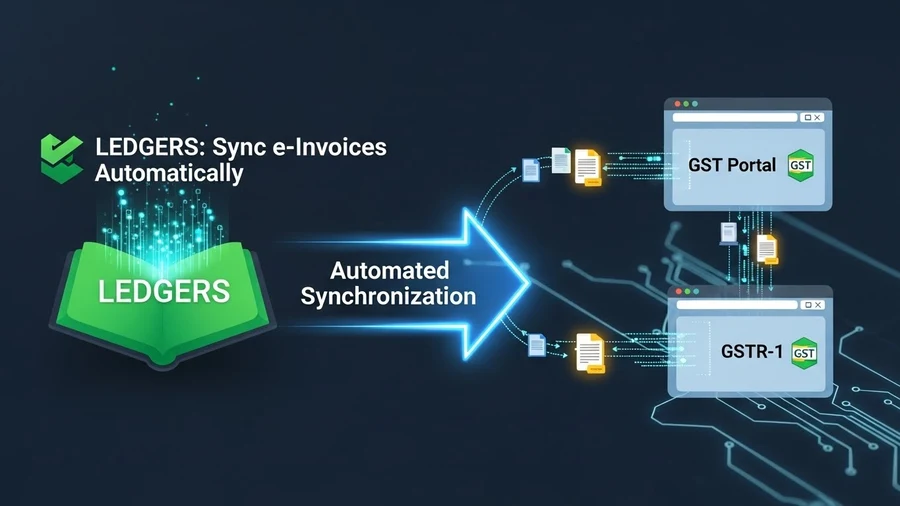
LEDGERS, through a continuous chain of electronic invoices, GST Portals, and workflows for returns filing, solves this problem. The e-Invoicing and the GST return processes will no longer be considered separate and distinct activities; instead, the LEDGERS system integrates e-Invoicing, GST returns process, and compliance into one comprehensive system.
When you file GSTR-1, the outward supply from GSTR-1 then becomes the determining factor for identifying what you owe in tax and what ITC the recipient can claim and also helps in the GST reconciliation process. If e-invoices are created but don't flow correctly into GSTR-1, it could lead to a number of issues for you and your business:
If you are manually reconciling e-invoice records to your GST returns, you are creating an unnecessary burden on your staff and increasing the risk of errors, especially for businesses that deal with large volumes of invoices.
In LEDGERS, e-invoices are not treated as independent records. When you create an invoice and receive the IRN number from the IRP, LEDGERS will automatically create a record that includes all the relevant information including the values of the invoice, the breakdown of the taxes, the IRN number and the acknowledgement information for you.
The result of this is that:
By utilizing a single source of truth, LEDGERS removes the potential for duplication and inconsistencies in data throughout the compliance process.
When companies are preparing GSTR-1, they will have the ability to prepare their returns automatically using LEDGERS's auto-mapping functionality. The auto-mapping functionality will automatically map GSTR-1 prepared data to the sections of GSTR-1, based on the type of transaction performed. For example, LEDGERS will automatically map the following types of transactions to GSTR-1:
Since e-Invoices are already submitted successfully as part of IRN generation, there is a considerable reduction in the possibility of any value/entry mismatch or another error being present in the data collected for the preparation of GSTR-1.
The user may verify the created map prior to submitting the GSTR-1, allowing the user to make sure everything is correct without needing to manually re-title or reconcile the information on the invoice.
Every e-Invoice uploaded to GSTR-1 will retain its IRN reference within LEDGERS, creating a traceable link for the e-Invoice. The cross-reference of e-Invoices will be used during various times throughout the process:
Businesses can find a way to backtrack their e-Invoice for any entry on GSTR-1 by tracing the original e-Invoice from the system back through the original e-Invoice and the IRP acknowledgement.
In situations where corrections are required, LEDGERS ensures that amended values remain properly linked to original invoice references. This prevents discrepancies between what was registered on the IRP and what is reported in subsequent returns.
By maintaining version consistency, businesses avoid compliance gaps that could otherwise surface during scrutiny or audit.
GST compliance is cumulative. Data filed in one period affects subsequent filings and annual returns. LEDGERS supports filing continuity by ensuring that e-Invoice data flows seamlessly from:
This continuity reduces year-end correction effort and improves confidence during financial closure.
By automating e-Invoice sync with the GST portal and GSTR-1, LEDGERS helps businesses:
Teams can focus on review and compliance oversight rather than repetitive data handling.
e-Invoicing and GST return filing are not independent processes - they are closely connected parts of a single compliance framework. Managing them separately increases risk and operational complexity.
LEDGERS bridges this gap by automatically syncing e-Invoices with the GST portal and GSTR-1 preparation workflows. By maintaining consistent data, reference linking, and filing continuity, the platform helps businesses stay compliant with confidence while simplifying day-to-day GST operations.
